| Piú votate - Mars Reconnaissance Orbiter (MRO) |
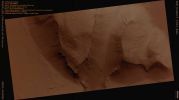
ESP_018075_1955_RED_abrowse-00.jpgAn Hill cut by Cerberus Fossae (Natural Colors; credits for the additional process. and color.: Dr Paolo C. Fienga - Lunexit Team)58 visitenessun commentoMareKromium
(2 voti)
|
|

PSP_002922_1725_RED_abrowse-01.jpgGlacier-like Flow on Arsia Mons (EDM - Natural Colors; credits for the additional process. and color.: Dr Paolo C. Fienga - Lunexit Team)55 visiteIt is possible that the Flow Features that we can see in this image are "Relict Glaciers". The Flow Lobes and Surface Lineations are similar to those found on Glaciers on Earth. The merging of the Lobes seen in the bottom of the CTX Frame as well as in the EDM might imply that multiple walls are shedding material.
It is likely also that the Flanks of Arsia Mons contain ice-rich material - possibly deposited during a different Obliquity (Obliquity ----> Tilt of Mars' Spin Axis) or Climate Regime.MareKromium
(2 voti)
|
|
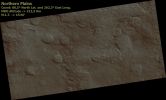
Psp_001483_2465_red.jpgThe Northern Plains (Natural Colors; credits for the additional process. and color.: Dr Paolo C. Fienga - Lunexit Team)57 visiteM.L.T.: 15:07 (early afternoon)
Latitude (centered): 66,5° North
Longitude: 262,2° East
Range to target site: 311,6 Km (about 194,8 miles)
Original image scale range: 31,2 cm/pixel (with 1 x 1 binning) so objects ~94 cm across are resolved
Map Projected Scale: 25 cm/pixel
Map Projection: POLAR STEREOGRAPHIC
Emission Angle: 1,4°
Phase Angle (Sun-Mars-MRO): 57,3 °
Solar Incidence Angle: 59° (meaning that the Sun is about 31° above the Local Horizon)
Solar Longitude: 138,0° (Northern Summer)MareKromium
(2 voti)
|
|
Psp_001497_2480_red-00~0.jpgThe Northern Lakes: Lake "Ginny" (CTX Frame - Natural Colors; credits: Dr Paolo C. Fienga - Lunexit Team) 123 visitenessun commentoMareKromium
(2 voti)
|
|
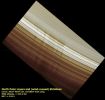
Psp_001488_2665_red.jpgNorth Polar Layers and WInd-caused Striations (Natural Colors; credits for the additional process. and color.: Dr Paolo C. Fienga - Lunexit Team)60 visitenessun commentoMareKromium
(2 voti)
|
|
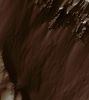
ESP_017736_1550_RED-EB-PCF-LXTT2.jpgRolling Rocks (Absolute Natural Colors; credits: Dr Paolo C. Fienga - Lunexit Team)56 visitenessun commentoMareKromium
(2 voti)
|
|

ESP_018094_1720_RED_abrowse.jpgRelatively recent Impact Crater in Meridiani Planum (Absolute Natural Colors; credits: Dr Paolo C. Fienga - Lunexit Team)60 visiteThe approximately 650-mt (2135 foot) diameter Crater in this image is relatively fresh, as evidenced by its sharp Rim and unmodified shape. Ejecta appears on top of pre-existing craters, and stands out against the background, again indicating relative youth.
However, there is something else interesting about the ejecta for this Crater: it is butterfly-shaped, with much more expansive ejecta along one axis, and much less along the other one.
Butterfly-shaped ejecta indicate that the body that caused the crater struck Mars at an oblique (or very shallow) angle. When this happens, the crater shape may be elliptical, although round craters can result from oblique impacts, too. During an oblique impact, much more ejecta is thrown out perpendicular to the direction of impact, and relatively little material is ejected along the impactor's trajectory.
Oblique impacts are relatively rare, and so a fresh, oblique impact like this one is an attractive target.MareKromium
(2 voti)
|
|

ESP_017897_2045_RED_abrowse-PCF-LXTT.jpgMawrth Vallis (Absolute Natural Colors; credits: Dr Paolo C. Fienga - Lunexit Team)56 visitenessun commentoMareKromium
(2 voti)
|
|
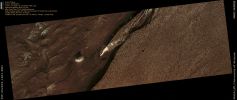
PSP_002839_1825_RED_abrowse-1.jpgAram Chaos (Absolute Natural Colors; credits for the additional process. and color.: Dr Paolo C. Fienga - Lunexit Team)62 visiteAram Chaos appears to be a former impact crater. The terrain is disrupted, giving it a chaotic appearance (hence the name "chaos"). Scientists have postulated that a lake may have once existed inside the crater and sediments were laid down within the lake. The mineral Hematite (rich in Iron) has been detected by orbiting spacecraft within Aram Chaos. Hematite has been identified in several other locations on Mars, including at the Mars Exploration Rover Landing Site in Meridiani Planum. The Hematite at both Meridiani and Aram Chaos most likely formed by precipitation in water.
This HiRISE image shows the light-toned sediments inside Aram Chaos that could have formed in a former lake. Unfortunately, dark debris now obscures much of this sediment, making it difficult to view and interpret the rocks. The light-toned Layered Deposit in the South (left) of the image is higher standing and has a peculiarly-looking pitted surface.
Circular structures with dark centers are likely to be impact craters that have been partly filled with dark debris, including sand. More irregular depressions appear to result from erosion of layered beds within the sediments. Wind could erode materials that are slightly weaker more quickly and produce the irregular topography seen along the surface of the deposit.MareKromium
(2 voti)
|
|
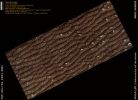
PSP_001736_2605_RED_abrowse.jpgOlympia Undae (Natural Colors; credits for the additional process. and color.: Dr Paolo C. Fienga - Lunexit Team)70 visiteThis observation shows Dark Dunes and light Polygonal Terrain in Olympia Undae, also known as the North Polar Erg.
Two sets of Dunes are obvious. The major set trends North-South, indicating winds from the East or West. Between the crests of these Dunes is a second set oriented mostly East-West.
Zooming in on the Dunes, a rippled texture is apparent, probably due to redistribution of sand at the scale of meters and less. Near the crests of some Dunes are Channel-like features, with some branching downslope. The origin of these Channels is unknown, but they may result from the flow and displacement of sand that was fluidized by sublimating CO2 or water frost.
Bright patches of ground are found in some inter-dune areas, with many having a polygonal texture.
Polygons on Earth form from contraction induced by stresses from dehydration, cooling and other processes, so these features may have a similar origin. The CRISM instrument on MRO and OMEGA on Mars Express indicates that many dunes in Olympia Undae are rich in the mineral Gypsum (---> gesso).MareKromium
(2 voti)
|
|

PSP_002439_2265_RED_abrowse.jpgScalloped Depressions with Layering (False Colors; credits: Dr Paolo C. Fienga - Lunexit Team)57 visiteThis image of the Northern Plains of Mars is marked by depressions in a layer of material that covers the Region. The depressions, several of which have coalesced together, have scalloped edges and layers in their walls.
Features such as these are most commonly found at approx. 55° North and South latitude.
Their presence has led to hypotheses of the removal of subsurface material, possibly ground ice, by sublimation, and this process is believed to be ongoing today.
In this image, steeper scarps with layers consistently face the North Pole while more gentle slopes without layers face in the direction of the Equator. This is most likely due to differences in Solar Heating.
Large boulders, some several meters in length, are scattered within the depressions and on the surrounding Surface. Also on the Surface surrounding the scalloped depressions is a polygonal pattern of fractures.
This is commonly associated with Scalloped Terrain and indicates that the surface has undergone stress potentially caused by Subsidence (Collapse), Desiccation (Drying-out), or Thermal Contraction.
MareKromium
(2 voti)
|
|
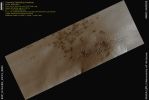
ESP_016280_2655_RED_abrowse.jpgMartian Tears... (possible Natural Colors; credits: Dr Paolo C. Fienga - Lunexit Team)65 visitenessun commentoMareKromium
(2 voti)
|
|
| 2235 immagini su 187 pagina(e) |
 |
|
|
|
|
152 | |
|
|
|
|





