| |

| Piú votate - Mars Reconnaissance Orbiter (MRO) |
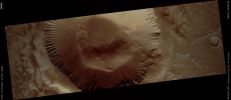
PSP_010402_2050_RED_abrowse.jpgUnnamed Fresh Crater in Utopia Planitia (Natural Colors; credits: Lunar Explorer Italia)57 visiteMars Local Time: 15:35 (middle afternoon)
Coord. (centered): 24,6° North Lat. and 124,5° East Long.
Spacecraft altitude: 287,2 Km (such as about 179,5 miles)
Original image scale range: 28,7 cm/pixel (with 1 x 1 binning) so objects ~ 86 cm across are resolved
Map projected scale: 25 cm/pixel
Map projection: EQUIRECTANGULAR
Emission Angle: 3,1°
Phase Angle: 48,0°
Solar Incidence Angle: 51° (meaning that the Sun is about 39° above the Local Horizon)
Solar Longitude: 142,0° (Northern Summer)
Credits: NASA/JPL/University of Arizona
Additional process. and coloring: Lunar Explorer ItaliaMareKromium
(6 voti)
|
|
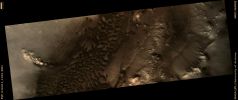
PSP_010413_1920_RED_abrowse.jpgMigrating Dunefield (Natural Colors; credits: Lunar Explorer Italia)56 visiteMars Local Time: 15:37 (middle afternoon)
Coord. (centered): 11,8° North Lat. and 185,9° East Long.
Spacecraft altitude: 280,9 Km (such as about 175,5 miles)
Original image scale range: 28,1 cm/pixel (with 1 x 1 binning) so objects ~ 84 cm across are resolved
Map projected scale: 25 cm/pixel
Map projection: EQUIRECTANGULAR
Emission Angle: 3,4°
Phase Angle: 49,6°
Solar Incidence Angle: 53° (meaning that the Sun is about 37° above the Local Horizon)
Solar Longitude: 142,4° (Northern Summer)
Credits: NASA/JPL/University of Arizona
Additional process. and coloring: Lunar Explorer ItaliaMareKromium
(6 voti)
|
|
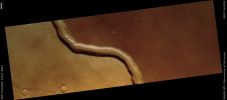
PSP_010404_1925_RED_abrowse.jpgArnus Vallis (Natural Colors; credits: Lunar Explorer Italia)58 visiteMars Local Time: 15:31 (middle afternoon)
Coord. (centered): 12,5° North Lat. and 70,0° East Long.
Spacecraft altitude: 281,5 Km (such as about 176,0 miles)
Original image scale range: 28,2 cm/pixel (with 1 x 1 binning) so objects ~ 84 cm across are resolved
Map projected scale: 25 cm/pixel
Map projection: EQUIRECTANGULAR
Emission Angle: 15,7°
Phase Angle: 66,4°
Solar Incidence Angle: 51° (meaning that the Sun is about 39° above the Local Horizon)
Solar Longitude: 142,0° (Northern Summer)
Credits: NASA/JPL/University of Arizona
Additional process. and coloring: Lunar Explorer ItaliaMareKromium
(6 voti)
|
|

PSP_010400_2620_RED_abrowse.jpgSample of North Polar Gypsum Dunes (Natural Colors; credits: Lunar Explorer Italia)82 visiteMars Local Time: 14:24 (early afternoon)
Coord. (centered): 81,7° North Lat. and 157,1° East Long.
Spacecraft altitude: 318,6 Km (such as about 199,1 miles)
Original image scale range: 31,9 cm/pixel (with 1 x 1 binning) so objects ~ 96 cm across are resolved
Map projected scale: 25 cm/pixel
Map projection: EQUIRECTANGULAR
Emission Angle: 0,1°
Phase Angle: 68,2°
Solar Incidence Angle: 68° (meaning that the Sun is about 22° above the Local Horizon)
Solar Longitude: 141,9° (Northern Summer)
Credits: NASA/JPL/University of Arizona
Additional process. and coloring: Lunar Explorer ItaliaMareKromium
(6 voti)
|
|

PIA11809.jpgColumnar Jointing (Natural Colors; credits for the additional process. and color.: Dr Paolo C. Fienga - Lunar Explorer Italia)56 visiteThis image from the High Resolution Imaging Science Experiment (HiRISE) on NASA's Mars Reconnaissance Orbiter shows an exposure of layered rock that exhibits a type of fracturing - called Columnar Jointing - that results when cooling lava contracts.
The observation is cited in a report, "Discovery of Columnar Jointing on Mars", publisged in the February 2009 issue of the journal Geology. The Authors propose that flooding by water was likely what caused a quick cooling of lava to result in this jointing.
The image, taken Oct. 31, 2007, shows a portion of an Unnamed Crater about 16 Km (such as approx. 10 miles) in diameter and centered at 21,52° North Latitude and 184,35° East Long.
Shown here is a section about 1 Km (0,6 mile) wide from the image catalogued by the HiRISE team as PSP_005917_2020. The column-forming fractures resemble textures common on Earth in locations such as the Colombia River Basalt Group and in the Colorado Plateau.MareKromium
(6 voti)
|
|

ESP_011341_0980_RED_abrowse.jpgStarburst Fans, or: the Arthur Clarke Trees (Natural Colors; credits: Lunar Explorer Italia)78 visiteQuante volte, su Siti (fanta/pseudo) Scientifici avete visto e letto degli "Alberi Marziani" (che sono anche - e meglio - noti al Pubblico come "Arthur Clarke Trees", in omaggio al Creatore della Saga di "2001 - Odissea nello Spazio")?
Sicuramente tante volte.
Oggi (in realtà esistevano già altre riprese sufficientemente chiare, ma facciamo finta che non lo fossero...), grazie a questa splendida immagine ottenuta dalla Sonda MRO, il "mistero" degli Alberi Marziani possiamo dire che è definitivamente risolto (anche se, a nostro avviso, queste Surface Features non erano mai state un VERO mistero): si tratta di Fans a forma di "stella che esplode".
E come si sono generati questi Fans (---sbuffi)? Ce lo spiega la NASA stessa:"During the Martian Winter a layer of Carbon Dioxide Ice (CO2, or Dry Ice) forms a seasonal cap over the South Polar Region. In the Spring — when the Sun starts to warm the ice and the surface below — gas escapes from beneath the ice layer, carrying dust with it.
The dust is deposited on top of the ice in Fans, with an orientation determined by the prevailing wind direction. In this Region, the gas flows along radial channels, so that when it emerges we see a circular set of Dust Fans. These inspire the “starburst” description".
La "morale" è sempre la stessa: i Misteri - su Marte e nel resto di Sistema Solare e del Cosmo - ci sono, esistono e sono grandi ed affascinanti.
Non serve quindi "inventarne" di sana pianta (se non per consentire a qualcuno di mettersi soldi e facile notorietà in tasca): basta osservare, studiare ed infine - credeteci - di motivi per sognare e per comprendere che "non siamo soli", ne troverete a milioni.
"Piramidi", "Sfingi" e "Parabole"? NO, grazie!
Mars Local Time: 17:06 (middle afternoon)
Coord. (centered): 81,8° South Lat. and 76,1° East Long.
Spacecraft altitude: 246,9 Km (such as about 154,3 miles)
Original image scale range: 49,4 cm/pixel (with 1 x 1 binning) so objects ~1,48 mt across are resolved
Map projected scale: 50 cm/pixel
Map projection: EQUIRECTANGULAR
Emission Angle: 0,2°
Phase Angle: 88,0°
Solar Incidence Angle: 88° (meaning that the Sun is about 2° above the Local Horizon)
Solar Longitude: 180,8° (Northern Autumn)
Credits: NASA/JPL/University of Arizona
Additional process. and coloring: Lunar Explorer ItaliaMareKromium
(6 voti)
|
|

PSP_005424_1700_RED_abrowse~0.jpgAurorae Chaos (MULTISPECTRUM; credits: Lunexit)54 visiteThis observation shows a portion of Aurorae Chaos, chaotic terrain East of the Vallis Marineris Canyon System. Aurorae Chaos extends from Capri and Eos Chasmata on the West, into Hydraotes and Aureum Chaos on the North and East.
Chaotic terrain is thought to form from subsurface collapse following volatile release. It is possible that the Martian crust was at one time enriched in ices that became gases or liquid at relatively low temperatures upon encountering a heat source or was violently shaken. These ices existed in spaces between soil particles. If a large volume of volatiles is suddenly released, then there is a large portion of the soil volume missing. The soil cannot support itself, so it collapses.
Since chaotic terrain is often located at the head of the Martian outflow channels (giant flood plains), it is also possible that the Chaotic Regions are the source of the fluids that formed the outflow channels.
Aurorae Chaos connects to outflow channels via other Chaotic Regions.MareKromium
(6 voti)
|
|

PSP_005571_0950_RED_abrowse-00~0.jpgSouth Polar Residual Cap Margin (context frame; MULTISPECTRUM - elab. Lunexit)54 visiteThis scene is about 2,7 Km (approx. 1,7 miles) long and shows part of the edge of the South Polar Residual Cap (...).
The relatively bright, grayish areas are the Residual Cap, and the darker, reddish areas are mostly likely covered by dust. The South Polar Residual Cap is made, for the most part, of Carbon Dioxide ice (commonly called "dry ice") and dust, with a little water ice in some places.MareKromium
(6 voti)
|
|

Psp_010744_1840_red.jpgSouthern Margin of Cerberus Palus (Natural Colors; credits: Lunar Explorer Italia)56 visiteMars Local Time: 15:41 (middle afternoon)
Coord. (centered): 4,0° North Lat. and 149,0° East Long.
Spacecraft altitude: 274,8 Km (such as about 171,7 miles)
Original image scale range: 27,5 cm/pixel (with 1 x 1 binning) so objects ~82 cm across are resolved
Map projected scale: 25 cm/pixel
Map projection: EQUIRECTANGULAR
Emission Angle: 4,8°
Phase Angle: 59,7°
Solar Incidence Angle: 55° (meaning that the Sun is about 35° above the Local Horizon)
Solar Longitude: 155,6° (Northern Summer)
Credits: NASA/JPL/University of Arizona
Additional process. and coloring: Lunar Explorer ItaliaMareKromium
(6 voti)
|
|

Psp_010589_1510_red.jpgLayered Deposits North of Hellas Basin (Natural Colors; credits: Lunar Explorer Italia)58 visiteMars Local Time: 15:47 (middle afternoon)
Coord. (centered): 28,7° South Lat. and 65,5° East Long.
Spacecraft altitude: 258,4 Km (such as about 161,5 miles)
Original image scale range: 51,7 cm/pixel (with 1 x 1 binning) so objects ~1,55 mt across are resolved
Map projected scale: 50 cm/pixel
Map projection: EQUIRECTANGULAR
Emission Angle: 0,3°
Phase Angle: 68,8°
Solar Incidence Angle: 69° (meaning that the Sun is about 21° above the Local Horizon)
Solar Longitude: 149,3° (Northern Summer)
Credits: NASA/JPL/University of Arizona
Additional process. and coloring: Lunar Explorer ItaliaMareKromium
(6 voti)
|
|

Psp_010624_2045_red.jpgFresh Impact Crater (Natural Colors; credits: Lunar Explorer Italia)61 visiteMars Local Time: 15:34 (middle afternoon)
Coord. (centered): 24,1° North Lat. and 182,5° East Long.
Spacecraft altitude: 291,6 Km (such as about 182,3 miles)
Original image scale range: 29,2 cm/pixel (with 1 x 1 binning) so objects ~88 cm across are resolved
Map projected scale: 25 cm/pixel
Map projection: EQUIRECTANGULAR
Emission Angle: 7,9°
Phase Angle: 59,9°
Solar Incidence Angle: 52° (meaning that the Sun is about 38° above the Local Horizon)
Solar Longitude: 150,7° (Northern Summer)
Credits: NASA/JPL/University of Arizona
Additional process. and coloring: Lunar Explorer ItaliaMareKromium
(6 voti)
|
|

MartianTerminator-TRA_000841_1300_RED.jpgHalf in the light and half in the darkness... (possible True Colors; credis: Lunar Explorer Italia)55 visiteCaption NASA originale:"Image TRA_000841_1300 was taken by the High Resolution Imaging Science Experiment (HiRISE) camera onboard the Mars Reconnaissance Orbiter spacecraft on October 1, 2006. The complete image is centered at 49,7° South Lat. and 154,2° East Long. The range to the target site was 248,4 Km (such as about 155,3 miles).
At this distance the image scale is 99,4 cm/pixel (with 4 x 4 binning) so objects ~298 cm across are resolved. The image shown here has been map-projected to 100 cm/pixel and North is up. The image was taken at a MLT of 15:39 and the scene is illuminated from the West with a solar incidence angle of 87°, thus the Sun was about 3° above the horizon.
At a Solar Longitude of 114,2°, the season on Mars is Northern Summer". MareKromium
(6 voti)
|
|
| 2235 immagini su 187 pagina(e) |
|
|
|
|
|
15 | |
|
|
|
|
|
|





