| Piú votate - Mars Reconnaissance Orbiter (MRO) |
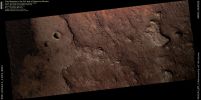
PSP_006625_1405_RED_abrowse-00-PCF-LXTT.jpgClay Minerals in the NW side of Bosporos Montes (Absolute Natural Colors; credits for the additional process. and color.: Dr Paolo C. Fienga - Lunexit Team)75 visiteThe Bosporos Montes make up part of the Rim of the giant Argyre Impact Basin on Mars. The Compact Reconnaissance Imaging Spectrometer (CRISM) identified this as a location with Clay Minerals (---> minerali a matrice argillosa). Such minerals contain water and may have formed under conditions favorable for life.
This HiRISE image was taken to support the CRISM Team’s investigation of this area. While HiRISE does not have the ability to identify minerals the way CRISM can, the enhanced colors in this image are similar to those seen in other Clay-containing parts of Mars.
The light-toned Mesas and Plains are crisscrossed with small Fractures that could have formed as a muddy Clay Deposit dried. However, this material is strong enough to form Boulders where it has been hit by Impact Craters.MareKromium
(2 voti)
|
|
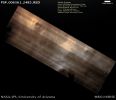
PSP_006561_2485_RED_abrowse.jpgWinter Sunrise in Vastitas Borealis (Absolute Natural Colors; credits for the additional process. and color.: Dr Paolo C. Fienga)70 visiteThis High Latitude image shows a portion of the Landing Ellipse for the Mars Scout Spacecraft Phoenix as seen during late Winter on Mars. Phoenix will land somewhere within the Ellipse on Memorial Day, 2008, but probably not within this image.
While the Phoenix Lander will land in Mid-Spring and operate through the Martian Summer, the current Winter landscape looks somewhat different. The Sun is beginning to rise from the Winter night and is only 10° above the horizon to illuminate the Surface in this image.
As a result, what few rocks are present cast noticeable shadows, and every bump and undulation of the Surface, now matter how small, is accentuated.
In this Winter image, a blanket of CO2 Frost (dry ice snow) about a foot deep covers the Surface. Bright patches in the image are areas where the Frost is relatively clean, while in darker areas over much of the image, the Frost is either dirty with Atmospheric dust or the Frost is somewhat translucent allowing us to see a little of the Soil forming the Surface.
Summertime images of this Region show that small Hexagonal and Polygonal Patterns a few meters (yards) in size ubiquitously cover the entire Region. These Patterns are the result of annual thermal contraction in ice-cemented soil forming a honeycomb network of small fractures below the Surface that manifest themselves as small shallow Troughs (---> canaletti) at the Surface.
Interestingly, these Patterns are not visible in this image. The shallow Troughs that mark the polygons are currently filled in with CO2 Frost making them virtually invisible.
As Spring approaches the CO2 Frost will slowly sublimate (changes directly from ice to gas) and the Polygons will once again become visible. MareKromium
(2 voti)
|
|
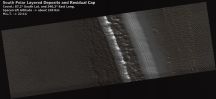
PSP_002856_0875_red-PCF-LXTT.jpgSouth Polar Layered Deposits and Scarp (Absolute Natural Colors; credits: Dr Paolo C. Fienga - Lunexit Team)125 visitenessun commentoMareKromium
(2 voti)
|
|

South_Polar_Feature-PIA13727.jpgBizarre-looking Surface Feature - Sol 2467 (EDM - Absolute Natural Colors; credits for the additional process. and color.: Dr Paolo C. Fienga - Lunexit Team)143 visiteThis approx. 4 Km diameter Surface Feature near the edge of the South Polar Residual Cap was recognized in Mariner 9 and Viking Orbiter images taken in the 1970s, but its origin could not be inferred. It was therefore targeted for HiRISE stereo imaging.
The bright areas in this image are covered by CO2 Frost, and the "Swiss Cheese" Terrain typical of the South Polar Residual Cap covers much of the imaged area.
The Dark Walls of the Circular Depression do not have as much Frost on them and are fractured in a Polygonal Pattern. Apparently the Surface of the Walls has been extensively modified by thermal expansion and contraction of water ice. It also appears that the "Swiss Cheese" Terrain of the Residual Cap has buried the Floor of the Circular Depression, as well as the Terrain surrounding the Feature, making it difficult to infer its origin.
Its circular symmetry is consistent with an impact origin, but there is no evidence of a Crater Rim or Ejecta Blanket (perhaps because they have been buried). The Depression may also have formed by Collapse, but there is little evidence of extensional fractures that would be expected around a Collapse Pit. Analysis of HiRISE stereo data may help the interpretation of this however really peculiar Surface Feature.MareKromium
(2 voti)
|
|

ESP_020204_1835_RED_abrowse-01.jpgNorthern Meridiani Planum (EDM - Enhanced Absolute Natural Colors; credits for the additional process. and color.: Dr Paolo C. Fienga - Lunexit Team:) 111 visitenessun commentoMareKromium
(2 voti)
|
|
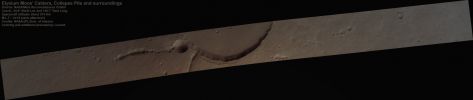
PSP_004903_2050_RED_browse-PCF-LXTT.jpgElysium Mons' Caldera and Collapse Pits (Absolute Natural Colors; credits for the additional process. and color.: Dr Paolo C. Fienga - Lunexit Team)125 visitenessun commentoMareKromium
(2 voti)
|
|

ESP_019987_1095_RED_abrowse.jpgHigh Southern Latitude "Dunes' Gullies" (Absolute Natural Colors; credits for the additional process. and color.: Elisabetta Bonora and Paolo C. Fienga - Lunexit Team)114 visitenessun commentoMareKromium
(2 voti)
|
|

ESP_020163_0980_RED_abrowse.jpgSouth Polar Features (Absolute Natural Colors; credits: Dr Paolo C. Fienga - Lunexit Team)105 visiteHiRISE images are monochromatic across much of the scene, but in the center we return color data. The color strip down the center of this image gives us insight into Aerosols (such as particles of Dust and Frost) suspended in the Atmosphere and the seasonal processes that get them there. In the Winter Mars' South Polar Region is covered by a layer of CO2 ice (dry ice).
In the Spring this ice evaporates from the top and the bottom of the Seasonal Ice Layer (typically a few centimeters thick). Where there are cracks in the ice, the gas from below escapes, carrying fine particles from the Surface up to the top of the ice. Larger particles fall back onto the ground in Fan-shaped Deposits pointing in a direction determined by the local winds. We see the smaller particles (Dust) suspended in the air locally over the cracks as the bluish tone over the Regions with Fans.
Over Regions without Fans, where Gas and Dust from the Surface are not escaping into the Atmosphere, the Surface is a more pinkish tone.MareKromium
(2 voti)
|
|

ESP_020204_1835_RED_abrowse-00.jpgNorthern Meridiani Planum (CTX Frame - Absolute Natural Colors; credits for the additional process. and color.: Dr Paolo C. Fienga - Lunexit Team:)87 visitenessun commentoMareKromium
(2 voti)
|
|

ESP_020297_2045_RED_abrowse.jpgFeatures of Mawrth Vallis - Layering (Absolute Natural Colors; credits for the additional process. and color.: Dr Paolo C. Fienga - Lunexit Team)106 visiteMawrth Vallis is a Martian Region that is famous for its "Mineral Diversity", which includes Clay minerals that formed by the chemical alteration of both rocks and loose “Regolith” (such as Soil) by water.
There is a high surface area of bedded Phyllosilicate (Clay) exposures (in a range of tens of kilometers), located in the Bright-Toned Materials.
The CRISM instrument working on the MRO Spacecraft detects a variety of Clay minerals here, which could signify different processes of formation.
The High Resolution of the HiRISE camera helps us to see and trace out Layers, Polygonal Fractures and, with CRISM, to examine the distribution of various minerals across the entire Surface.
In the light of the above considerations and data, this Surface comes out as scientifically compelling for the Mars Science Laboratory (MSL) Rover 'Curiosity' (this Region is one of the four candidate Landing Sites for the MSL).MareKromium
(2 voti)
|
|
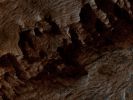
PSP_003830_1740_RED_abrowse-02.jpgLayered Bedrock in Candor Chasma (EDM n.2 - Absolute Natural Colors; credits for the additional process. and color.: Dr Paolo C. Fienga - Lunexit Team)83 visitenessun commentoMareKromium
(2 voti)
|
|
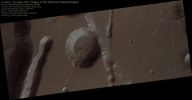
PSP_004046_2080_RED_browse-PCF-LXTT.jpgFeatures of Elysium Fossae (Absolute Natural Colors; credits for the additional process. and color.: Dr Paolo C. Fienga - Lunexit Team:)114 visitenessun commentoMareKromium
(2 voti)
|
|
| 2235 immagini su 187 pagina(e) |
 |
|
|
|
|
144 | |
|
|
|
|





