| Piú votate - Mars Reconnaissance Orbiter (MRO) |
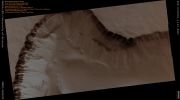
ESP_020956_1115_RED_abrowse.jpgFrosted presso-polar "Pit Gullies" (Absolute Natural Colors; credits for the additional process. and color.: Dr Paolo C. Fienga - Lunexit Team)79 visitenessun commentoMareKromium
(2 voti)
|
|

ESP_019559_1390_RED_abrowse-PCF-LXTT.jpgThe Dunes of Arkhangelsky Crater (Absolute Natural Colors; credits for the additional process. and color.: Dr Paolo C. Fienga - Lunexit Team)78 visitenessun commentoMareKromium
(2 voti)
|
|
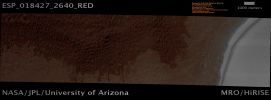
ESP_018427_2640_RED_abrowse-PCF-LXTT-1.jpgWhere the Erg meets the Polar Cap (Absolute Natural Colors; credits for the additional process. and color.: Dr Paolo C. Fienga - Lunexit Team)67 visitenessun commentoMareKromium
(2 voti)
|
|
ESP_016190_2635_RED_abrowse.jpgFrost-covered Northern Dunefield (Absolute Natural Colors; credits for the additional process. and color.: Dr Paolo C. Fienga - Lunexit Team:)66 visitenessun commentoMareKromium
(2 voti)
|
|
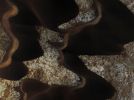
PSP_005684_1890_RED_abrowse-01.jpgDark Dunefield in Nili Patera Caldera (EDM - Enhanced Absolute Natural Colors; credits for the additional process. and color.: Dr Paolo C. Fienga - Lunexit Team)76 visitenessun commentoMareKromium
(2 voti)
|
|
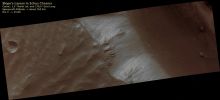
PSP_002472_1810_red_abrowse-PCF-LXTT.jpgSlope Layers in Echus Chasma (Absolute Natural Colors; credits for the additional process. and color.: Dr Paolo C. Fienga - Lunexit Team:)57 visitenessun commentoMareKromium
(2 voti)
|
|

Northern_Dunes-PIA13797-2-PCF-LXTT.jpgSeasonal Changes in a Dune of the North Polar Erg (Absolute Natural Colors; credits for the Additional Process. and Color.: Dr Paolo C. Fienga - Lunexit Team)75 visitenessun commentoMareKromium
(2 voti)
|
|

Northern_Dunes-PIA13797-1.jpgSeasonal Changes in a Dune of the North Polar Erg57 visiteThree images of the same location taken at different times on Mars show seasonal activity causing Sand Avalanches and Ripple changes on a Martian Dune. Time sequence of the images progresses from top to bottom. Each image covers an area of 285 meters (312 yards) by 140 meters (153 yards). The Crest of a Dune curves across the upper and left portions of the image.
The High Resolution Imaging Science Experiment (HiRISE) camera on NASA's Mars Reconnaissance Orbiter took these images. The site is at about 84° North Latitude and 233° East Longitude, in a vast Region of Dunes at the Edge of Mars' North Polar Ice Cap. The area is covered by Carbon-Dioxide (CO2) Ice in Winter but is Ice-free in Summer. The top and bottom images show part of one Dune about one Mars Year apart, at a time of the year when all the Seasonal Ice has disappeared: in late Spring of one year (top) and early Summer of the following year (bottom). The middle image is from the second year's mid-Spring, when the Region was still covered by Seasonal CO2 Ice.
Spring evaporation of the Seasonal Layer of Ice is manifested as Dark Streaks of fine particles carried to the top of the Ice Layer by escaping gas. The bottom of the Ice Layer, in contact with the Dark Ground, warms faster than the top of the Ice does in the Spring. Carbon-Dioxide gas produced by the thawing (----> disgelo) of the bottom Ice is temporarily trapped under the top Ice.
As the Ice evaporates from the bottom, flow of gas under the Ice destabilizes the Sand on the Dune, thus causing the Sand itself to avalanche down the Dune "Slipface".
A before-and-after comparison of the Dune shows new Alcoves and extension of the Debris Apron on the Slipface of the Dune caused by descending Grains of Sand. New Wind Ripples appear on the Debris Apron.
The top image is a portion of the HiRISE observation catalogued as PSP_008867_2640, taken on June 17, 2008.
The middle image is a portion of the HiRISE observation catalogued as ESP_016779_2640, taken on Feb. 23, 2010.
The bottom image is a portion of the HiRISE observation catalogued as ESP_018427_2640, taken on July 2, 2010.MareKromium
(2 voti)
|
|

PSP_005369_1925_RED_abrowse.jpgFeatures of Terra Sabaea (Absolute Natural Colors; credits for the additional process. and color.: Dr Paolo C. Fienga - Lunexit Team)80 visitenessun commentoMareKromium
(2 voti)
|
|
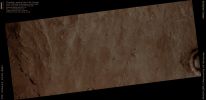
PSP_006633_2010_RED_abrowse~0.jpgPossible MSL Landing Site in Nili Fossae (Absolute Natural Colors; credits for the additional process. and color.: Dr Paolo C. Fienga - Lunexit Team) 80 visiteThe Nili Fossae are Valleys that have cut into the ancient crust of Mars, exposing Clay Minerals. These minerals formed in the presence of water and may be the result of chemical reactions between hot water and rocks. If so, this could have been a favorable location for Martian Life in ancient times.
This HiRISE image is part of a series in search for a safe place the Mars Science Laboratory Rover can land. In the central part of the image, the Terrain is a mix of Sand Dunes and relatively smooth rock exposures. There are some small Knobs but very few large rocks in the area. Instead, the multi-colored rock exposures seem to be mostly a mosaic of flat fractured rock.
On the Southern edge of the image (Dx), an Impact Crater is a potential hazard. In the Northern part of the image, the Scarp marking the boundary of the valley is visible.MareKromium
(2 voti)
|
|
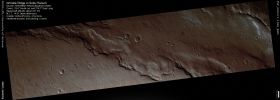
PSP_006573_1560_RED_abrowse-PCF-LXTT.jpgWrinkle Ridge in Solis Planum (Absolute Natural Colors; credits for the additional process. and color.: Dr Paolo C. Fienga)68 visiteThis observation shows a "Wrinkle Ridge" in Solis Planum, located in the Thaumasia Region of Mars, a high-elevation Volcanic Plain located South of the Valles Marineris Canyon System and East of the Tharsis Volcanic Complex.
Solis Planum contains some of the most distinct and well studied arrays of Wrinkle Ridges on Mars. Wrinkle Ridges are long, winding topographic highs and are often characterized by a broad arch topped with a crenulated ridge. These features have been identified on many other planetary bodies such as the Moon, Mercury and Venus.
On Mars, they are many tens to hundreds of kilometers long, tens of kilometers wide, and have a relief of a few hundred meters.
Wrinkle Ridges are most commonly believed to form from horizontal compression or shortening of the Crust due to Faulting and are often located in Volcanic Plains. They commonly have asymmetrical cross sectional profiles and an offset in elevation on either side of the ridge. Large Dunes are also visible bordering the Wrinkle Ridge. The reddish colors seen in this image most likely indicate the presence of Dust (or indurated Dust) and the darker, bluish colors most likely indicate the presence of larger Rocks and Boulders on the Wrinkle Ridge.MareKromium
(2 voti)
|
|
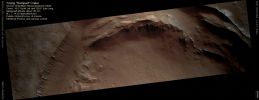
PSP_006588_1615_RED_abrowse-PCF-LXTT.jpgRelatively young "Rampart" Crater (Absolute Natural Colors; credits for the additional process. and color.: Dr Paolo C. Fienga - Lunexit Team)75 visiteThis image captures the Western Side of a relatively young “Rampart” Crater located in the Tharsis Region.
Rampart Craters are surrounded by a fluidized Ejecta Blanket (an Ejecta Blanket is the material thrown out around a Crater when the impact occured, in this case resembling the whites of a fried egg, where the crater is the yolk). Researchers speculate that these may form when an object impacts ground that contains fluid (liquid or frozen) that is released upon impact.
THEMIS images V06896002 and V10266002 provide context images for this side of the Crater and show better its Rampart.
Within the Crater we see evidence of Landslides originating at the upper edges. These Landslides have exposed individual Rocky Layers as well as Outcrops of stronger rock types which are more resistant to erosion.MareKromium
(2 voti)
|
|
| 2235 immagini su 187 pagina(e) |
 |
|
|
|
|
143 | |
|
|
|
|





