| Piú votate - Mars Reconnaissance Orbiter (MRO) |

ESP_020950_1410_RED_abrowse.jpgRelatively recent Impact Crater with Gullies and exposed Bedrock (Absolute Natural Colors; credits for the additional process. and color.: Dr Paolo C. Fienga - Lunexit Team)375 visitenessun commentoMareKromium
(2 voti)
|
|

ESP_020951_1435_RED_abrowse.jpgUnnamed Crater in Terra Cimmeria (Natural Colors; credits for the additional process. and color.: Dr Paolo C. Fienga - Lunexit Team)559 visitenessun commentoMareKromium
(2 voti)
|
|

ESP_020929_1360_RED_abrowse.jpgUplifted Bedrock (Absolute Natural Colors; credits for the additional process. and color.: Dr Paolo C. Fienga - Lunexit Team)335 visiteCaption NASA:"Large Impact Craters expose deep Bedrock. After the transient cavity forms, the Crater Floor rebounds and creates a permanent structural Uplift, typically equivalent to about 10% of the Crater diameter.
A Crater approx. 70 Km (43,47 miles) wide like this one, can raise up and expose Bedrock that was approx. 7 Km (4,34 miles) lower in elevation prior to the Impact.
Deeper rocks are usually older, and on Mars the oldest rocks are interesting because they are more likely to have been altered by water and provide clues to ancient environments and processes. This image reveals good Bedrock exposures with diverse rock types (as indicated by colors and textures)".MareKromium
(2 voti)
|
|

ESP_020922_1635_RED_abrowse.jpgProximities of Gratteri Crater (Absolute Natural Colors; credits: Dr Paolo C. Fienga - Lunexit Team)270 visiteCaption NASA:"Gratteri Crater, located about 150 Km to the South-East, ejected rocks that created millions of Secondary Craters over a Region at least 500 Km wide.
Many of these Secondary Craters are concentrated in "Rays", or lines extending radially from the Primary Impact Area (such as the "Gratteri Crater" Area).
Crater Rays on the Moon are typically bright at visible wavelengths, but on Mars they are often best seen in the Thermal InfraRed wavelengths, from temperature contrasts. This image confirms that this Ray contains many Secondary Craters (they are the small, sharp-rimmed Craters). Since millions of Secondary Craters form at once, they all have the same age and same degree of modification over time. Understanding the distribution of secondary craters provides information about impact processes, including escape of rocks that could become Martian meteorites on Earth".MareKromium
(2 voti)
|
|

ESP_020918_1400_RED_abrowse.jpgOutcrops in the Southern Latitudes (Natural Colors; credits for the additional process. and color.: Dr Paolo C. Fienga - Lunexit Team)321 visitenessun commentoMareKromium
(2 voti)
|
|
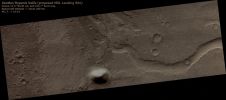
PSP_002919_1915_red-abrowse-PCF-LXTT.jpgPossible MSL Landing Site between Xanthe Terra and Hypanis Vallis (Absolute Natural Colors; credits for the additional process. and coloring: Dr Paolo C. Fienga - Lunexit Team)204 visitenessun commentoMareKromium
(2 voti)
|
|
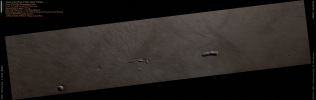
PSP_009343_1700_RED-abrowse-PCF-LXTT.jpgVents on the Floor of Arsia Mons' Caldera (Absolute Natural Colors; credits for the additional process. and color.: Dr Paolo C. Fienga - Lunexit Team)133 visitenessun commentoMareKromium
(2 voti)
|
|
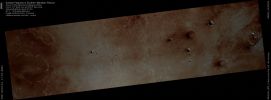
PSP_009352_1770_red_abrowse-PCF-LXTT.jpgSouthern Meridiani Planum (Absolute Natural Colors; credits for the additional process. and color.: Dr Paolo C. Fienga - Lunexit Team)136 visitenessun commentoMareKromium
(2 voti)
|
|
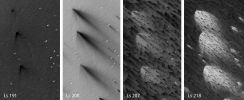
ESP_020953_0925_RED_abrowse-01.jpgEvolution of Southern Fans (an Image-Mosaic by NASA/JPL/University of Arizona)90 visiteThis is a sequence of 4 images acquired in Early Southern Spring over a particular spot in the South Polar Region. The changes in patterns are so great over just half a season that it is difficult to believe that the images cover the same ground. This composite helps by focusing on 3 distinctive Fans as they evolve. The Dark Fans turn into broad Bright Fans, then new small Dark Fans form inside the old Bright Fans. The newer Dark Fans form along cracks forming polygonal or other patterns.
These changes are driven by Sublimation and Condensation of volatiles, primarily CO2. Sunlight passes through the Ice to warm Subsurface Pockets of Gas which escape to form cold jets and the wind blows to form Fans on the Surface, depositing Dark Dust and Bright Frost.
Note: The Martian year is measured by 360° of Areocentric Longitude of the Sun or "Ls", where Ls 180-270 marks Southern Spring and Northern Fall. The Ls of each image is marked in each subframe and covers only 30% of the Spring.MareKromium
(2 voti)
|
|

ESP_020245_2190_RED_abrowse.jpgUnnamed Northern Crater with Gullies (Natural Colors; credits for the additional process. and color.: Dr Paolo C. Fienga - Lunexit Team)89 visitenessun commentoMareKromium
(2 voti)
|
|

ESP_020058_1300_RED_abrowse-02.jpgDune-Gullies in Matara Crater (EDM - Approx. True Colors; credits for the additional process. and color.: NASA/JPL/University of Arizona)57 visiteCaption NASA:"This image shows changing Dunes and incised Gullies (so-called "Dune-Gullies") in the Southern Matara Crater.
Repeat imaging of the Dunes in this Crater shows that material towards the top of the Gullies has moved downslope and the Channel Beds may have widened over time.
Since this activity occurs during Martian Southern Hemisphere Winter, it is believed to be related to Carbon Dioxide (CO2) Frost that forms as the area grows colder. Scientists continue to monitor this specific Region for changes in the Gullies and the Dunes themselves. This frame is approx. 1 (one) Km (0,6 miles) across".MareKromium
(2 voti)
|
|

PSP_002324_1815_red-PCF-LXTT.jpgNorthern Meridiani Planum (Absolute Natural Colors; credits for the additional process. and color.: Dr Paolo C. Fienga - Lunexit Team)90 visitenessun commentoMareKromium
(2 voti)
|
|
| 2235 immagini su 187 pagina(e) |
 |
|
|
|
|
142 | |
|
|
|
|





