| Piú votate - Mars Reconnaissance Orbiter (MRO) |

ESP_021569_1650_RED_abrowse-PCF-LXTT-1.jpgOver the Columbia Hills (Natural Colors; credits: Dr Paolo C. Fienga - Lunexit Team)234 visiteAcquisition date: 04 March 2011
Mars Local Time (M.L.T.): 15:11 (Early Afternoon)
Latitude (centered): 14,6° South
Longitude (East): 175,6°
Spacecraft Altitude: approx. 264 Km (163,944 miles)
Original Image Scale Range: 26,4 cm/pixel (with 1 x 1 binning) so objects ~79 cm across are resolved
Map Projected Scale: 25 cm/pixel and North is up
Map Projection: EQUIRECTANGULAR
Emission Angle: 2,9°
Sun-Surface-Spacecraft Angle (i.e.: Phase Angle): 48,7°
Solar Incidence Angle (S.I.A.): 46°, with the Sun about 44° above the Local Horizon
Solar Longitude: 247,7° - Northern AutumnMareKromium
(2 voti)
|
|

ESP_021641_1205_RED_abrowse-PCF-LXTT.jpgSouthern Dunefield (Absolute Natural Colors; credits for the additional process. and color.: Dr Paolo C. Fienga - Lunexit Team)257 visitenessun commentoMareKromium
(2 voti)
|
|

PIA10147-Starburst_Channels-PCF-LXTT.jpgThe "Arthur Clarke Trees" (Enhanced Absolute Natural Colors; credits for the additional process. and color.: Dr Paolo C. Fienga - Lunexit Team)210 visitenessun commentoMareKromium
(2 voti)
|
|
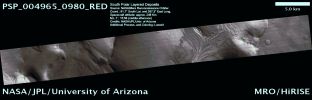
PSP_004965_0980_RED_abrowse-00~0.jpgSouth Polar Layered Deposits - SPLD (Absolute Natural Colors; credits for the additional process. and color.: Dr Paolo C. Fienga - Lunexit Team)117 visiteThe South Polar Layered Deposits (SPLD) are interesting because they were probably formed by global climate changes on Mars, like ice ages on Earth. The Martian SPLD are rich in water ice, but appear to be covered by a dusty layer that protects the underlying ice from evaporation and erosion.MareKromium
(2 voti)
|
|
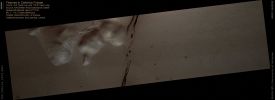
PSP_006234_1870_RED_abrowse-PCF-LXTT.jpgFeatures of Cerberus Fossae (Absolute Natural Colors; credits for the additional process. and color.: Dr Paolo C. Fienga)212 visitenessun commentoMareKromium
(2 voti)
|
|

PSP_004980_1035_RED_browse-01-PCF-LXTT.jpgUnnamed "Ghost" Crater near the South Pole (EDM - Absolute Natural Colors; credits for the additional process. and color.: Dr Paolo C. Fienga - Lunexit) 235 visiteCreep of the Crater Wall Material may have also played a role in erasing the Crater. This far South, the Surface Material is likely to be ice-rich and will slowly flow downhill. Additional evidence for near-surface ice is provided by the pervasive Polygons in the image, forming due to stresses caused by temperature variations in ice-rich ground.
Regardless of the mechanism, the Crater remains faintly expressed in the surface morphology. Note that the Surface has a similar texture away from the Crater, but not organized into concentric arcs. The residual structure of the Crater provides some control on stresses, producing the ringed pattern. MareKromium
(2 voti)
|
|
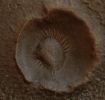
PSP_006250_2200_RED_abrowse-PCF-LXTT-1.jpgUnnamed Crater in Nilosyrtis Region (Absolute Natural Colors; credits for the additional process. and color.: Dr Paolo C. Fienga - Lunexit Team)231 visitenessun commentoMareKromium
(2 voti)
|
|

ESP_020959_0985_RED_abrowse.jpgEarly Spring in Inca City (Absolute Natural Colors; credits for the additional process. and color.: Dr Paolo C. Fienga - Lunexit Team)309 visitenessun commentoMareKromium
(2 voti)
|
|

ESP_020876_1330_RED_abrowse-PCF-LXTT.jpgDune-Gullies in Kaiser Crater (Absolute Natural Colors; credits for the additional process. and color.: Dr Paolo C. Fienga - Lunexit Team)296 visitenessun commentoMareKromium
(2 voti)
|
|

ESP_020873_1640_RED_abrowse.jpgLayered Bedrock in Central Uplift (Absolute Natural Colors; credits: Dr Paolo C. Fienga - Lunexit Team)286 visitenessun commentoMareKromium
(2 voti)
|
|
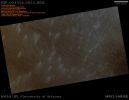
ESP_021454_0925_RED_abrowse-00-PCF-LXTT.jpgPolar Streaks (Absolute Natural Colors; credits: Dr Paolo C. Fienga - Lunexit Team)302 visiteThis is the first HiRISE image taken after Solar Conjunction (2010), when Mars passes behind the Sun as seen from Earth. The Solar Corona interferes with radio communication with MRO for a few weeks during conjunction, so no HiRISE imaging was planned until reliable communication resumed.
This image is one of a set of images taken to monitor the evolution of the South Polar Seasonal Cap. The Seasonal Caps on Mars are mostly composed of Carbon Dioxide, the major component of the Martian Atmosphere. It is currently Spring in the Southern Hemisphere of Mars, so the Cap is warming and evaporating into the Atmosphere by way of Sublimation.
The Dark Streaks visible in this image are thought to be sand ejected onto the Surface of the Cap by "Jets" of CO2. It is thought that Sunlight penetrates to the base of the Seasonal Cap, warming the soil at its base. This in turn warms the Cap from below, causing Carbon Dioxide to evaporate and build pressure until the gas escapes through Vents to the Surface. Sand grains are apparently entrained in this flow and deposited in Fans on the Surface.
The White Streaks may be formed by recondensation of ice on the Surface of the Cap.MareKromium
(2 voti)
|
|

ESP_020873_1005_RED_abrowse.jpgDusty "Cryptic Terrain" (Absolute Natural Colors; credits for the additional process. and color.: Dr Paolo C. Fienga - Lunexit Team)272 visitenessun commentoMareKromium
(2 voti)
|
|
| 2235 immagini su 187 pagina(e) |
 |
|
|
|
|
140 | |
|
|
|
|





