| Piú votate - Mars Reconnaissance Orbiter (MRO) |

Craters-Victoria_Crater-PIA12167.jpgVictoria Crater (Natural Colors; credits: Lunexit)59 visiteThis image of Victoria Crater in the Meridiani Planum Region of Mars was taken by the High Resolution Imaging Science Experiment (HiRISE) camera on NASA's Mars Reconnaissance Orbiter at more of a sideways angle than earlier orbital images of this feature.
The camera pointing was 22° East of straight down, yielding a view comparable to looking at the landscape out an airplane window. East is at the top. The most interesting exposures of geological strata are in the steep walls of the Crater, difficult to see from straight overhead.
Especially prominent in this oblique view is a bright band near the top of the Crater wall.
Earlier HiRISE images of Victoria Crater supported the exploration of this Crater by NASA's Opportunity Rover and contributed to joint scientific studies. Opportunity explored the Rim and interior of this 800-meter-wide (about 0,5-mile-wide) Crater from September 2006 through August 2008.
The Rover's on-site investigations indicated that the bright band near the top of the Crater wall was formed by diagenesis (chemical and physical changes in sediments after deposition). The bright band separates bedrock from the material displaced by the impact that dug the Crater.
This view is a cutout from a HiRISE exposure taken on July 18, 2009. Some of Opportunity's Tracks are still visible to the North of the Crater (left side of this cutout).
Full-frame images from this HiRISE observation, catalogued as ESP_013954_1780, are at http://hirise.lpl.arizona.edu/ESP_013954_1780.
The full-frame image is centered at 2,1° South Latitude and 354,5° East Longitude. It was taken at 2:31 p.m. Local Mars Time. The scene is illuminated from the West with the Sun about 49° above the Local Horizon (therefore the S.I.A. was about 41°).MareKromium
(6 voti)
|
|

ESP_012584_1265_RED_abrowse-00.jpg"Hot Surprise" in Nia Vallis (ctx frame - Natural Colors; credits: Lunexit)56 visiteImmagini orbitali come questa, nel 99,99% dei casi passano del tutto inosservate ma, come Voi sapete (e come noi abbiamo - da tempo - imparato), spesso le più grosse sorprese si annidano tra le pieghe dei frames - apparentemente - meno intriganti.
In fondo, che cosa ci mostra di particolare questo frame? Si tratta della Regione Marziana di Nia Vallis (siamo nelle medie Latitudini dell'Emisfero Australe di Marte, intorno alle coordinate 53° Sud e 323° Est) ed il dettaglio colto dagli occhi della Sonda MRO ci mostra quelli che sembrano residui di antiche (ed ormai del tutto estinte) attività fluviali su una superficie rocciosa e ricca di macigni di dimensioni medio-piccole. Nulla di più.
Eppure, una volta che il nostro Dr Faccin ha "scansionato" il frame nella sua versione JP2000, qualcosa è emersa.
Qualcosa che vedrete nel prossimo frame...MareKromium
(6 voti)
|
|

PSP_010397_1725_RED_abrowse-01.jpgLight-Toned Rock Exposures in Noctis Labyrinthus OR Salty "Outlines"? (Perspective View - Natural Colors; credits: Dr M. Faccin)83 visitenessun commentoMareKromium
(6 voti)
|
|

ESP_012912_1320_RED_abrowse.jpgGullies in Noachis Terra (Natural Colors; credits: Lunar Explorer Italia)57 visiteGeologically young Gullies are a prime target for the HiRISE camera. Gullies are located in a variety of settings and are found all over Mars.
This "Ring Trough" or "Eroded Pit Crater", is located in the rugged Southern Highland Terrain known as Noachis Terra. The HiRISE image shows the layered, boulder-rich wall rock facing to the North-East and Gullies that are transporting material downslope.
The material collects into debris aprons along the walls, which often exhibit narrow channels along its surface.MareKromium
(6 voti)
|
|

ESP_012202_1390_RED_abrowse.jpgDunes in Western Nereidum Montes (Extremely Enhanced Natural Colors; credits: Lunar Explorer Italia)57 visitenessun commentoMareKromium
(6 voti)
|
|

ESP_011930_1875_RED_abrowse.jpgLong Fissure in Cerberus Fossae (Natural Colors; credits: Lunar Explorer Italia)57 visitenessun commentoMareKromium
(6 voti)
|
|

ESP_012251_0935_RED_abrowse.jpgJust like Magnetic Fields (Natural Colors; credits: Lunar Explorer Italia)59 visitenessun commentoMareKromium
(6 voti)
|
|
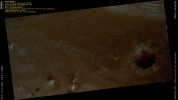
ESP_012940_1655_RED_abrowse-00.jpgThe Floor of Eos Chasma (ctx frame - Natural Colors; credits: Lunar Explorer Italia)58 visiteThe scoured and scabby floor of Eos Chasma, located East of Valles Marineris, is covered with Dunes or Ripples and Eroded Craters. The reddish-brown color likely represents older, eroded Basalt and much of this erosion may have been accomplished by water.MareKromium
(6 voti)
|
|
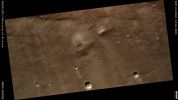
ESP_012692_1810_RED_abrowse.jpgThe "Dusty" Summit of Pavonis Mons (Natural Colors; credits: Lunar Explorer Italia)55 visitePavonis Mons is one of the 3 giant Tharsis Montes Shield Volcanoes. Its Summit rises so far above the Surface that the Atmosphere is extremely thin, even for Mars.
Dust that reaches these heights (for example, during major Dust Storms) is hard to remove, so the upper parts of these Volcanoes are covered by vast deposits of dust. The dust is moved a little by the thin winds, producing ripples and other textures near the limit of HiRISE’s resolution. The fluffy, ripply surface looks “smudged” or out of focus, but by looking at some of the small impact craters you can see that the HiRISE camera is, indeed, properly focused. It’s the surface of Mars that is blurry!
Nota Lunexit: NO. A nostro parere NON è la Superficie di Marte che è "sfuocata" (blurry) e non è neppure la fotocamera dell'Orbiter che è "out of focus". Si tratta, come abbiamo già visto in passato (nelle immagini dei fly-by ravvicinati di alcune Lune Saturniane - Encelado su tutte) di un caso classico di "Sfuocatura da Movimento" (in altre parole: è un mero problema di lunghezza dell'esposizione - ivi: eccessiva -, data la vicinanza del target ripreso in rapporto alla velocità dell'Orbiter rispetto al medesimo). Curioso che i Ragazzi di Pasadena non ci abbiano pensato...
The impact craters also show that the dust is not a thin veneer. Instead, it is a thick coat, at least several meters deep. This mantling of dust hides the details of the Lava Flows and Vents, frustrating volcanologists but delighting those who study dust.
Mars Local Time: 15:23 (early afternoon)
Coord. (centered): 0,9° North Lat. and 246,8° East Long.
Spacecraft altitude: 254,1 Km (such as about 158,8 miles)
Original image scale range: 50,8 cm/pixel (with 1 x 1 binning) so objects ~1,53 mt across are resolved
Map projected scale: 50 cm/pixel
Map projection: EQUIRECTANGULAR
Emission Angle: 2,5°
Phase Angle: 52,4°
Solar Incidence Angle: 55° (meaning that the Sun is about 35° above the Local Horizon)
Solar Longitude: 244,7° (Northern Autumn)
Credits: NASA/JPL/University of Arizona
Additional process. and coloring: Lunar Explorer ItaliaMareKromium
(6 voti)
|
|
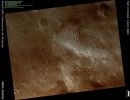
PSP_010430_1605_RED_abrowse.jpgUnusually-looking "Ripples" (Natural Colors; credits: Lunar Explorer Italia)56 visitenessun commentoMareKromium
(6 voti)
|
|
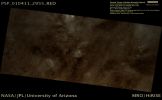
PSP_010411_2955_RED_abrowse.jpgSample of Terrain in Vastitas Borealis (Natural Colors; credits: Lunar Explorer Italia)56 visitenessun commentoMareKromium
(6 voti)
|
|

ESP_011477_1275_RED_abrowse.jpgHuge Seepage in Argyre Region (Natural Colors; credits: Lunar Explorer Italia)66 visiteMars Local Time: 16:02 (middle afternoon)
Coord. (centered): 52,0° South Lat. and 304,9° East Long.
Spacecraft altitude: 251,0 Km (such as about 156,9 miles)
Original image scale range: 25,1 cm/pixel (with 1 x 1 binning) so objects ~ 75 cm across are resolved
Map projected scale: 25 cm/pixel
Map projection: EQUIRECTANGULAR
Emission Angle: 1,6°
Phase Angle: 71,6°
Solar Incidence Angle: 70° (meaning that the Sun is about 20° above the Local Horizon)
Solar Longitude: 186,9° (Northern Autumn)
Credits: NASA/JPL/University of Arizona
Additional process. and coloring: Lunar Explorer ItaliaMareKromium
(6 voti)
|
|
| 2235 immagini su 187 pagina(e) |
 |
|
|
|
|
14 | |
|
|
|
|





