| Piú votate - Mars Reconnaissance Orbiter (MRO) |
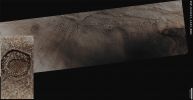
ESP_024315_1435_RED_abrowse-PCF-LXTT-001.jpgUnusually-looking Unnamed Crater near the Confluence of Dao Vallis with Niger Vallis (Absolute Natural Colors; credits for the additional process. and color.: Dr Paolo C. Fienga - Lunexit Team)181 visiteMars Local Time: 14:32 (Early Afternoon)
Coord. (centered): 36,1° South Lat. and 90,3° East Long.
Spacecraft altitude: 258,3 Km (such as about 161,4 miles)
Original image scale range: 51,7 cm/pixel (with 2 x 2 binning) so objects ~ 1 mt and 55 cm across are resolved
Map projected scale: 50 cm/pixel
Map projection: EQUIRECTANGULAR
Emission Angle: 5,6°
Sun-Mars-Spacecraft (or "Phase") Angle: 50,5°
Solar Incidence Angle: 54° (meaning that the Sun is about 36° above the Local Horizon)
Solar Longitude: 10,1° (Northern Spring)
Credits: NASA/JPL/University of Arizona
Additional process. and coloring: Dr Paolo C. Fienga - Lunar Explorer MareKromium
(2 voti)
|
|

ESP_023314_1440_RED_abrowse-PCF-LXTT-01.jpgUnusual Surface Features in Hellas Planitia (EDM - Enhanced Absolute Natural Colors; credits for the additional process. and color.: Dr Paolo C. Fienga - Lunexit Team)158 visiteMars Local Time: 14:16 (Early Afternoon)
Coord. (centered): 35,9° South Lat. and 58,6° East Long.
Spacecraft altitude: 261,1 Km (such as about 163,2 miles)
Original image scale range: 52,2 cm/pixel (with 2 x 2 binning) so objects ~ 1 mt and 57 cm across are resolved
Map projected scale: 50 cm/pixel
Map projection: EQUIRECTANGULAR
Emission Angle: 6,0°
Sun-Mars-Spacecraft (or "Phase") Angle: 34,3°
Solar Incidence Angle: 39° (meaning that the Sun is about 51° above the Local Horizon)
Solar Longitude: 329,9° (Northern Winter)
Credits: NASA/JPL/University of Arizona
Additional process. and coloring: Dr Paolo C. Fienga - Lunar Explorer ItaliaMareKromium
(2 voti)
|
|

ESP_023314_1440_RED_abrowse-PCF-LXTT-00.jpgUnusual Surface Features in Hellas Planitia (CTX Frame - Enhanced Absolute Natural Colors; credits for the additional process. and color.: Dr Paolo C. Fienga - Lunexit Team)167 visiteMars Local Time: 14:16 (Early Afternoon)
Coord. (centered): 35,9° South Lat. and 58,6° East Long.
Spacecraft altitude: 261,1 Km (such as about 163,2 miles)
Original image scale range: 52,2 cm/pixel (with 2 x 2 binning) so objects ~ 1 mt and 57 cm across are resolved
Map projected scale: 50 cm/pixel
Map projection: EQUIRECTANGULAR
Emission Angle: 6,0°
Sun-Mars-Spacecraft (or "Phase") Angle: 34,3°
Solar Incidence Angle: 39° (meaning that the Sun is about 51° above the Local Horizon)
Solar Longitude: 329,9° (Northern Winter)
Credits: NASA/JPL/University of Arizona
Additional process. and coloring: Dr Paolo C. Fienga - Lunar Explorer ItaliaMareKromium
(2 voti)
|
|

PSP_001942_2310_RED_abrowse-00.jpgSigns of Fluids and Ice in an Unnamed Crater in Acidalia Planitia (CTX Frame - Absolute Natural Colors; credits for the additional process. and color.: Dr Paolo C. Fienga - Lunexit Team) 194 visiteThis image shows an Unnamed Crater approx. 11 Km (about 7 miles) in diameter, located in Acidalia Planitia, part of the Northern Plains. Several features in and around this Crater are suggestive of fluids and ice at and near the surface.
The muted topography of the Crater and its surroundings, the relatively shallow floor (300 mt or 330 yards), the convex slope of its Walls — all are consistent with ice being present under the Surface, mixed with rocks and soil. Ice would have acted as a lubricant, facilitating the flow of rocks and soils and hence smoothing landscape's features such as ridges and Craters' Rims.
The concentric and radial fissures in the Crater's Floor may indicate decrease of volume due to loss of underground ice. Piles of rocks aligned along these fissures and arranged forming polygons are similar to features observed in terrestrial periglacial regions such as Antarctica.
Antarctica's features are produced by repeated expansion and contraction of subsurface soil and ice, due to seasonal temperature oscillations.
The funnel-shaped depressions visible in the Crater's Floor could be Collapse Pits, further evidence of ice decay; alternatively, they could be smoothed-out small Impact Craters.
MareKromium
(2 voti)
|
|

ESP_023327_2065_RED_abrowse-PCF-LXTT-00.jpgDark Dust Devil Tracks on colourful Dunes (CTX Frame - Absolute Natural Colors; credits for the additional process. and color.: Dr Paolo C. Fienga - Lunexit Team)164 visiteMars Local Time: 14:09 (Early Afternoon)
Coord. (centered): 26,1° North Lat. and 57,0° East Long.
Spacecraft altitude: 304,8 Km (such as about 190,5 miles)
Original image scale range: 30,5 cm/pixel (with 1 x 1 binning) so objects ~ 91 cm across are resolved
Map projected scale: 25 cm/pixel
Map projection: EQUIRECTANGULAR
Emission Angle: 20,6°
Phase Angle: 36,0°
Solar Incidence Angle: 49° (meaning that the Sun is about 41° above the Local Horizon)
Solar Longitude: 330,5° (Northern Winter)
Credits: NASA/JPL/University of Arizona
Additional process. and coloring: Dr Paolo C. Fienga - Lunar Explorer Italia
Caption NASA:"Dust Devils leave Tracks behind them that create the beautiful swirling patterns visible in the EDM n.2 (approximately 0,5 Km, or about 0,3 miles across) and in many other images of Dust-covered Terrain. Suction created by the air rotating in a whirlwind removes a thin layer of light-colored Dust from the Martian Surface, leaving behind dark lines in the Dust Devil's path. That's what usually happens. In this case, however, there is an unusual Streak that appears brighter at one end (see EDM n.1 - approximately 0,6 Km or just about 0,4 miles across, with North is roughly upwards).
The bright Streak could be a deposit of light-colored Material that the Dust Devil dropped for some reason: maybe the Dust Devil died out right at this spot. Or it could be that at this particular location, the underlying dune is brighter than the dust on top of it, so when the dust devil removed the surface layer, a brighter layer below was revealed. Or there could be some other explanation we haven't even thought of yet!
Numerous small Slope Streaks are also visible in this image; for example, on the left side of the EDM n.2, indicated by the white arrow. These are thought to occur when a thin layer of Dust Avalanches downhill, revealing darker material beneath. Over time, these Streaks, like the DDTs, slowly brighten to match their surroundings, as Dust is deposited from the Atmosphere to cover them".MareKromium
(2 voti)
|
|

ESP_023327_2065_RED_abrowse-PCF-LXTT-02.jpgDark Dust Devil Tracks on colourful Dunes (EDM n.1 - Enhanced Absolute Natural Colors; credits for the additional process. and color.: Dr Paolo C. Fienga - Lunexit Team)186 visiteMars Local Time: 14:09 (Early Afternoon)
Coord. (centered): 26,1° North Lat. and 57,0° East Long.
Spacecraft altitude: 304,8 Km (such as about 190,5 miles)
Original image scale range: 30,5 cm/pixel (with 1 x 1 binning) so objects ~ 91 cm across are resolved
Map projected scale: 25 cm/pixel
Map projection: EQUIRECTANGULAR
Emission Angle: 20,6°
Phase Angle: 36,0°
Solar Incidence Angle: 49° (meaning that the Sun is about 41° above the Local Horizon)
Solar Longitude: 330,5° (Northern Winter)
Credits: NASA/JPL/University of Arizona
Additional process. and coloring: Dr Paolo C. Fienga - Lunar Explorer ItaliaMareKromium
(2 voti)
|
|

ESP_023327_2065_RED_abrowse-PCF-LXTT-01.jpgDark Dust Devil Tracks on colourful Dunes (EDM n.2 - Enhanced Absolute Natural Colors; credits for the additional process. and color.: Dr Paolo C. Fienga - Lunexit Team)184 visiteMars Local Time: 14:09 (Early Afternoon)
Coord. (centered): 26,1° North Lat. and 57,0° East Long.
Spacecraft altitude: 304,8 Km (such as about 190,5 miles)
Original image scale range: 30,5 cm/pixel (with 1 x 1 binning) so objects ~ 91 cm across are resolved
Map projected scale: 25 cm/pixel
Map projection: EQUIRECTANGULAR
Emission Angle: 20,6°
Phase Angle: 36,0°
Solar Incidence Angle: 49° (meaning that the Sun is about 41° above the Local Horizon)
Solar Longitude: 330,5° (Northern Winter)
Credits: NASA/JPL/University of Arizona
Additional process. and coloring: Dr Paolo C. Fienga - Lunar Explorer ItaliaMareKromium
(2 voti)
|
|
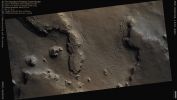
PSP_008508_1870_RED_abrowse.jpgPeri-Equatorial Pedestal Crater's Margin (Absolute Natural Colors; credits for the additional process. and color.: Dr Paolo C. Fienga - Lunar Explorer Italia)189 visitenessun commentoMareKromium
(2 voti)
|
|
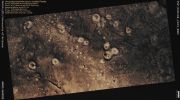
PSP_008548_2205_RED_abrowse.jpgMounds in Acidalia Planitia (Enhanced Absolute Natural Colors; credits for the additional process. and color.: Dr Paolo C. Fienga - Lunexit Team)161 visiteCaption NASA:"This image shows bright mounds scattered throughout a rather flat, dark landscape. These mounds range approximately between 20 and 500 meters (yards) in diameter.
The largest among them show central crater-like depressions which give them an appearance similar to terrestrial volcanoes. The origin of these mounds is still unclear. The most widely accepted hypotheses involve extrusion of underlying fluid-like materials (lava, wet/icy sediments) through weak points in the surface.
Similar mounds have been observed elsewhere in the Northern Lowlands (the Northern Lowlands encompass a vast region of Mars younger than the rest of the Planet, as shown by lower number of impact craters, and well below its average altitude). Mounds such as the ones shown in this image may hold important clues for scientist to decipher the history of the Northern Lowlands: an old ocean basin?
The site of continental-scale volcanism?
Detailed analysis of HiRISE and other complementary datasets will help solve this mystery".MareKromium
(2 voti)
|
|

ESP_023482_2010_RED_abrowse.jpgFresh Impact Crater on the S/W Edge of Elysium Mons (Absolute Natural Colors; credits for the additional process. and color: Dr Paolo C. Fienga - Lunexit Team)194 visiteMars Local Time: 14:04 (early afternoon)
Coord. (centered): 20,7° North Lat. and 144,0° East Long.
Spacecraft altitude: 281,3 Km (such as about 175,8 miles)
Original image scale range: 28,1 cm/pixel (with 1 x 1 binning) so objects ~ 84 cm across are resolved
Map projected scale: 25 cm/pixel
Map projection: EQUIRECTANGULAR
Emission Angle: 1,4°
Sun-Mars-Spacecraft (or "Phase") Angle: 42,0°
Solar Incidence Angle: 43° (meaning that the Sun is about 47° above the Local Horizon)
Solar Longitude: 337,0° (Northern Winter)
Credits: NASA/JPL/University of Arizona
Additional process. and coloring: Dr Paolo C. Fienga - Lunar Explorer ItaliaMareKromium
(2 voti)
|
|

ESP_023660_1710_RED_abrowse.jpgFeatures of Aurorae Chaos (Absolute Natural Colors; credits for the additional process. and color.: Dr Paolo C. Fienga - Lunexit Team) 183 visiteMars Local Time: 14:11 (Early Afternoon)
Coord. (centered): 9,0° South Lat. and 327,7° East Long.
Spacecraft altitude: 265,9 Km (such as about 166,2 miles)
Original image scale range: 53,2 cm/pixel (with 2 x 2 binning) so objects ~ 1 mt and 60 cm across are resolved
Map projected scale: 50 cm/pixel
Map projection: EQUIRECTANGULAR
Emission Angle: 0,1°
Sun-Mars-Spacecraft (or "Phase") Angle: 32,6°
Solar Incidence Angle: 33° (meaning that the Sun is about 57° above the Local Horizon)
Solar Longitude: 344,4° (Northern Winter)
Credits: NASA/JPL/University of Arizona
Additional process. and coloring: Dr Paolo C. Fienga - Lunar Explorer ItaliaMareKromium
(2 voti)
|
|

ESP_023674_1590_RED_abrowse-PCF-LXTT-01.jpgColorful Central Peak in an Unnamed Crater (EDM - Absolute Natural Colors; credits for the additional process. and color.: Dr Paolo C. Fienga - Lunexit Team)207 visiteMars Local Time: 14:11 (Early Afternoon)
Coord. (centered): 20,5° South Lat. and 306,4° East Long.
Spacecraft altitude: 259,1 Km (such as about 162,0 miles)
Original image scale range: 51,8 cm/pixel (with 2 x 2 binning) so objects ~ 1 mt and 56 cm across are resolved
Map projected scale: 50 cm/pixel
Map projection: EQUIRECTANGULAR
Emission Angle: 7,2°
Sun-Mars-Spacecraft (or "Phase") Angle: 41,5°
Solar Incidence Angle: 35° (meaning that the Sun is about 55° above the Local Horizon)
Solar Longitude: 345,0° (Northern Winter)
Credits: NASA/JPL/University of Arizona
Additional process. and coloring: Dr Paolo C. Fienga - Lunar Explorer ItaliaMareKromium
(2 voti)
|
|
| 2235 immagini su 187 pagina(e) |
 |
|
|
|
|
131 | |
|
|
|
|





