| Piú votate - Mars Reconnaissance Orbiter (MRO) |
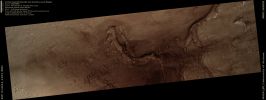
ESP_014414_2205_RED_abrowse.jpgEroded Layered Deposits near Ismenius Lacus Region (Natural Colors; credits: Lunexit)57 visitenessun commentoMareKromium
(6 voti)
|
|

ESP_014339_1710_RED_abrowse.jpgLight-Toned Units along the Wallrock and Floor of Melas Region (Natural Colors; credits: Lunexit)55 visitenessun commentoMareKromium
(6 voti)
|
|

ESP_014097_1120_RED_abrowse.jpgDisappearing Craters (Natural Colors; credits: Lunar Explorer Italia)61 visiteImpact Craters that form at High Latitudes often disappear faster than those that form in Equatorial Regions. The craters in this image are only barely detectable.
Over time, craters in ice, particularly large craters, "relax".
Their depth-to-diameter ratio decreases as the bowl of the crater gets shallower with time. The craters slowly appear softer and smoother, fading into the surrounding landscape, until they remain only as circular patterns on flat ground, before they eventually disappear altogether. The larger the crater, the faster it will relax.
The reason for the crater degradation is partly due to in-filling by snow or dust and slumping off of the crater walls, and also partly from processes that produce the patterned ground you see in this HiRISE image. But the primary reason for the shallowing is because the ground at High Latitudes on Mars is ice-rich, and ice is not very strong. At warmer temperatures found in the Inner Solar System, ice generally flows more easily than rock, so ice cannot support the structure of the crater as well as rock. The crater relaxes as the ice begins to flow back to a level surface.
All of the processes listed above have likely acted on these craters, and recently, they have also been swept by Dust Devils, which left dark streaks in their wake.MareKromium
(6 voti)
|
|

ESP_014353_1685_RED_abrowse-01.jpgLight-Toned Deposits in Noctis Labyrinthus (EDM - Natural Colors; credits: Lunexit)56 visiteCRISM observations of this Region of the Noctis Labyrinthus formation have shown indications of Iron-bearing Sulfates and Phyllosilicate (such as "clay" ----> argilla) minerals.
HiRISE observations have revealed exposed layers which are possibly the sources of the signatures seen by CRISM.
In this image, the layering can be seen on the right side of the image.
On the lower left, instead, a large Dunefield which covers other beds can also be seen.MareKromium
(6 voti)
|
|
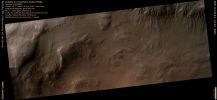
ESP_014187_2230_RED_abrowse.jpgGullies in a Northern Crater Walls (Natural Colors; credits: Lunexit)56 visitenessun commentoMareKromium
(6 voti)
|
|

ESP_014100_1600_RED_abrowse.jpgPossible Inverted Meanders (Natural - but enhanced - Colors; credits: Lunexit)58 visitenessun commentoMareKromium
(6 voti)
|
|

ESP_014103_2485_RED_abrowse.jpgMonitoring of Phoenix Landing Site (Natural Colors; credits: Lunexit)57 visitenessun commentoMareKromium
(6 voti)
|
|

ESP_014083_0945_RED_abrowse-00.jpgActive Geyser on Mars: the "Region" (Natural Colors; credits: Lunexit)60 visiteCoord.: 85,4° South Lat. and 104,0° East Long.
Spacecraft altitude: about 248 Km
M.L.T.: 16:08 (middle afternoon)
S.I.A.: 69° (with the Sun about 21° above the Local Horizon)
Credits: NASA/JPL/Univ. of Arizona
Additional process. and color.: Lunexit
Attività geotermica su Marte? La risposta, detta quasi sussurrando, ci arriva direttamente dalla NASA ed è "Si": su Marte si manifesta ancora CERTAMENTE un quantum (residuale?) di attività geotermica e la prova è nelle bocche ancora attive di una serie di geysers che vediamo nelle Regioni Sud-Polari (le Regioni che sembrano ospitarne di più, ma certo non le uniche Regioni ancora "vive" di Marte).
Dietro questa semplice (ed affascinante) ammissione, si apre un universo di possibilità, tutte quante accomunate da una circostanza: il sottosuolo di Marte è ancora "vivo" ed è ancora abbastanza "caldo e vivace" da sostenere la verificazione di eventi eruttivi (di modesta scala, ma non per questo di modesta importanza).
A quando la notizia che nel sottosuolo di Marte esistono ancora e, nelle ere, si sono sviluppate ed evolute delle Forme Vitali Indigene?...MareKromium
(6 voti)
|
|
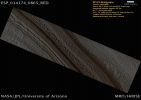
ESP_014174_0865_RED_abrowse.jpgSouth Polar Layered Deposits' (SPLD) Stratigraphy (Natural Colors; credits: Lunexit)58 visitenessun commentoMareKromium
(6 voti)
|
|

ESP_014111_1130_RED_abrowse.jpgPityhusa Patera Caldera (Natural Colors; credits: Lunexit)60 visitenessun commentoMareKromium
(6 voti)
|
|

ESP_014114_0935_RED_abrowse.jpgSouth Polar Residual Cap Monitoring (Natural Colors; credits: Lunexit)59 visitenessun commentoMareKromium
(6 voti)
|
|

PSP_001348_1770_RED_abrowse-02.jpgUnusual Crater in Meridiani Planum (SuperEDM-JP2 - Natural Colors; credits: Dr M. Faccin & Lunar Explorer Italia)54 visitenessun commentoMareKromium
(6 voti)
|
|
| 2235 immagini su 187 pagina(e) |
 |
|
|
|
|
13 | |
|
|
|
|





