| Piú votate - Mars Reconnaissance Orbiter (MRO) |

PSP_20_008753_1876_XN_07N211W.jpgPyramid?174 visiteSu immagini come questa potremmo speculare per anni, senza arrivare a nulla (come ci insegna la - ormai - "antica" vicenda di Cydonia Mensae). Dunque la proponiamo così com'é (dettaglio magnificato di un frame MRO).
Interessante.... O no?!?MareKromium
(2 voti)
|
|

PIA23513-4.jpgFlying over Olympus & Friends... (S-EDM)204 visiteDust Storm? Smoke from a volcanic vent? That's the best we can offer you so far.... Then, You decide.MareKromium
(2 voti)
|
|

PIA23513-2.jpgFlying over Olympus & Friends... (EDM)204 visiteHo fatto un minimo di processing addizionale, magnificando ed esaltando contrasti e contorni. Immagine comunque splendida!MareKromium
(2 voti)
|
|

Ruins-ESP_038184_1815_57-1.jpgUnusually-looking Surface Features on Mars (EDM from ESP 038184-1815-57)151 visitenessun commentoMareKromium
(2 voti)
|
|

PIA23513-1000w.jpgFlying over Olympus & Friends...161 visitenessun commentoMareKromium
(2 voti)
|
|

Dust_Storm-MGS-41669_Zurek-1-PIA22519.gifThe Global Dust Storm that wiped Oppy away (Annotated)119 visiteCaption NASA:"This set of images from NASA’s Mars Reconnaissance Orbiter (MRO) shows a fierce, giant Dust Storm is kicking up on Mars, with Rovers on the Surface indicated as icons. The spread of the Storm can be seen in the salmon-colored overlay. These images from MRO's Mars Color Imager start from May 31, when the Dust Event was first detected, and go through June 11, 2018.
MRO creates Global Maps of Mars but roll maneuvers for targeted observations produce gaps in the coverage, which appear as black gores in the aforementioned Maps. On some days there are data drops where partial or full orbits of coverage are missing. Green and purple observed in the South Polar Region indicate saturated pixels. Latitude is indicated along the Vertical Axis. Longitude is indicated along the Horizontal Axis".MareKromium
(2 voti)
|
|
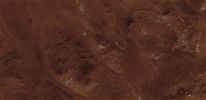
PSP_004277_1530_RED-PCF-LXTT-01.jpgFeatures of Holden Crater's Rim (CTX Frame "B" - Absolute Natural Colors; credits for the additional process. and color.: Dr Paolo C. Fienga - Lunexit Team)78 visiteHiRISE image PSP_004277_1530 covers a portion of the rim of Holden Crater, revealing breaches created when water over-topped the Rim and incised a series of Channels as it flowed down the Crater Wall.
The water responsible for the Channels was impounded outside of the rim of Holden in Uzboi Vallis (Holden Crater itself is approx. 150 Km in diameter).
Uzboi Vallis was interrupted when Holden Crater formed and the Rim formed an effective, temporary damn to flow farther to the North. Once the Uzboi Basin filled, water began flowing into Holden again, creating a series of low fan-shaped Deltas, alluvial deposits and a shallow, but relatively short-lived lake.
The Channels in this image were only active for a short time, as a Channel just to the East cut quickly into the Rim and became responsible for most of the drainage into the Crater.
The fact that most of the fan-shaped Deltas radiate from the Dominant Channel to the East rather than those in this image supports this scenario. MareKromium
(2 voti)
|
|

PSP_005011_0885-PCF-LXTT-02.jpgThe "Terra Incognita" (Saturated Natural Colors; credits for the additional process. and color.: Dr Paolo C. Fienga - Lunexit Team)170 visiteMars Local Time: 21:11 (early evening hours)
Coord. (centered): 88,4° South Lat. and 191,1° East Long.
Spacecraft altitude: 256,6 Km (such as about 160,4 miles)
Original image scale range: 25,7 cm/pixel (with 1 x 1 binning) so objects ~ 77 cm across are resolved
Map projected scale: 25 cm/pixel
Map projection: POLAR STEREOGRAPHIC
Emission Angle: 17,3°
Sun - Mars - MRO (or "Phase") Angle: 80,2°
Solar Incidence Angle: 69° (meaning that the Sun is about 21° above the Local Horizon)
Solar Longitude: 299,8° (Northern Winter)
Credits: NASA/JPL/University of Arizona
Additional process. and coloring: Lunar Explorer ItaliaMareKromium
(2 voti)
|
|
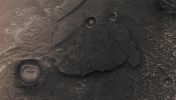
ESP_024887_2155_RED-PCF-LXTT-00.jpgFluvial "Fan" On an Unnamed Crater Floor (CTX Frame - Absolute Natural Colors; credits for the additional process. and color.: Dr Paolo C. Fienga - Lunexit Team)132 visiteMars Local Time: 14:34 (early afternoon)
Coord. (centered): 35,2° North Lat. and 304,5° East Long.
Spacecraft altitude: 296,1 Km (such as about 185,1 miles)
Original image scale range: 29,6 cm/pixel (with 1 x 1 binning) so objects ~ 89 cm across are resolved
Map projected scale: 25 cm/pixel
Map projection: EQUIRECTANGULAR
Emission Angle: 8,9°
Sun - Mars - MRO (or "Phase") Angle: 33,2°
Solar Incidence Angle: 41° (meaning that the Sun is about 49° above the Local Horizon)
Solar Longitude: 31,0° (Northern Spring)
Credits: NASA/JPL/University of Arizona
Additional process. and coloring: Lunar Explorer ItaliaMareKromium
(2 voti)
|
|

ESP_024421_1530-PCF-LXTT-01.jpgLayered Features inside Terby Crater (CTX Frame "B" - Absolute Natural Colors; credits for the additional process. and color.: Dr Paolo C. Fienga - Lunexit Team)225 visiteCoord. (centered): 27,1° South Lat. and 75,0° East Long.MareKromium
(2 voti)
|
|

ESP_024421_1530-PCF-LXTT-00.jpgLayered Features inside Terby Crater (CTX Frame "A" - Absolute Natural Colors; credits for the additional process. and color.: Dr Paolo C. Fienga - Lunexit Team)216 visiteCoord. (centered): 27,1° South Lat. and 75,0° East Long.MareKromium
(2 voti)
|
|

ESP_024886_1765_RED-PCF-LXTT-01.jpgPeri-Equatorial Layered Features (EDM - Enhanced Absolute Natural Colors; credits for the additional process. and color.: Dr Paolo C. Fienga - Lunexit Team)225 visiteCoord. (centered): 3,5° South Lat. and 335,5° East Long.MareKromium
(2 voti)
|
|
| 2235 immagini su 187 pagina(e) |
 |
|
|
|
|
124 | |
|
|
|
|





