| |

| Piú votate - Mars Reconnaissance Orbiter (MRO) |

S-PIA08816.jpgCape Verde and Cabo Frio (2)59 visiteThis image from the High Resolution Imaging Science Experiment on NASA's Mars Reconnaissance Orbiter shows the Mars Exploration Rover Opportunity near the rim of "Victoria crater." Victoria is an impact crater about 800 meters (half a mile) in diameter at Meridiani Planum near the equator of Mars. Opportunity has been operating on Mars since January, 2004. Five days before this image was taken, Opportunity arrived at the rim of Victoria crater, after a drive of more than 9 kilometers (over 5 miles). It then drove to the position where it is seen in this image.
Shown in the image are "Duck Bay," the eroded segment of the crater rim where Opportunity first arrived at the crater; "Cabo Frio," a sharp promontory to the south of Duck Bay; and "Cape Verde," another promontory to the north. When viewed at the highest resolution, this image shows the rover itself, wheel tracks in the soil behind it, and the rover's shadow, including the shadow of the camera mast. Since this image was taken, Opportunity has moved to the very tip of Cape Verde to perform more imaging of the interior of the crater.
This view is a portion of an image taken by the High Resolution Imaging Science Experiment (HiRISE) camera onboard the Mars Reconnaissance Orbiter spacecraft on Oct. 3, 2006. The complete image is centered at minus7.8 degrees latitude, 279.5 degrees East longitude. The range to the target site was 297 kilometers (185.6 miles). At this distance the image scale is 29.7 centimeters (12 inches) per pixel (with 1 x 1 binning) so objects about 89 centimeters (35 inches) across are resolved. The image shown here has been map-projected to 25 centimeters (10 inches) per pixel and north is up. The image was taken at a local Mars time of 3:30 PM and the scene is illuminated from the west with a solar incidence angle of 59.7 degrees, thus the sun was about 30.3 degrees above the horizon. At a solar longitude of 113.6 degrees, the season on Mars is northern summer.
Images from the High Resolution Imaging Science Experiment and additional information about the Mars Reconnaissance Orbiter are available online at: http://www.nasa.gov/mro or http://HiRISE.lpl.arizona.edu.

(3 voti)
|
|
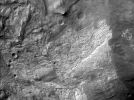
R-JusChasma-PIA08789.jpgJus Chasma58 visiteThe high resolution camera on NASA's Mars Reconnaissance Orbiter captured its first image of Mars in the mapping orbit, demonstrating the full resolution capability, on Sept. 29, 2006. The High Resolution Imaging Science Experiment (HiRISE) acquired this image at 8:16 AM (Pacific Time), and parts of the image became available to the HiRISE team at 1:30 PM. With the spacecraft at an altitude of 280 kilometers (174 miles), the image scale is 29.7 centimeters per pixel (about 12 inches per pixel).
This sub-image covers a small portion of the floor of Ius Chasma, one branch of the giant Valles Marineris system of canyons. The image illustrates a variety of processes that have shaped the Martian surface. There are bedrock exposures of layered materials, which could be sedimentary rocks deposited in water or from the air. Some of the bedrock has been faulted and folded, perhaps the result of large-scale forces in the crust or from a giant landslide. The darker unit of material at right includes many rocks. The image resolves rocks as small as small as 90 centimeters (3 feet) in diameter. At bottom right are a few dunes or ridges of windblown sand. If a person was located on this part of Mars, he or she would just barely be visible in this image.
Image TRA_000823_1720 was taken by the High Resolution Imaging Science Experiment (HiRISE) camera onboard the Mars Reconnaissance Orbiter spacecraft on September 29, 2006. Shown here is a small portion of the full image. The full image is centered at minus 7.8 degrees latitude, 279.5 degrees East longitude. The image is oriented such that north is to the top. The range to the target site was 297 kilometers (185.6 miles). At this distance the image scale is 29.7 centimeters per pixel (with one-by-one binning) so objects about 89 centimeters (35 inches) across are resolved. The image was taken at a local Mars time of 3:30 PM and the scene is illuminated from the west with a solar incidence angle of 59.7 degrees, thus the sun was about 30.3 degrees above the horizon. At an Ls of 113.6 degrees, the season on Mars is Northern Summer/Southern Winter.
(3 voti)
|
|
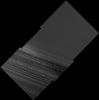
R-NorthPolarLayers-PIA08791_modest.jpgNorth Polar Layers (or "Bands")57 visiteThe HiRISE on NASA's MRO acquired this image during its first day of test imaging from the spacecraft's low-altitude mapping orbit, such as on Sept. 29, 2006.
This image of Mars' North Polar Layered Deposits was taken during the summer season (Solar Longitude of 113,6°), when CO2 frost had evaporated from the surface. The bright spots seen here are most likely patches of water frost, but the location of the frost patches does not appear to be controlled by topography. Layers are visible at the right side of the image, mostly due to difference in slope between them. The variations in slope are probably caused by differences in the physical properties of the layers. Thinner layers that have previously been observed in these deposits are visible, and may represent annual deposition of water ice and dust that is thought to form the polar layered deposits. These deposits are thought to record global climate variations on Mars, similar to ice ages on Earth. HiRISE images such as this should allow Mars' climate record to be inferred and compared with climate changes on Earth.
Image TRA_000825_2665 was taken by the High Resolution Imaging Science Experiment (HiRISE) camera onboard the Mars Reconnaissance Orbiter spacecraft on September 29, 2006. Shown here is the full image, centered at 86.5 degree latitude, 172.0 degrees east longitude. The image is oriented such that north is to the top. The range to the target site was 298.9 kilometers (186.8 miles). At this distance the image scale is 59.8 centimeters (23.5 inches) per pixel (with two-by-two binning} so objects about 1.79 meters (70 inches) across are resolved. In total the original image was 12.2 kilometers 7.58 mile; 10024 pixels) wide and 6.1 kilometers (3.79 miles; 5000 pixels) long. The image was taken at a local Mars time of 3:30 PM and the scene is illuminated from the southwest with a solar incidence angle of 63.5 degrees, thus the sun was about 26.5 degrees above the horizon.
(3 voti)
|
|

Q-U-Bosporus Planum (IR-VIS)-04.jpgBosporus Planum - detail mgnf (4)59 visitenessun commento
(3 voti)
|
|

Q-U-Bosporus Planum (IR-VIS)-03.jpgBosporus Planum - detail mgnf (3)57 visiteCaption NASA originale, riferita al full-frame:"This image was taken by HiRISE on March 24, 2006.
The image is centered at 33,65° South Latitude and 305,07° East Longitude. It is oriented such that North is 7° to the left of up.
The range to the target was 2.493 Km (about 1.549 miles) and at this distance the image scale is 2,49 mt (such as approx. 8,17 feet) per pixel, so objects as small as 7,5 mt (about 24,6 feet) are resolved. In total this image is 49,92 Km (such as about 31,02 miles) or 20.081 pixels wide and 23,66 Km (about 14,70 miles) or 9.523 pixels long. The image was taken at a MLT of 07:33 and the scene is illuminated from the upper right with a solar incidence angle of 78° (this meaning that the Sun, at the time the picture was taken, was 12° above the local horizon).
At an Ls of 29° (with Ls an indicator of Mars' position in its orbit around the Sun), the season on Mars is Southern Autumn".
(3 voti)
|
|

Q-U-Bosporus Planum (IR-VIS)-01.jpgBosporus Planum - detail mgnf (1)100 visiteCaption originale NASA, riferita al full-frame:"This is the first color image of Mars from the High Resolution Imaging Science Experiment on NASA's Mars Reconnaissance Orbiter. At the center portion of the camera's array of light detectors there are extra detectors to image in green and near-infrared color bandpasses, to be combined with the black-and-white images (from red-bandpass detectors) to create color images.
This is not natural color as seen by human eyes, but infrared color - shifted to longer wavelengths. This image also has been processed to enhance subtle color variations. The southern half of the scene is brighter and bluer than the northern half, perhaps due to early-morning fog in the atmosphere".
(3 voti)
|
|
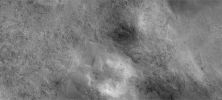
Q-S-HalleyCrater-PIA08048_modest-1.jpgIn the vicinities of Halley Crater (1)58 visiteThis image shows a landscape West of Mars' Argyre impact basin and North-East of Halley Crater. The large but faint circular feature near the center of the image is an unnamed impact crater about 7,5 Km (about 4,7 miles) in diameter. It has been all but erased by geological (and probably ice-related) processes. In fact, the majority of impact craters in this image have been modified from their original shapes, some undoubtedly beyond recognition. Only a few small craters remain pristine. The most prevalent surface type in this image is rough, dissected terrain, which is characterized by a complex pattern of knobs, pits, ridges and valleys. In places the rough terrain has been covered by a younger material that appears flat, smooth and nearly featureless. The smooth material may have been emplaced as muddy or icy debris. It filled low-lying areas (most notably craters) and surrounded higher features, preserving islands of rough terrain. Wind-formed dunes have formed atop some of the smooth material and diagonal streaks on the right side of the image may be due to the winds. Images such as this show the importance of water (liquid and/or ice), wind, and impacts in shaping the surface of Mars.
(3 voti)
|
|

Q-T-TerraCimmeria-PIA08052_modest.jpgTerra Cimmeria55 visiteThis scene in a Region of Mars named Terra Cimmeria shows a variety of ancient and recent geologic processes. In the upper portion of the image, a twisting ridge of raised ground may outline the location of a subsurface thrust fault. This type of fault results in the compression and crumpling of a Planet's surface. This crumpling of the Planet's surface has squeezed two originally circular craters on the ridge into oval-shaped craters. Valleys are also present throughout the image, suggesting that water flowed across this area a long time ago. Many valleys and craters in the image are now filled by deposits of dust or debris. This debris mantle is common over the middle latitudes of Mars and is a geologically recent deposit.
This image was taken by the High Resolution Imaging Science Experiment (HiRISE) camera onboard NASA's Mars Reconnaissance Orbiter spacecraft on March 25, 2006. The image is centered at 40,64° South latitude, 144,39° East Longitude. It is oriented such that North is 7° to the left of up. The range to the target was 2.038 Km (1.266 miles). At this distance the image scale is 2,04 meters (6,69 feet) per pixel, so objects as small as 6,1 mt (20 feet) are resolved. In total this image is 12,34 Km (such as about 7,67 miles) or 6.045 pixels wide and 34,68 Km (such as about 21,55 miles) or 17.003 pixels long. The image was taken at a Local Mars Time of 07:28 and the scene is illuminated from the upper right with a solar incidence angle of 82,0° (this meaning that the Sun was about 8,0° above the horizon).
(3 voti)
|
|

Q-T-ArgyrePlanitia-PIA08049_modest.jpgArgyre Basin, in the morning twilights...58 visiteThis image shows part of a low mountain belt that rings the Argyre Impact Basin in Mars' Southern Hemisphere. The mountains or hills seen here are located in the northwestern part of the Charitum Montes. Taken just minutes after the Sun had risen over the horizon, only the sun-facing slopes are well illuminated and much of the scene is in shadow, but the camera has nevertheless captured many details of the surface that are only dimly illuminated. There are terrains that are both smooth and rough at this scale (2,94 mt - or 9,65 feet per pixel). The rough terrain is littered with blocks roughly 10 mt (30 feet) across and the smooth material has a uniform appearance broken by subtle, undulating ridges. The rough terrains usually occur at relatively high elevations and smooth material occupies the lowest areas. In some locations it is evident that boulders from the rough terrain have tumbled downhill onto the smooth material. The smooth material is younger than the rough terrain, and some of it may have formed when water-rich or ice-rich debris flooded low-lying areas. In other areas the smooth material mantles the topography like deposits of airborne dust. Further upslope, the mountain flanks have a variety of rough textures. In places the terrain has been eroded into streamlined forms and striations, suggestive of glacial erosion. Gullies formed in one spot near bottom center. Perhaps the most striking aspect of this image is the dearth of fresh impact craters. The Argyre basin is thought to be billions of years old, but much more recent processes have greatly modified the surface.
This image was taken by the High Resolution Imaging Science Experiment (HiRISE) camera onboard NASA's Mars Reconnaissance Orbiter spacecraft on March 24, 2006. The image is centered at 52.20 degrees south latitude, 300.75 degrees east longitude. It is oriented such that north is 7 degrees to the left of up. The range to the target was 1,470 kilometers (913 miles). With 2x2 pixel binning, the scale of the image is 2.94 meters (9.65 feet) per pixel, so objects as small as 8.82 meters (28.94 feet) are resolved. In total this image is 29.47 kilometers (18.31 miles) or 10,040 pixels wide and 76.44 kilometers (47.50 miles) or 26,011 pixels long. The image was taken at a local Mars time of 07:24 and the scene is illuminated from the upper right with a solar incidence angle of 87.1 degrees, thus the sun was about 2.9 degrees above the horizon. At an Ls of 29 degrees (with Ls an indicator of Mars' position in its orbit around the sun), the season on Mars is southern autumn.
(3 voti)
|
|

Q-pia08014-04-AEB1-full-reduced1.jpgMartian Southern Highlands (4) - HR71 visitenessun commento
(3 voti)
|
|

Q-pia08014-03-AEB1-full-reduced1.jpgMartian Southern Highlands (3) - HR59 visitenessun commento
(3 voti)
|
|

PIA08013_modest.jpgThe "First Frame" from MRO102 visiteThis view shows a full-resolution portion of the first image of Mars taken by the High Resolution Imaging Science Experiment camera (HiRISE) on NASA's Mars Reconnaissance Orbiter. The spacecraft, launched Aug. 12, 2005, began orbiting Mars on March 10, 2006. The image is of an area in Mars' mid-latitude Southern Highlands.
HiRISE took this first test image from orbit on March 24, 2006, from an altitude of 2.489 Km (about 1.547 miles), achieving a resolution of 2,49 mt (98" - inches) per pixel, or picture element. The smallest objects of discernable shape are about 3 pixels across. An image acquired at this latitude during the Mars Reconnaissance Orbiter's main science phase, beginning in fall 2006, would be taken from an altitude of about 280 Km (approx. 174 miles) and have a resolution of 28 cm (11") per pixel.
This view covers an area about 4,5 by 2,1 Km (about 1,6 by 1,3 miles).
The quality of this test image is spectacular, with no hint to the eye of any smear or blurring. A high signal-to-noise ratio reveals fine details even in the shadows.
(3 voti)
|
|
| 2235 immagini su 187 pagina(e) |
|
|
|
|
|
123 | |
|
|
|
|
|
|





