| Piú votate - Mars Reconnaissance Orbiter (MRO) |
PSP_004847_1745_RED_browse-00.jpgThe "Martian Black Hole"...Again! (context frame)58 visiteVi invitiamo a leggere l'ultimo articolo sull'argomento (pubblicato su TruePlanets) dal titolo "Velvet Underground".MareKromium
(3 voti)
|
|

PSP_003252_1425_RED_browse-01.jpgBright Gully Deposit in Terra Sirenum (the "crater" - close-up; false colors)62 visiteAs seen in the context image and here, the appearance of the crater wall differs between the Northern and Southern Sides. On the Northern Pole-Facing Side Walls, prominent gullies with channels and aprons are apparent, with many of these having valley-like alcoves near their tops. The morphology of the gullies is consistent with formation by a fluid, most likely water.
On the pole-facing slopes, ground ice or aquifers may be more stable, being subjected to less heating from sunlight compared to equator-facing slopes.
In contrast, the Southern, Equator-Facing Walls are dominated by rocky debris flows that lack prominent channels.MareKromium
(3 voti)
|
|
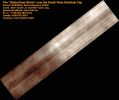
PSP_004353_0935_RED_browse.jpgThe "Global Dust Storm" over the South Polar Residual Cap59 visiteA dust storm has been raging on Mars, hampering the ability of the HiRISE team to carry out a seasonal monitoring campaign.
An area of the Southern Seasonal Polar Cap was selected in December 2006 for repeated imaging, to observe the sublimation (evaporation) of the seasonal Carbon Dioxide Polar Cap through Southern Spring.
Images collected as the season progressed show channels carved by escaping gas and fans of dust blown by the wind. This campaign has been stymied however by the arrival of a Martian dust storm. In this image the surface is completely obscured by the dust in the air.MareKromium
(3 voti)
|
|
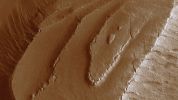
PSP_003442_1215_RED_browse-01.jpgLayers in Spallanzani Crater (extra-detail mgnf)103 visiteThe layers within Spallanzani Crater are eroding in a stair-stepped pattern.
Each layer appears as a sequence of a broad flat area or plateau, which drops off abruptly down to the next flat surface (see this extra-detail mgnf).
This stair-stepped pattern suggests that the layers have discreet boundaries that may be the result of differing compositions, time of deposition, or both. Near, but not at the edge of each plateau, the material is fracturing into polygonal plates or blocks that tilt downward away from the plateau center. MareKromium
(3 voti)
|
|
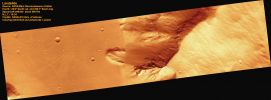
PSP_003516_1540_RED_browse.jpgLarge (and VERY Old) Landslide Deposit59 visiteThis HiRISE image is centered on a large landslide which formed the large lobe at the base of the steep slope. This is material which was transported in a massive rock-slide.
The landslide has several ridge-and-trough lineations in the direction of the flow. These occur in similar landslides on Earth as well. Comparing these features on Mars with similar examples on Earth helps geologists better understand how they work on both Planets.
In this case, the slide is relatively old.
The material has many impact craters superimposed. The steep slope, which was the source of the landslide, has undergone further erosion, so the landslide source area is no longer clear. MareKromium
(3 voti)
|
|
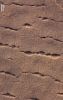
PSP_002202_2250_RED_browse-01.jpgPits, Cracks, and Polygons in Western Utopia Planitia (extra-detail mgnf) - elab. NASA57 visitenessun commentoMareKromium
(3 voti)
|
|
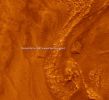
Psp_002098_2220_red-01.jpgMantles and Flows in Moreux Crater, with a "small" Surface Anomaly (EDM - False Colors)59 visiteSegnalataci dal Dr Barca (ottimo "occhio"!), la possibile Anomalìa di Superficie si sostanzia in una traccia di colore scuro che ci appare incongrua, nella sua direzione, rispetto alle altre fratture (anche modeste) della superficie ripresa, rispetto alla generale direzione assunta da dune e ripples e rispetto a tutte le altrei stratificazioni visibili.
Di che si tratta? Potrebbe essere un image-artifact (la definizione del frame, sebbene eccellente, non è tale da consentirci di escludere l'ipotesi del vizio fotografico), così come potrebbe trattarsi di una recente frattura del suolo (magari di origine sismica) o anche di uno "scalino" roccioso (un layer sedimentario parzialmente esumato).
Certo, se fossimo degli Eso-Archeologi illuminati ed immaginifici, ci saremmo già diretti verso l'ipotesi (decidete Voi se è "esotica" o meno) della "possibile evidenza di una struttura superficiale artificiale".
Ma noi non siamo Eso-Archeologi.
E, purtroppo, non siamo neppure illuminati ed immaginifici, però...però, se proprio dovessimo "azzardare"...diremmo che il rilievo scuro, in questo frame, potrebbe anche essere un'ombra. Di che cosa? Beh, questo "azzardatelo" Voi!...
(3 voti)
|
|

PSP_001948_1425_red.jpgGorgonum Chaos (Original NASA/JPL/University of Arizona b/w Frame)58 visitePSP_001948_1425 shows part of Gorgonum Chaos, a large cluster of chaotic terrain found in the Southern Hemisphere.
Many regions of chaotic terrain are found at the head of large outflow channels that were scoured by ancient floods. Gorgonum Chaos is one region that is not associated with an outflow channel. Chaotic terrain can form when subsurface volatiles (such as water) are catastrophically released and the overlying surface collapses. It is not known whether isolated chaotic terrain — such as that shown in this image — formed in the same way that the chaotic terrain near the outflow channels did. Wind erosion might play a role in their formation.
Gorgonum Chaos is an especially interesting area because gullies thought to have been eroded by liquid water are located on its mesas. The gullies have a wide range of orientations and many appear to emanate from a distinct layer in the mesas.
It is not known why gullies form on one slope rather than another, but insolation (amount of sunlight received), availability of water, and regional slope are possible contributing factors.
(3 voti)
|
|

Psp_001691_1320_red.jpgGullied Trough in Noachis Terra(False Colors)58 visitePSP_001691_1320 shows gullies in a semi-circular trough in Noachis Terra. The gullies are observed to face all directions.
It is interesting to note that the gully morphology seen here depends on the orientation of the gullies. The morphology differences are most pronounced on the sunlit slope, with the gullies facing South (Dx) being more deeply incised than those facing the West. It is unknown what caused the different gully morphologies, but there are several possibilities.
Gullies are proposed to form at locations determined by the availability of a forming liquid (thought to be water) and/or the amount of insolation the slope receives, among other factors. It is possible that the deeper gullies experienced more erosional events or that their erosional events were more effective for undetermined reasons. It is also possible that the gullies formed at different times such that they did not have the same amount of water — either for an individual flow or total — available to them.
Also, the underlying topography could make the gullies appear relatively more incised without this actually being the case.
(3 voti)
|
|

Terra_Sirenum-PIA09101.jpgSeasonal frost in Terra Sirenum (according to NASA)62 visiteCaption NASA originale:"This image of the Terra Sirenum Region of Mars was taken by the Compact Reconnaissance Imaging Spectrometer for Mars (CRISM) at 09:18 UTC (4:18 a.m. EST) on Nov. 25, 2006, near 38,9° South Lat. and 195,9° East Long. CRISM's image was taken in 544 colors covering 0,36-3,92 micrometers and shows features as small as 18 mt (60 feet) across.
At this time, Mars' Southern Hemisphere was experiencing mid-Winter. During Martian Southern Winter, the Southern Polar Cap is covered and surrounded by CO2 frost and water frost. This is unlike Earth, whose frozen Winter precipitation is made up of only one volatile -- water. The CO2 frost evaporates, or sublimates, at a lower temperature than water frost. So, during Spring, the CO2 ice evaporates first and leaves a residue of water frost, which later sublimates as well.
The image shown here covers part of a crater rim, which is illuminated from the upper left. North is at the top.
The topography creates a cold microenvironment on the South side of the rim that is partially protected from solar illumination. That cold surface contains an outlier of the southern seasonal frost about 15° of Lat. closer to the Equator than the average edge of the frost at this season.
The top image was constructed from 3 infrared wavelengths that highlight the bluer color of frost than the background rock and soil. Note that the frost occurs both on sunlit and shaded surfaces on the south side of the rim. The shaded areas are still visible because they are illuminated indirectly by the Martian Sky.
The bottom image was constructed by measuring the depths of spectral absorption bands due to water frost and CO2 frost and displaying the results in image form. Blue shows strength of an absorption due to water frost near 1,50 mmts and green shows strength of an absorption due to CO2 frost near 1,45 mmts. Red shows brightness of the surface at 1,33 micrometers -- outside of the frost absorption bands -- in order to show the relationship of frost to the illuminated crater rim.
In comparing the top and bottom images, note that water frost occurs in many locations on the south-facing side of the crater rim, both in sunlit and shaded areas. Because it faces away from the Sun, this side of the crater rim is colder than the north, Sun-facing side.
This favors the formation of frost. In contrast, CO2 frost occurs only in the coldest, most shaded areas".MareKromium
(3 voti)
|
|

Craters-Holden_Crater-03.jpgThe beautiful "Holden Crater" (3)59 visitenessun commentoMareKromium
(3 voti)
|
|
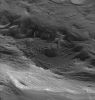
Juventae_Chasma_12m-01.jpgFeatures of Juventae Chasma (2)57 visiteCaption NASA originale:"Among the more interesting aspects of this image are the dunes of sand that appear to be migrating over the top of the mound, and a flat-surfaced, plateau/mesa forming unit covering the North-East side of the mound but also seen within valleys to the North and along the Southern margin of the mound. This unit may be the marker of an ancient erosional surface. In this image, North is towards the top and the Sun is coming from the left".
(3 voti)
|
|
| 2235 immagini su 187 pagina(e) |
 |
|
|
|
|
121 | |
|
|
|
|





