| Piú votate - Mars Reconnaissance Orbiter (MRO) |
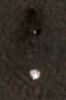
PSP_008591_2485_cut_c.jpgBack-Shell and Parachute (MULTISPECTRUM; credits: Lunexit)66 visitenessun commentoMareKromium
(3 voti)
|
|

PSP_008591_2485_cut_e.jpgPhoenix Lander "Hardware" (Day-Time Frame; MULTISPECTRUM process.)56 visitenessun commentoMareKromium
(3 voti)
|
|
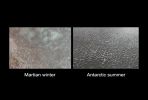
Polygons-PIA10658.jpgMartian and Earthly Polygons (comparison)63 visiteSome High-Latitude Areas on Mars (left) and Earth (right) exhibit similarly patterned ground where shallow fracturing has drawn Polygons on the surface. This patterning may result from cycles of freezing and thawing (---> disgelo).
The left image shows ground within the targeted landing area NASA's Phoenix Mars Lander before the Winter frost had entirely disappeared from the Surface. The bright ice in shallow crevices accentuates the area's polygonal fracturing pattern. The polygons are a few meters (several feet) across.
The image is a small portion of an exposure taken in March 2008 by the High Resolution Imaging Science Experiment (HiRISE) camera on NASA's Mars Reconnaissance Orbiter.
The image on the right is an aerial view of similarly patterned ground in Antarctica.MareKromium
(3 voti)
|
|

Weather-PIA10672.gifClear Skies over the Northern Regions (GIF-Movie; credits: NASA)61 visiteScientists are anticipating clear skies when NASA's Phoenix Mars Lander arrives on the north polar plains of the Red Planet Sunday, May 25, 2008.
This orbital view of the north polar region of Mars, where NASA's Phoenix Mars Lander will land, shows clear skies as of May 22, 2008. Mission planners are always on the lookout for dust storms in daily weather updates like this one, provided by the Mars Color Imager on NASA's Mars Reconnaissance Orbiter. Based on current conditions, they are predicting good weather when Phoenix arrives May 25, 2008.
Temperature profiles, used to calculate atmospheric density, are also updated on a regular basis, provided by the Mars Climate Sounder, another instrument on the Mars Reconnaissance Orbiter. Atmospheric density was well within expectations as of May 22, 2008. Mission planners will continue to receive updates on weather and atmospheric conditions prior to landing.
The animated orbital view shows recent weather conditions from May 16 to May 22, 2008, as tracked by the Mars Color Imager on NASA's Mars Reconnaissance Orbiter. A cloud of dust kicked up by Martian winds traveled from west to east between May 19 and May 22, 2008, passing over Phoenix's landing site. The dust cloud was about 500 kilometers (300 miles) from head to tail and made the skies somewhat hazy. Since then, the dust has been replaced by clear skies, indicating that Phoenix will not land in any dust clouds, which are a common occurrence in the northern latitudes of Mars.
MareKromium
(3 voti)
|
|
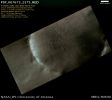
PSP_007673_2575_RED_abrowse.jpgFrosted North Polar Crater (MULTISPECTRUM; credits: Lunexit)59 visiteThis image was taken over the North Polar Region of Mars, just South of the Layered Ice Cap.
The image shows a 10 Km diameter impact crater during Northern Spring, still covered by Carbon Dioxide ice/frost, and perhaps some water ice/frost.
There are color variations due to the presence of reddish dust mixed with the ice/frost in different proportions, and the dark and relatively blue spots form when CO2 is released in small jets from beneath the ice.
There are no clear examples of small impact craters superimposed on the large crater, although there are many shallow depressions that might be degraded craters.
This seems puzzling because small (approx. 10 meters in diameter) craters form much more frequently than 10 Km craters.
In fact, they form about a billion times more frequently! The reason why there aren’t any sharp small craters is due to the fact that the ice destroys them, and does so rapidly, compared with the cratering rate.
Ice on Mars does not melt in the current climate, but it does expand and contract with temperature variations and it can flow.MareKromium
(3 voti)
|
|
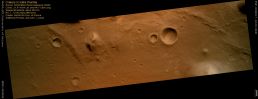
PSP_008017_2020_RED_abrowse.jpgCraters in Isidis Planitia (MULTISPECTRUM; credits: Lunexit)72 visiteThis image shows a young impact crater in the Northern part of Isidis Planitia. The crater is fresh enough to preserve some fine textures that are eroded around other craters.
The ejecta blanket of material thrown out of the crater is distinctly dark and rough, with many small boulders and rugged texture. To the South of the crater there is a wedge-shaped area with little ejected material. This may indicate that the impactor which formed this crater came from the south, since at moderate impact angles ejecta is preferentially thrown in the direction of motion of the impactor.
Eventually, a combination of erosion and mantling by dust will smooth and obscure the ejecta and cover over the crater, turning it into a shallow depression like the others in this image. Reworking of the crater is already beginning, as shown by the network of fine ridges (wind-blown ripples) on the crater floor.MareKromium
(3 voti)
|
|

PSP_007925_1990_RED_abrowse-01.jpgChannels in Jezero Crater Delta (extra-detail mgnf - MULTISPECTRUM; credits: Lunexit)66 visiteThis extra-detail mgnf shows a section of one channel in greater detail. Wind-blown dunes or ripples now cover much of the channel floor, but in some places the older channel floor is visible. Here, the channel bed has a layered appearance. The plains outside the channel are fractured into polygonal patterns.
The CRISM instrument has detected water-bearing clay minerals in these plains, which were eroded by flows down the channel.
Clays are also seen in the sediments deposited on the floor of Jezero Crater.MareKromium
(3 voti)
|
|

PSP_001750_1425.jpgSouthern Crater (side-view; credits: Dr M. Faccin)107 visitenessun commentoMareKromium
(3 voti)
|
|
SHARAD-1.gifUnder the Ice... (1)57 visiteRadar Sounder Instruments orbiting Mars have looked beneath the Martian Surface and opened up the Third Dimension for Planetary Exploration.
The technique's success is prompting scientists to think of all the other places in the Solar System where they would like to use Radar Sounders.
The first Radar Sounder at Mars was the Mars Advanced Radar for Subsurface and Ionospheric Sounding (MARSIS) on the European Space Agency's Mars Express Orbiter. It has been joined by the complementary Shallow Subsurface Radar (SHARAD), operating at a different wavelength aboard NASA's Mars Reconnaissance Orbiter.
The data in this animation are from SHARAD.MareKromium
(3 voti)
|
|
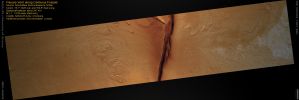
PSP_006999_1965_RED_abrowse.jpgFissure-Vent along Cerberus Fossae (MULTISPECTRUM; credits: Lunexit)62 visitenessun commentoMareKromium
(3 voti)
|
|
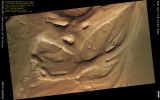
PSP_007738_2145_RED_abrowse.jpgStreamlined Islands in Hrad Vallis (possible natural colors; credits: Lunexit)60 visiteThis image shows a portion of Hrad Vallis, an approx. 400 mt (1300 feet) deep and about 800 Km (approx. 500 mile) long depression located in the Elysium Planitia.
Hrad Vallis is one of several channel systems that are found just West of the Elysium volcanoes. The scoured floor of Hrad Vallis shows the effects of erosion, presumably by water.
Flowing water in the past has carved and sculpted rocky masses into streamlined shapes or islands. The streamlined islands often have sharp edges and are narrower at the downstream end and wider at the upstream end. The streamlined islands visible here are located in an area where the flow condensed from the fractured terrain of the Hrad Valles headwaters (to the South-East) to a more regular channel (to the North-West).MareKromium
(3 voti)
|
|

PSP_006673_1600_RED_abrowse.jpgBright Material on the Floor of an Unnamed Crater (natural colors; credits: Lunexit)60 visiteThis image shows part of a crater wall and floor, where the floor is covered by dunes and distinct regions of bright material. The bright material stands higher than the rest of the floor suggesting that it is more resistant to erosion than surrounding materials.
It is possible that more and more bright material will be exposed over time; why the material is bright is unknown.
The material might be evaporites, that form when salt water dries up and leaves behind salt deposits (the evaporites).
Also in this scene is a crater with a ridge running up to its west (left) side. The ridge is lighter and might be evidence that water flowed through it, bleaching the rocks as it went. The water might have cemented the soil, causing it to be more resistant to erosion and high standing as seen today.MareKromium
(3 voti)
|
|
| 2235 immagini su 187 pagina(e) |
 |
|
|
|
|
119 | |
|
|
|
|





