| Piú votate - Mars Reconnaissance Orbiter (MRO) |
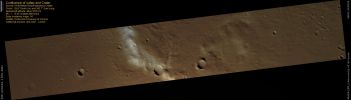
Psp_009669_1500_red.jpgConfluence of Valley and Crater (natural colors; credits: Lunexit)60 visiteThis image shows the South-Eastern Rim of a large degraded Impact Crater where a Valley breaches the Crater Rim. The Valley itself, no longer pristine, is difficult to locate in the image.
However, it appears to be in the center, near the right of the Crater Rim. It is possible that this Valley transported water into the Crater, forming a lake in the ancient past.
The scene is peppered with craters of various sizes and states of degradation, indicating that the surface is not young.
A few craters are young enough to still have raised rims. One of these, located on the floor of the larger crater, has distinct raised ejecta radiating out from it.
The crater also has dunes on its floor, indicating that aeolian processes have modified it since it formed.MareKromium
(3 voti)
|
|

Psp_009799_2205_red.jpgFeatures of Deuteronilus Mensae (natural colors; credits: Lunexit)75 visiteThis image shows Lineated Valley Fill and Lobate Debris Aprons in the Deuteronilus Mensae Region. Deuteronilus Mensae is located on the northern edge of Arabia Terra and borders the high-standing, heavily-cratered Southern Hemisphere and the low, uncratered plains that cover most of the Northern Hemisphere of Mars.
The Region is characterized by Hills and Mesas surrounded by debris Slopes and broad Valleys.
Many of the valley floors in the Deuteronilus Mensae Region exhibit complex alignments of small Ridges and Pits often called “Lineated Valley Fill”.
The cause of the small-scale texture is not well understood, but may result from patterns in ice-rich soils or ice loss due to sublimation (ice changing into water vapor).
The linear alignment may be caused by downhill movement of ice-rich soil or by glacial flow.
For example, flowing ice on Earth typically develops wrinkles or ridges and pits due to stresses in the ice as it moves.
The result is flow patterns, called “stream lines” that follow the valleys and curve around obstacles. In this image, stream lines are diverted or curve around the Mesas.
The mesas in this image are also surrounded by aprons of debris that appear to have flowed away from the Mesa. Recent results from the SHAllow RADar (SHARAD) instrument, another instrument onboard the Mars Reconnaissance Orbiter, indicate that lobate debris aprons in Deuteronilus Mensae, similar to those visible here, are composed of material dominated by ice [Plaut et al., 2008] and are interpreted to be potential debris-covered glaciers or rock glaciers.
The Debris Aprons in this image appear to lie on top of the Lineated Valley Fill and are therefore probably younger deposits.MareKromium
(3 voti)
|
|
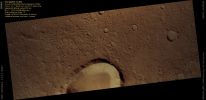
Psp_009665_1525_red.jpgElongated Crater (natural colors; credits: Lunexit)64 visiteThis scene captures about half of a crater with an elongated rim.
When craters form, they typically have a circular shape. This crater has been modified since it formed, possibly by tectonic processes or excavation, although its raised rim indicates that these processes have not heavily eroded the rim since formation.
The terrain surrounding the crater consists of megaripples, degraded craters, and rough terrain, possibly due to ancient lava flows from the nearby Hadriaca Patera.
Determining the age of these features and the processes that formed them may be possible; one such process is the interaction between the ripples and bedrock. The Transverse Aeolian Ripples (or "TARs") with a N-S wind direction appear to be lithified because the rugged bedrock, impact craters, and ejecta overlay the ripples, indicating that the ripples are older.
In the larger craters, brighter (possibly newer) ripples suggest a dominant wind direction from the North-West.MareKromium
(3 voti)
|
|

PIA11230.jpgDust Storm in the North Polar Regions58 visiteCaption NASA:"This is an image of Mars taken from orbit by the Mars Reconnaissance Orbiter's Mars Color Imager (MARCI). The Red Planet's Polar Ice-Cap is in the middle of the image. Captured in this image is a 37.000 square-kilometer (almost 23.000 miles) Dust Storm that moved counter-clockwise through the Phoenix Landing Site on Oct 11, 2008, or Sol 135 of the Mission.
Viewing this image as if it were the face of a clock, Phoenix is shown as a small white dot, located at about 10 AM. The storm, which had already passed over the Landing Site earlier in the day, is located at about 9:30 AM".MareKromium
(3 voti)
|
|

Spirit-OrbitalView-20081009-MRO.jpgGusev Crater and Spirit: Aerial View58 visiteCaption NASA:"Clear skies and low-angle sunlight are an outdoor photographer's dream. On the shortest day of Martian winter, June 24, 2008, Spirit had both. Conditions were ideal for an orbiter's shot of the Mars Rover parked on the sunlit slope of a volcanic plateau.
Shadows outlined shapes in the landscape, such as the upturned edges of the bowl-shaped plateau known as "Home Plate". Shadows also reveal nearby ridges, slopes, and large boulders. Spirit is the dark "bump", marked by a yellow arrow.
Detailed images such as this one will help scientists select a future path for Spirit. For plotting a path on Mars, a powerful orbiting camera, long shadows, and a clear sky are about as good as it gets".MareKromium
(3 voti)
|
|
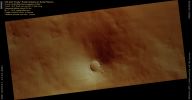
PSP_009527_1670_RED.JPGOld and "Dusty" Volcano in Syria Planum (natural colors; credits: Lunexit)59 visiteThis image shows an old volcano in Syria PlanumRegion, near the edge of the Tharsis volcanic rise. This is a Region where extensive volcanism has occurred; in many places, the upper walls of Valles Marineris have cut through lava flows.
The basic shape of the old volcano is visible here, but the entire region has been coated by dust.
This makes it difficult to learn more about the volcanic processes that have occurred at this site. However, the mantle is interesting by itself. It has probably settled out of the atmosphere, either as dust or possibly volcanic ash, since it seems to coat the entire region uniformly. (Mars has frequent, massive Dust Storms which could create large deposits over time.) This mantle has a regular, scalloped texture that is visible at several scales.
The texture is not well understood; it is common in volcanic terrains, but also occurs on some other rock outcrops.
HiRISE scientists are studying images like this one to determine how it forms.MareKromium
(3 voti)
|
|
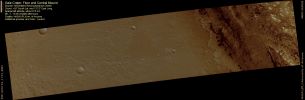
Psp_009716_1755_red.jpgSurface Features inside Gale Crater (natural colors; credits: Lunexit)58 visitenessun commentoMareKromium
(3 voti)
|
|
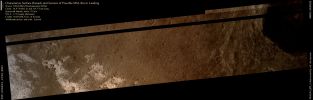
Psp_008891_2050_red.jpgCharacterize Surface Hazards and Science of Possible MSL Rover Landing - Mawrth Vallis (natural colors; credits: Lunexit)57 visitenessun commentoMareKromium
(3 voti)
|
|
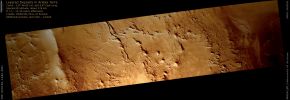
PSP_009180_1840_RED.jpgLayered Deposits within Unnamed Crater in Arabia Terra (natural colors; credits: Lunexit)59 visiteArabia Terra is an area of Mars that has an abundance of Layered Deposits within Impact Craters.
The Region of Arabia has plateau material that is thought to be part of the ancient highland crust that is Noachian in age according to Martian timescale. Thus, the layered deposits may represent some of the earliest eroded and infilled materials on Mars.
In this Unnamed Crater, we see layering exposed along the margins of a scarp-like bench.
The layering is of particular interest because on Earth, they may represent multiple sequences of deposited material or some geologic process (subaerial or subaqueous) that has modified and/or deposited material on the surface in some constant fashion.
If the layered sequences are consistently the same, we can infer that the conditions of their deposition were the same for some period of time. If the layers changed in some way (e.g., thickens and thins), then we can infer that some condition(s) caused this to happen.
From these observations and analyses, scientists can attempt to quantify and reconstruct what the ancient conditions were like in this Region of Mars.MareKromium
(3 voti)
|
|
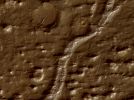
PSP_009318_1465_RED-01.jpgChloride Salt Deposits within a Channel in Terra Sirenum (edm - natural colors; credits: Lunexit)70 visitenessun commentoMareKromium
(3 voti)
|
|
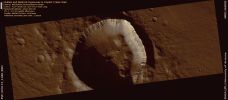
PSP_009155_1480_RED.jpgGullies and Bedrock Exposures in Impact Crater Wall (natural colors; credits: Lunexit)59 visiteThis image shows a rather pristine crater with Gullies and Bedrock Exposures. The Gullies are mostly on the South-Facing (such as the Poleward facing) wall. Some of the gully channels are very sharp, indicating that they have not been modified much since they formed.
Other channels criss-cross each other, demonstrating that there were multiple periods of activity. Scientists do not know how closely these were spaced in time.
The South and East walls of the Crater (upper right of the frame) have very distinct bright layers. These layers are possibly Ancient Bedrock. These walls also have what appear to be bright Landslides.MareKromium
(3 voti)
|
|
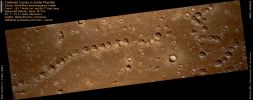
PSP_009177_1985_RED.jpgCratered Cones in Isidis Planitia (natural colors; credits: Lunexit)57 visiteThis image shows part of a broad field of cratered cones in the Isidis Planitia region of Mars. The cones occur over a wide area and are commonly aligned in chains, like those here.
The cratered-cone morphology suggests formation by eruption of some material. The cones resemble small volcanoes on Earth called cinder cones, and are approximately the same size. Another possibility is that these are mud volcanoes, formed by eruption of wet, pressurized mud. This has been suggested as an important process in some parts of Mars. The aligned chains probably indicate sites of weakness, perhaps faults, where lava or mud could preferentially rise.
The scene is relatively bland in color, but this could be due to a thin coating of dust veiling color differences. The cones are clearly not very young or pristine; they have a battered, pitted appearance. However, they have not been heavily eroded, as features like the cone rims are still sharp in most cases. This state is typical of the cones in Isidis region.
MareKromium
(3 voti)
|
|
| 2235 immagini su 187 pagina(e) |
 |
|
|
|
|
117 | |
|
|
|
|





