| Piú votate - Mars Reconnaissance Orbiter (MRO) |

PSP_009311_1735_RED.jpgPeri-Equatorial Surface Features (possible True Colors; credits: Lunar Explorer Italia)71 visiteMars Local Time: 15:27 (early afternoon)
Coord. (centered): 6,5° South Lat. and 33,9° East Long.
Spacecraft altitude: 264,3 Km (such as about 165,2 miles)
Original image scale range: 26,4 cm/pixel (with 1 x 1 binning) so objects ~52,9 cm across are resolved
Map projected scale: 25 cm/pixel
Map projection: EQUIRECTANGULAR
Emission Angle: 3,0°
Phase Angle: 57,1°
Solar Incidence Angle: 59° (meaning that the Sun is about 31° above the Local Horizon)
Solar Longitude: 101,9° (Northern Summer)
Credits: NASA/JPL/University of Arizona
Additional process. and coloring: Lunar Explorer ItaliaMareKromium
(3 voti)
|
|
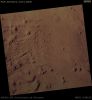
PSP_009304_2015_RED.jpgRidges in Olympus Mons Aureole (possible True Colors; credits: Lunar Explorer Italia)56 visiteMars Local Time: 15:21 (early afternoon)
Coord. (centered): 21,4° North Lat. and 221,3° East Long.
Spacecraft altitude: 283,8 Km (such as about 177,4 miles)
Original image scale range: 28,4 cm/pixel (with 1 x 1 binning) so objects ~85 cm across are resolved
Map projected scale: 25 cm/pixel
Map projection: EQUIRECTANGULAR
Emission Angle: 0,2°
Phase Angle: 46,1°
Solar Incidence Angle: 46° (meaning that the Sun is about 44° above the Local Horizon)
Solar Longitude: 101,7° (Northern Summer)
Credits: NASA/JPL/University of Arizona
Additional process. and coloring: Lunar Explorer ItaliaMareKromium
(3 voti)
|
|
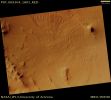
PSP_009304_1805_RED.jpgEquatorial Rocky Terrain (possible True Colors; credits: Lunar Explorer Italia)59 visiteMars Local Time: 15:25 (early afternoon)
Coord. (centered): 0,6° North Lat. and 223,9° East Long.
Spacecraft altitude: 269,2 Km (such as about 168,2 miles)
Original image scale range: 53,9 cm/pixel (with 1 x 1 binning) so objects ~1,62 mt across are resolved
Map projected scale: 50 cm/pixel
Map projection: EQUIRECTANGULAR
Emission Angle: 0,0°
Phase Angle: 55,1°
Solar Incidence Angle: 55° (meaning that the Sun is about 35° above the Local Horizon)
Solar Longitude: 101,7° (Northern Summer)
Credits: NASA/JPL/University of Arizona
Additional process. and coloring: Lunar Explorer ItaliaMareKromium
(3 voti)
|
|

Psp_001860_1685_red.jpgLight-colored terrain in the Southern Highlands (possible True Colors; credits: Lunar Explorer Italia)58 visiteThis HiRISE image shows part of the floor of a large impact crater in the southern highlands, north of the giant Hellas impact basin. Most of the crater floor is dark, with abundant small ripples of wind-blown material. However, a pit in the floor of the crater has exposed light-toned, fractured rock.
The light-toned material appears fractured at several different scales. These fractures are called joints, and result from stresses on the rock after its formation.
Joints are similar to faults, but have undergone virtually no displacement. With careful analysis, joints can provide insight into the forces that have affected a unit of rock, and thus into its geologic history. The fractures appear dark; this may be due to trapping of dark, wind-blown sand in the crack, to precipitation of different minerals along the fracture, or both.MareKromium
(3 voti)
|
|
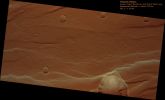
Psp_001840_2000_red.jpgTharsis' Plains (natural colors; credits: Lunar Explorer Italia)58 visiteThis HiRISE image samples the plains between the large shelf volcanoes in the Tharsis Region of Mars.
The long scarps in the area have been formed by faults as the ground was pulled apart. The large circular depression on the edge of the image is a giant collapse pit that appears to be related to the opening up of crust.
If you look at this image carefully, much of the plains appears blurry, as if the picture was out of focus. But HiRISE remains in perfect focus and it is Mars that is actually this blurry. Soft wind-blown dust mutes all the features in the area to create this effect.MareKromium
(3 voti)
|
|
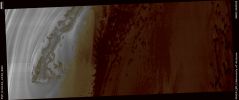
PSP_010169_2650_RED_abrowse-00.jpgDunes and other Surface Features in Chasma Boreale (ctx frame - possible True Colors; credits: Lunexit)65 visiteThis image shows dark sand dunes in Chasma Boreale. Chasma Boreale is a giant trough that cuts into the North Polar Ice Cap for about 570 Km (approx. 350 miles) forming a broad valley bordered by stacked layers of ice.
A portion of the North Polar Ice Cap is visible at the northern edge of the trough in the left portion of the image.
Many dark toned sand dunes march down the trough under the winds’ direction.
Coord.: 84,9° North Lat. and 331,8° East Long.
Spacecraft altitude: about 319 Km
M.L.T.: 13:35 (early afternoon)
Solar Incidence Angle: 67°MareKromium
(3 voti)
|
|

PSP_010169_2650_RED_abrowse-03.jpgDunes and other Surface Features in Chasma Boreale (edm n. 2 - natural colors; credits: Lunexit)57 visiteLe dune che vedete in questo dettaglio extramagnificato del panorama relativo alla Regione di Chasma Boreale SEMBRANO essere collegate da una frattura longitudinale, semi-irregolare ed a bordi frastagliati. Questa "frattura", se sovrasaturiamo l'immagine ed operiamo una ulteriore magnificazione, mostra delle leggere differenze di colore e di albedo e, alla fine, pare assomigliare davvero molto ad un canale di drenaggio (una sorta di fiumiciattolo, per dirla semplicemente).
Rilievi similari li abbiamo già incontrati su Titano e, se per i drainage channels della Luna Nebbiosa non paiono esserci più dubbi sul fatto che un qualche tipo di liquido scorra nel loro letto, per quanto attiene Marte ancora tutto tace.
In realtà, il fatto che questa specie di "frattura" superficiale possa essere un piccolo canale (che si inserisce in un ampio reticolo di canali - osservate il ctx frame per capire il contesto di riferimento) e che all'interno di esso scorra qualcosa, è pura speculazione; ma che la "frattura" (rectius: il network di fratture) sia oltremodo recente, è un fatto (basta osservare il dettaglio magnificato con una minima attenzione per capirlo).
La NASA, nel commentare questo frame, non si sofferma su queste "curiose" fratture del suolo e non ci offre alcuna idea/spiegazione delle stesse.
Peccato.MareKromium
(3 voti)
|
|
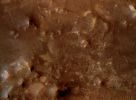
PSP_010206_1975_RED_abrowse-01.jpgAncient Bedrock and Megabreccia in Nili Fossae region (edm - possible True Colors; credits: Lunexit)62 visiteThis edm shows a rock type known as Megabreccia, composed of numerous differently colored blocks, each up to 40 meters (130 feet) across, arranged in a seemingly disorganized array.
Megabreccia forms when an energetic event, such as formation of an impact crater, breaks up pre-existing rocks and jumbles their fragments. Megabreccia is found in some of the most ancient rocks exposed on the Martian Surface.MareKromium
(3 voti)
|
|
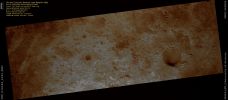
PSP_010183_2035_RED_abrowse-00.jpgColourful old Bedrock near Mawrth Vallis (possible True Colors; credits: Lunexit)59 visiteThis image covers part of a proposed Rover Landing Site in the Mawrth Vallis Region of Mars.
Polygonal fracture patterns (similar to a tiled floor) are visible on the surfaces of some of these rocks, and yellow/brown ridges protruding from the Surface may be composed of hard minerals or cemented sediments formed when water flowed through fractures in the ancient Bedrock. Dark gray-bluish dunes or ripples of wind-blown sand are also visible on the Surface here.
Elsewhere in the image, exposures of the light-toned rocks in the steep walls of impact craters reveal that these rocks are finely layered, similar to sedimentary rocks on Earth. The orbiting Infrared Spectrometers OMEGA and CRISM have demonstrated that these layered rocks contain Clay (---> argilla/minerali argillosi) minerals, which can only form in the presence of water.
The different colors of the rocks typically reflect differences in composition, suggesting that multiple styles or episodes of water activity may be recorded in the rock record here.
These characteristics have made Mawrth Vallis a prime candidate Landing Site for future Mars Rover Missions, including NASA’s Mars Science Laboratory due to launch in 2009.MareKromium
(3 voti)
|
|
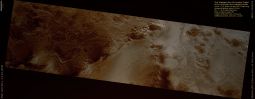
PSP_007961_2530_RED.jpgWestern Rim Region of Korolev Crater (possible True Colors; credits: Lunexit)59 visiteThis image was originally suggested by Ehsan Sanaei’s high school astronomy club in Yazd, Iran. They write, “[We are interested in] exploring the impact region near the northern Martian Pole and observing the contrast between ice-covered and [non-ice covered] Regions.”
Mrs. Stoica’s 9th grade class, at Tudor Vianu High-School of Computer Science, in Bucharest, Romania, helped to analyze the image by writing that “we observe a major crater, a small mountain chain, dunes and a series of small valleys and crevasses which [contain] ice.”
Indeed, this image shows part of the western rim of Korolev Crater, a prominent 80-Km-diameter crater located in the Northern Polar Region. It was taken in Northern Spring and shows dark regions of dust and sediment and bright regions of ice and frost. At highest resolution both bright and dark areas of the surface are covered by polygonal fracture patterns.
Although much of the ice has likely started to sublimate (change from a solid to a gas) in the darker regions, ice fills the fractures.MareKromium
(3 voti)
|
|
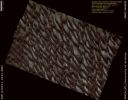
PSP_010071_2615_RED.jpgGypsum-rich Dunes in Olympia Undae Region (natural colors; credits: Lunexit)62 visiteIn this enhanced-natural color image are dunes within the largest collection of dunes on Mars, Olympia Undae, near the margin of the North Polar Layered Deposits, Planum Boreum.
This section of Olympia Undae is particularly interesting because the dunes are rich in Gypsum (---> Gesso), a mineral that forms in the presence of water. The material comprising these dunes is thought to have eroded from geologic units near the base of the NPLD, but these units have poor to no gypsum content.
Therefore, water likely affected these dunes after the sand had eroded out from the NPLD. Several ideas have been proposed to explain the formation of Gypsum, including hydrothermal (hot water) activity and melting of water-ice in the NPLD.
While gypsum dunes on Earth (for example, at White Sands, New Mexico) are white (the color of Gypsum), these Martian Dunes are dark due to the presence of basaltic grains that lower the brightness of the dunes.
CRISM, another instrument on MRO, has found that the crests of the dunes are the most Gypsum-rich. So, what is the bright, polygonally-fractured material in the low spaces between the dunes?
Perhaps it is Polar Ice lying beneath, desiccated (dried) gypsum material whose fine grain size makes it difficult for CRISM to detect, or something else altogether.MareKromium
(3 voti)
|
|
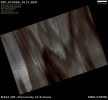
PSP_010086_2615_RED.jpgInfilled Crater on the North Polar Layered Deposits (natural colors; credits: Lunexit)59 visiteThe Polar Deposits of Mars are among the most geologically active on the Planet today. This image illustrates several processes affecting the Polar Landscape both today and in the recent past.
Frost streaks cross this image from lower left to lower right and are a testament to the power of the wind to redistribute material in this Region. In the center of the image lies an impact crater about 130 meters across (425 feet). Craters on the Polar Deposits are rare because the very active surface processes remove them quickly. This particular crater is likely to have been formed less than 100.000 years ago, which is very recent in geologic terms.
Streaks of material emanating from the crater rim have been created as the ice and dust being transported across the surface by the wind encounters that obstacle.
Although its initial depth was probably about 25 m (80 ft), the crater has been infilled with ice and dust and is now quite shallow. However, in one portion of the crater (upper area), the fill material has been removed, creating a pit adjacent to the crater wall. This pit contains a fresh deposit of ice and may be in the beginning stages of being infilled again. These cycles of infilling and erosion will eventually erase the crater from the landscape.
Scientists can examine many of these craters at different stages in their lifespan, from the very fresh to the almost erased. Using these data we can make estimates of how active this part of the Martian Surface is today.
Of course we need to find these rare craters first! Craters this size are usually about 200 Km (approx. 125 miles) apart in this Region, with the intervening landscape being relatively featureless.MareKromium
(3 voti)
|
|
| 2235 immagini su 187 pagina(e) |
 |
|
|
|
|
116 | |
|
|
|
|





