| Piú votate - Mars Reconnaissance Orbiter (MRO) |

PSP_001501_2280_RED_abrowse-01.jpgThe Viking Lander 2 Landing Site - Gerald Soffen Memorial Station (edm - Natural Colors; credits: Lunar Explorer Italia)61 visiteM.L.T.: 15:14 (early afternoon)
Latitude (centered): 47,7° North and Longitude 134,3° East
Range to target site: 310 Km (approx. 193,8 miles)
Original image scale range: 31 cm/pixel (with 1 x 1 binning) so objects ~93 cm across are resolved
Map projected scale: 25 cm/pixel and North is up
Map projection: EQUIRECTANGULAR
Emission angle: 11,7°
Phase angle: 62,1°
Solar Incidence Angle: 51°, with the Sun about 39° above the Local Horizon
Solar Longitude: 138,7° (Northern Summer) MareKromium
(3 voti)
|
|

ESP_011618_1885_RED_abrowse-01.jpgRecent Double-Impact (edm - possible Natural Colors; credits: Lunar Explorer Italia)71 visiteThe MRO Context Imager (CTX) team has been discovering many new impact events on Mars, and then they request HiRISE follow-up imaging to confirm an impact origin and to identify and measure the craters.
Crater clusters are common as these small (typically less than 1 meter diameter) objects break up in the thin Martian air and separate a little bit to make crater clusters up to a few hundred meters wide. The example shown here is the result of an impact that occurred between May 2003 and September 2007.
It was first discovered as a dark spot in a CTX image acquired in March 2008, but later found to be partly visible at the very edge of a CTX image acquired in September 2007.
A dark spot is not present in the previous image of this location with sufficient resolution to have detected it, acquired by the visible THEMIS camera on Mars Odyssey in May 2003. Thus the impact might have formed anytime between May 2003 and September 2007. The dark markings are created by removing or disturbing the surficial dust cover, and so far new impact sites have been discovered only in dust-covered regions of Mars.
Although small Martian crater clusters are common, this example is unusual because there is a dark line between the two largest craters. We hypothesize that atmospheric breakup coincidentally made two nearly equal-size objects that impacted close together in space and time so the air blasts interacted with each other to disturb the dust along this line.
Hundreds of these small objects (mostly asteroid fragments) impact Mars per year. A comparable number of small objects impact Earth each year, but explode in the upper reaches of our atmosphere and have no effect on the surface, fortunately for those of us who live here.MareKromium
(3 voti)
|
|
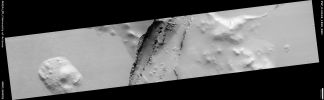
PSP_010638_1890_RED_abrowse-00.jpgAngular Unconformity in Cerberus Fossae (ctx RAW frame)83 visiteThis HiRISE image shows a part of the Cerberus Fossae, a long system of aligned fissures. The Cerberus Fossae were the source of the youngest major volcanic eruption on Mars that covered much of the surrounding area in lava. The region has also seen much other volcanic activity.
The walls of the fissures typically reveal lava layers. At this site, they have cut through an older hill that protrudes above the surrounding plains. The layers within the hill are tilted relative to the overlying rock, which appears to drape the region and runs continuously over the hill and plains.
This tilted contact is known as an Angular Unconformity. It is most likely that this formed when horizontal layers were tilted by faults before the most recent volcanic eruptions, forming the irregular hills.
The hills represent relatively old rock, while the smooth plains and the thin draping cover were formed more recently.MareKromium
(3 voti)
|
|
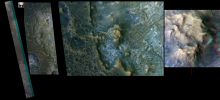
PSP_001454_2030_zoom3d-00.jpgLayered Terrain Near Mawrth Valles Phyllosilicates (High-Def-3D - false colors; credits: DR M. Faccin)62 visite...Un'incredibile ricostruzione in High-Def-3D (realizzata dal Dr Faccin) di uno dei paesaggi più intriganti e suggestivi di Marte: Mawrth Vallis.
Indossate gli occhialini e poi guardate: Vi sembrerà di "volare" su Marte, a 284 Km di quota, aggrappati al nostro "Amico" Mars Reconnaisance Orbiter!
Mars Local Time: 15:27 (early afternoon)
Coord. (centered): 22,8° North Lat. and 341,7° East Long.
Spacecraft altitude: 284,1 Km (such as about 177,6 miles)
Original image scale range: 28,4 cm/pixel (with 1 x 1 binning) so objects ~85 cm across are resolved
Map projected scale: 25 cm/pixel
Map projection: EQUIRECTANGULAR
Emission Angle: 1,3°
Phase Angle: 47,6°
Solar Incidence Angle: 49° (meaning that the Sun is about 41° above the Local Horizon)
Solar Longitude: 136,9° (Northern Summer)
Credits: NASA/JPL/University of Arizona
Additional process.: Dr Marco FaccinMareKromium
(3 voti)
|
|
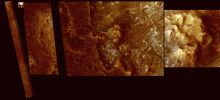
PSP_001454_2030_zoom3d-01.jpgLayered Terrain Near Mawrth Valles Phyllosilicates (High-Def-3D + natural colors; credits: DR M. Faccin & Lunar Explorer Italia)62 visiteMars Local Time: 15:27 (early afternoon)
Coord. (centered): 22,8° North Lat. and 341,7° East Long.
Spacecraft altitude: 284,1 Km (such as about 177,6 miles)
Original image scale range: 28,4 cm/pixel (with 1 x 1 binning) so objects ~85 cm across are resolved
Map projected scale: 25 cm/pixel
Map projection: EQUIRECTANGULAR
Emission Angle: 1,3°
Phase Angle: 47,6°
Solar Incidence Angle: 49° (meaning that the Sun is about 41° above the Local Horizon)
Solar Longitude: 136,9° (Northern Summer)
Credits: NASA/JPL/University of Arizona
Additional process.: Lunar Explorer ItaliaMareKromium
(3 voti)
|
|

PSP_003249_1510_RED_browse_01~0.jpgLayered Deposits in Ritchey Crater (edm - possible True Colors; credits: Lunar Explorer Italia)78 visite
This cutout from the top center part of the context image shows this stack.
The dark unit is thin and breaking into boulders. The light material is actually divided into smaller layers, and is pervasively fractured. However, the boulders falling from the edge are mostly small and rarely remain intact if they move more than a few meters.
The cracking of the layer could be due to water loss from the layer, or to regional tectonic effects such as stresses from burial and erosion.
The base unit is partially covered by wind-blown ripples.MareKromium
(3 voti)
|
|
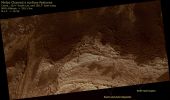
Psp_001443_1695_red~0.jpgFeatures of Melas Chasma (possible True Colors; credits: Lunar Explorer Italia)58 visitenessun commentoMareKromium
(3 voti)
|
|
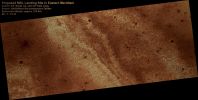
PSP_003326_1800_RED_browse.jpgProposed MSL Landing Site in Eastern Meridiani (possible True Colors; credits: Lunar Explorer Italia)67 visitenessun commentoMareKromium
(3 voti)
|
|
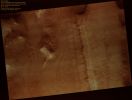
PSP_002545_1430_RED_browse-00~0.jpgJuncture of Two Branches of Dao Vallis (ctx frame - possible True Colors; credits: Lunar Explorer Italia)59 visiteMartian outflow channels are believed to be some of the largest features formed from the catastrophic flooding that scoured the landscape during ancient times. The source of the water likely originated in the subsurface and was somehow disturbed, depressurizing an aquifer, causing a sudden burst of water onto the surface.
This image shows multiple branches of the outflow channel Dao Vallis, which flows towards the West (down), ending near Hellas Basin. Although it is not clear exactly where the water that created these floods ended up, it is possible that Dao Vallis and its neighboring outflow channel, Niger Vallis, deposited water in Hellas Basin and formed a short-lived lake. Within the floor of Dao Vallis is material that appears striped, known as "lineated valley fill".
Valley fill material is thought to be ice-rich material that has flowed or been deposited onto the floor. Several lineations or "flow lines" appear to merge towards the upper left of the scene which supports this idea that the fill materials flowed, similar to slow-moving glacial material on Earth.
Also present in this scene is a mantling deposit which drapes much of the mid-latitudes of Mars. The deposit or "mantle" can be seen on south-facing slopes of positive-relief features, appearing as if its sliding off the walls. The mantle material is thought to be ice-cemented dust that was deposited during times when snowfall occurred on Mars.MareKromium
(3 voti)
|
|

PSP_002545_1430_RED_browse-01~0.jpgJuncture of Two Branches of Dao Vallis (edm - possible True Colors; credits: Lunar Explorer Italia)57 visiteHiRISE images, such as this one (here, approximately 680 mt across), show that the mantled unit is textured and full of boulders, which contrasts with the smooth appearance of this material in MOC images.MareKromium
(3 voti)
|
|

PSP_005392_0995_RED_abrowse-01~0.jpgImpact Crater on the South Polar Layered Deposits (EDM n.1; MULTISPECTRUM - credits: Lunexit)58 visiteA problem with using craters to determine age on the icy SPLD is that erosion of the icy substrate and relaxation of crater topography (i. e., relief becoming more gentle) is probably more rapid on ice than on harder rocky surfaces.
A detailed study of craters in ice will help better to understand this process of how craters in ice degrade, or deteriorate, with time.
Perhaps then we will know how to use the number and distribution of craters over the icy polar layered deposits in constraining the geologic and climate history of the Mars Polar Regions.MareKromium
(3 voti)
|
|
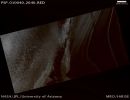
PSP_010040_2640_RED~0.jpgEnds of n. 2 North Polar Troughs (possible True Colors; credits: Lunar Explorer Italia)98 visiteMars Local Time: 14:16 (early afternoon)
Coord. (centered): 83,8° North Lat. and 264,3° East Long.
Spacecraft altitude: 321,4 Km (such as about 200,9 miles)
Original image scale range: 32,2 cm/pixel (with 1 x 1 binning) so objects ~96 cm across are resolved
Map projected scale: 25 cm/pixel
Map projection: EQUIRECTANGULAR
Emission Angle: 7,4°
Phase Angle: 59,4°
Solar Incidence Angle: 65° (meaning that the Sun is about 25° above the Local Horizon)
Solar Longitude: 128,2° (Northern Summer)
Credits: NASA/JPL/University of Arizona
Additional process. and coloring: Lunar Explorer ItaliaMareKromium
(3 voti)
|
|
| 2235 immagini su 187 pagina(e) |
 |
|
|
|
|
113 | |
|
|
|
|





