| |

| Piú votate - Mars Reconnaissance Orbiter (MRO) |
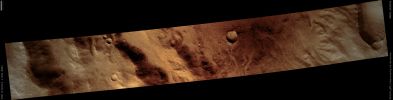
PSP_010435_1700_RED_abrowse.jpgPossible "Paleo-Lake" in Ophir Planum (Natural Colors; credits: Lunar Explorer Italia)79 visiteMars Local Time: 15:35 (middle afternoon)
Coord. (centered): 10,0° South Lat. and 306,2° East Long.
Spacecraft altitude: 274,2 Km (such as about 171,4 miles)
Original image scale range: 54,9 cm/pixel (with 1 x 1 binning) so objects ~ 1,65 mt across are resolved
Map projected scale: 50 cm/pixel
Map projection: EQUIRECTANGULAR
Emission Angle: 19,1°
Phase Angle: 75,7°
Solar Incidence Angle: 59° (meaning that the Sun is about 31° above the Local Horizon)
Solar Longitude: 143,2° (Northern Summer)
Credits: NASA/JPL/University of Arizona
Additional process. and coloring: Lunar Explorer ItaliaMareKromium
(3 voti)
|
|

ESP_011909_1320_RED_abrowse.jpgSand Dunes and Ripples in Proctor Crater (Natural Colors; credits: Lunar Explorer Italia)76 visiteMars Local Time: 16:00 (middle afternoon)
Coord. (centered): 47,8° South Lat. and 30,7° East Long.
Spacecraft altitude: 253,2 Km (such as about 158,3 miles)
Original image scale range: 50,7 cm/pixel (with 1 x 1 binning) so objects ~ 1,52 mt across are resolved
Map projected scale: 50 cm/pixel
Map projection: EQUIRECTANGULAR
Emission Angle: 3,2°
Phase Angle: 59,1°
Solar Incidence Angle: 62° (meaning that the Sun is about 28° above the Local Horizon)
Solar Longitude: 206,7° (Northern Autumn)
Credits: NASA/JPL/University of Arizona
Additional process. and coloring: Lunar Explorer ItaliaMareKromium
(3 voti)
|
|

ESP_011834_1605_RED_abrowse.jpgRecent and small Impact Crater (Natural Colors; credits: Lunar Explorer Italia)61 visiteMars Local Time: 15:52 (middle afternoon)
Coord. (centered): 19,3° South Lat. and 273,8° East Long.
Spacecraft altitude: 254,4 Km (such as about 159,0 miles)
Original image scale range: 25,5 cm/pixel (with 1 x 1 binning) so objects ~ 76 cm across are resolved
Map projected scale: 25 cm/pixel
Map projection: EQUIRECTANGULAR
Emission Angle: 0,2°
Phase Angle: 56,8°
Solar Incidence Angle: 57° (meaning that the Sun is about 33° above the Local Horizon)
Solar Longitude: 203,2° (Northern Autumn)
Credits: NASA/JPL/University of Arizona
Additional process. and coloring: Lunar Explorer ItaliaMareKromium
(3 voti)
|
|

ESP_011605_1170_RED_abrowse.jpgDefrosting Malea Patera (Natural Colors; credits: Lunar Explorer Italia)77 visiteMalea Patera is one of a group of ancient volcanoes that ring the Hellas Impact Basin. This HiRISE image was intended to investigate the nature of the volcanic materials at this location. However, the image was taken in early Spring for this location in the Southern Hemisphere and so the ground is covered with bright frost except for some dark splotches found in discrete patches.
This is where the sunlight has penetrated the frost and initiated defrosting around discrete spots.
Clearly something is different about the patches where this defrosting has started before any other locations. One possibility is that these are (frost covered) dark sand dunes that heat up more easily than the surrounding terrain. However, we will need to take a new image in the Summer time to really know what is happening here.
Mars Local Time: 16:11 (middle afternoon)
Coord. (centered): 62,5° South Lat. and 53,3° East Long.
Spacecraft altitude: 249,1 Km (such as about 155,7 miles)
Original image scale range: 24,9 cm/pixel (with 1 x 1 binning) so objects ~75 cm across are resolved
Map projected scale: 25 cm/pixel
Map projection: EQUIRECTANGULAR
Emission Angle: 0,9°
Phase Angle: 72,4°
Solar Incidence Angle: 73° (meaning that the Sun is about 17° above the Local Horizon)
Solar Longitude: 192,6° (Northern Autumn)
Credits: NASA/JPL/University of Arizona
Additional process. and coloring: Lunar Explorer ItaliaMareKromium
(3 voti)
|
|

ESP_011648_1730_RED_abrowse-00.jpgOval Mesa on Ganges Mensa (and another "mistery" solved) - Natural Colors; credits: Lunar Explorer Italia96 visiteMars Local Time: 15:56 (middle afternoon)
Coord. (centered): 7,2° South Lat. and 311,5° East Long.
Spacecraft altitude: 277,5 Km (such as about 173,4 miles)
Original image scale range: 27,8 cm/pixel (with 1 x 1 binning) so objects ~83 cm across are resolved
Map projected scale: 25 cm/pixel
Map projection: EQUIRECTANGULAR
Emission Angle: 17,7°
Phase Angle: 41,0°
Solar Incidence Angle: 59° (meaning that the Sun is about 31° above the Local Horizon)
Solar Longitude: 194,6° (Northern Autumn)
Credits: NASA/JPL/University of Arizona
Additional process. and coloring: Lunar Explorer Italia
This Oval Mesa is a remnant of a geological unit that once covered this area, similar to the Mesas and Buttes in Monument Valley, in Arizona and Utah. This is a small remnant of a much larger unit of similar material that caps Ganges Mensa to the West.
As can be seen in the sides of this small Mesa, this remnant consists of a layered stack of rock. Prior to the massive erosion that left this a high-standing Mesa, a more gentle phase of erosion created the small hills and whorls on the upper surface of the Mesa. It seems that this gentle erosion continued even after the Mesa was created, as this pattern of small hills and whorls is visible on the terrain surrounding the Mesa.
Although not visible in the area shown in this HiRISE image, this Mesa actually sits on top of the much larger Ganges Mensa, which is itself a large Mesa within Ganges Chasma.
Nota Lunexit: una diversa ripresa di questo medesimo dettaglio costituì oggetto di una lunga discussione sul Forum degli Amici di "UFO-On Line". La querelle riguardava la presenza di un presunto (ed oggi, come viene ben dimostrato da questa nuova immagine, inesistente) "ingresso" (porta) sul versante Nord-Occidentale della Mesa Ovale che campeggia a centro frame. La discussione, forse innescatasi a seguito delle deliranti asserzioni di un noto Eso-Archeografo Italiano (e relative alla presenza di "evidenti accessi a presidi minerari" sul Pianeta Rosso...) si sviluppò in maniera interessante e costruttiva e ci portò anche al calcolo delle possibili dimensioni della "porta".
Oggi, grazie a questa nuova immagine - che pubblichiamo anche in versione RAW Original b/w - tutti potranno constatare che quella che SEMBRAVA essere una "porta" era, in vero, solo un leggero incavo (indentation) naturale presente sulla parete Nord-Occidentale della Mesa.
Morale: prima di parlare e di lanciarsi in interpretazioni che superano la Fantasia e sconfinano nella Bufala al 100% (e qui, che sia chiaro, NON CI RIFERIAMO agli Amici di "UFO-On Line"!), conviene sempre STUDIARE, DOCUMENTARSI, FARE CONFRONTI FRA DIVERSE IMMAGINI e poi, se proprio si vuol dare aria alla bocca e lavoro alla tastiera, SI SUGGERISCE DI RESTARE SEMPRE POSSIBILISTI - onde evitare di fare delle figure che definirle "meschine" è certamente riduttivo...
Ogni riferimento alle stupidaggini proferite da noti Eso-Archeografi Italici e non, è ASSOLUTAMENTE VOLUTO e NON CASUALE.MareKromium
(3 voti)
|
|

ESP_011631_1515_RED_abrowse.jpgInside Hellas Basin (Natural Colors; credits: Lunar Explorer Italia)89 visiteThis image shows part of the floor of an impact crater on the Northern Rim of the giant Hellas Basin.
Hellas includes the lowest elevations on Mars, and may have once held lakes or seas; layered rock outcrops occur around much of the edge of the basin. At this site, a large impact crater (about 90 kM across) was partly filled by layered rocks. These rocks on the crater floor are now eroding and forming strange pits.
Here, the layers are mostly exposed on a steep slope which cuts across much of the image. On this slope, they crop out as rocky stripes, some continuous and others not. The material between the stripes is mostly covered by debris, but some areas of exposed rock are visible. The slope is capped by a thick, continuous layer that armors it against erosion; once this cap is gone, the lower material is removed rapidly, forming the steep slope. At the base of this slope, rocks on the floor of the pit appear bright and heavily fragmented by cracks known as joints. The variation in rock types suggests that the rocks here were deposited by multiple processes or in different environments. Sites like this may preserve a record of conditions on early Mars.
Mars Local Time: 15:55 (middle afternoon)
Coord. (centered): 28,4° South Lat. and 57,1° East Long.
Spacecraft altitude: 256,9 Km (such as about 160,6 miles)
Original image scale range: 25,7 cm/pixel (with 1 x 1 binning) so objects ~51,4 cm across are resolved
Map projected scale: 25 cm/pixel
Map projection: EQUIRECTANGULAR
Emission Angle: 0,3°
Phase Angle: 60,1°
Solar Incidence Angle: 60° (meaning that the Sun is about 30° above the Local Horizon)
Solar Longitude: 193,8° (Northern Autumn)
Credits: NASA/JPL/University of Arizona
Additional process. and coloring: Lunar Explorer ItaliaMareKromium
(3 voti)
|
|
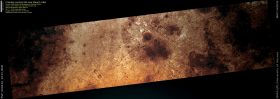
PSP_006610_2035_RED_abrowse~0.jpgPotential MSL Landing Site near Mawrth Vallis (MULTISPECTRUM; credits: Lunexit)58 visiteMawrth Vallis contains clay minerals that formed by chemical alteration of rocks by water. It is one of the short list of potential sites that the Mars Science Laboratory Rover will land at, and the HiRISE team is working to find a safe place to land in this area.
This observation shows a wide variety of scientifically interesting terrains as well as some potential hazards for landing. The central part of the image is dominated by light-toned materials with curving fractures of many different sizes. These fractures do not have a preferred orientation, indicating that they did not form in response to some regional stress pattern.
Instead, they formed by some more uniform process, possibly the drying of a thick mud deposit or the gradual rebound of the area as the overlying material was eroded away. The scattered mounds and sand dunes may or may not prove to be a danger, but it is reassuring to see that many of the impact craters have been smoothed out with a filling of wind-blown sand.MareKromium
(3 voti)
|
|
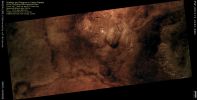
PSP_007173_2245_RED_abrowse-00~0.jpgScallops and Polygons in the Utopia Planitia Region (context frame - MULTISPECTRUM; credits: Lunexit)62 visiteThis image shows a portion of the Utopia Planitia, marked by polygonal features bounded by cracks and depressions in the mantle that possess scalloped edges.
Scalloped pits are typical features of the Martian mid-latitude mantle. Their presence has led to hypotheses of the removal of subsurface material, possibly interstitial ice, by sublimation (ice going directly from the solid state to the gas state). Their formation most likely involves development of oval- to scalloped-shaped depressions that may coalesce together, leading to the formation of large areas of pitted terrain. Scalloped pits typically have a steep pole-facing scarp and a gentler equator-facing slope.
On the surface surrounding the scalloped depressions is a polygonal pattern of fractures. This is commonly associated with scalloped terrain, and indicates that the surface has undergone stress, potentially caused by subsidence (sinking), desiccation (drying out), or thermal contraction. These polygon features are similar to permafrost polygons that form in polar and high alpine regions on Earth by seasonal-to-annual contraction of the subsoil. On Earth, such polygon features are indicative of the presence of ground ice.MareKromium
(3 voti)
|
|

PSP_001513_1655_RED_abrowse-01.jpgThe MER Spirit Landing Site (edm - Natural Colors; credits: Lunar Explorer Italia)57 visiteThe bright irregularly-shaped feature in area "A" of the image is Spirit's parachute, now lying on the Martian surface. Near the parachute is the cone-shaped "backshell" that helped protect Spirit's lander during its seven-month journey to Mars. The backshell appears relatively undamaged by its impact with the martian surface. Wrinkles and folds in the parachute fabric are clearly visible.
Area "B" of the image shows Spirit's lander. The crater in the upper left-hand portion of the image, just to the northwest of the lander, is the one that the Mars Exploration Rover team named "Sleepy Hollow".
Area "C" shows the damaged remnant of the heat shield that protected the vehicle during the high-speed entry through the Martian atmosphere. The heat shield impacted the surface after being separated from the vehicle during the final stages of the descent.
Area "D" of the image shows the current location of Spirit. Toward the top of the image is "Home Plate", a plateau of layered rocks that Spirit explored during the early part of its third year on Mars. Spirit itself is clearly seen just to the southeast of Home Plate. Also visible are the tracks made by the rover before it arrived at its current location.MareKromium
(3 voti)
|
|

PSP_001513_1655_RED_abrowse-00.jpgThe MER Spirit Landing Site (ctx frame - Natural Colors; credits: Lunar Explorer Italia)58 visiteThis HiRISE image shows the Landing Site of the Mars Exploration Rover Spirit. The impact crater in the upper left-hand portion of the image is "Bonneville Crater", which was investigated by Spirit shortly after landing. In the lower right-hand portion of the image is "Husband Hill", a large hill that Spirit climbed and where it spent much of its now nearly five-year mission.
M.L.T.: 15:29 (early afternoon)
Latitude (centered): 14,6° South and Longitude 175,5° East
Range to target site: 270,7 Km (approx. 169,2 miles)
Original image scale range: 27,1 cm/pixel (with 1 x 1 binning) so objects ~81 cm across are resolved
Map projected scale: 25 cm/pixel and North is up
Map projection: EQUIRECTANGULAR
Emission angle: 15,8°
Phase angle: 73,6°
Solar Incidence Angle: 60°, with the Sun about 30° above the Local Horizon
Solar Longitude: 139,1° (Northern Summer)MareKromium
(3 voti)
|
|
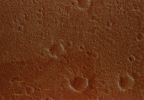
PSP_001521_2025_RED_abrowse-01.jpgThe Viking Lander 1 Landing Site - Thomas Mutch Memorial Station (edm - Natural Colors; credits: Lunar Explorer Italia)57 visiteM.L.T.: 15:20 (early afternoon)
Latitude (centered): 22,3° North and Longitude 312,1° East
Range to target site: 303,3 Km (approx. 189,5 miles)
Original image scale range: 30,3 cm/pixel (with 1 x 1 binning) so objects ~91 cm across are resolved
Map projected scale: 25 cm/pixel and North is up
Map projection: EQUIRECTANGULAR
Emission angle: 21,2°
Phase angle: 68,5°
Solar Incidence Angle: 48°, with the Sun about 42° above the Local Horizon
Solar Longitude: 139,4° (Northern Summer)MareKromium
(3 voti)
|
|

PSP_001501_2280_RED_abrowse-00.jpgThe Viking Lander 2 Landing Site - Gerald Soffen Memorial Station (ctx frame - Natural Colors; credits: Lunar Explorer Italia)61 visiteViking Lander 2 (VL2) landed on Mars on 3 September 1976, in Utopia Planitia. The Lander, which has a diameter of about 3 meters, has been precisely located in the HiRISE image, and likely locations have been found for the Heat-Shield and Backshell.
The Lander location has been confirmed by overlaying the lander-derived topographic contours on the HiRISE image, which provides an excellent match.
VL2 was one element of an ambitious mission to study Mars, with a 4-spacecraft flotilla consisting of 2 Orbiters and 2 Landers.
Large Boulders, Dunes and other features visible in Lander images can be located in the HiRISE image. The polygonal pattern of the Surface is typical at these latitudes and may be due to the presence of deep subsurface ice.
As chance would have it, this image is blurred in some places due to the abrupt motion associated with the restart of the High Gain Antenna tracking during the very short image exposure. This is the first time after acquiring hundreds of pictures that an image has been unintentionally smeared, but the overall performance has been excellent.
A prime motivation for early viewing of these Viking sites is to calibrate what we see from space with the data previously acquired by the Landers. In particular, determining what sizes of rocks can be seen from MRO aids the interpretation of data now being taken to characterize sites for future landers.MareKromium
(3 voti)
|
|
| 2235 immagini su 187 pagina(e) |
|
|
|
|
|
112 | |
|
|
|
|
|
|





