| Piú votate - Mars Reconnaissance Orbiter (MRO) |
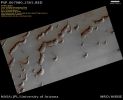
PSP_007080_2565_RED_abrowse.jpgSouth Polar Dunes (Natural Colors; credits: Lunar Explorer Italia)60 visitenessun commentoMareKromium
(3 voti)
|
|

ESP_013089_2040_RED_abrowse.jpgTooting Crater (Natural Colors; credits: Lunar Explorer Italia)61 visiteThis image is of the Ejecta Blanket of the Tooting Crater in the Northern Hemisphere of Mars.
Tooting is a "rampart" crater that is roughly 29 Km (about 18 miles) in diameter and appears to be one of the youngest craters of this size.
A "rampart crater" is one where the material ejected from the crater during impact forms lobes that end with a low ridge, or rampart. One indication of Tooting Crater's youth is its ratio of depth to width.
As a crater ages, the walls of the crater will tend to erode and debris will accumulate in the crater's floor making its apparent depth less, while also making its width larger.
One of the major features of Tooting Crater are its multiple ejecta layers that build a sequence of ramparts. The shapes of these ramparts suggest that the ejected material acted as a fluid (like mud) as it moved across the surface.
Most researchers think that such fluid ejecta indicates that there was ice in the ground when the crater formed.MareKromium
(3 voti)
|
|
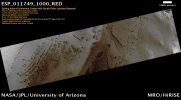
ESP_011749_1000_RED_abrowse.jpgSpring View of Unnamed Crater with South Polar Layered Material (Natural Colors; credits: Lunar Explorer Italia)61 visitenessun commentoMareKromium
(3 voti)
|
|

ESP_013329_1070_RED_abrowse.jpgSouth Polar Layered Deposits (Natural Colors; credits: Lunar Explorer Italia)60 visiteThe Ice Caps on Mars are surrounded by a thick stack of Layered Deposits. HiRISE and other instruments have shown that these layers are composed of dusty ice. Now imagine this stack of layers as a cake with alternating layers.
What happens if someone comes and takes a big scoop out of the middle of the cake? Well, while our first reaction might be to get mad at them for ruining the cake, take a moment to think what the pattern would look like: it would have rings going round and round the hole. This is what we are seeing in this image of Mars.
The same pattern that you can see HERE!
Therefore, what you see in this frame is just the consequence of some erosional process which has scooped a big hole into the Layered Deposits.MareKromium
(3 voti)
|
|
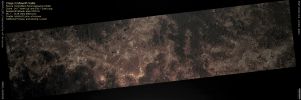
PSP_006742_2050_RED_abrowse.jpgClays in Mawrth Vallis (MULTISPECTRUM; credits: Lunexit)104 visiteMawrth Vallis is one of the most colorful parts of Mars. However, it is not quite as colorful as seen in this observation, where this “extra” color comes from the fact that HiRISE can “see” into part of the infrared, enhancing its ability to detect color differences that are indicative of various minerals.
Properly identifying those minerals is where the CRISM instrument excels.
They show that this area has a variety of different types of clay minerals: these are especially interesting because they had to form when water was interacting with rocks.
The different types of clays point to different water chemistries and temperatures.
With HiRISE, we can better pinpoint how these different materials are distributed across the surface. Furthermore, by taking two images we can produce a stereo image and see the topography, allowing the different clay-bearing layers to be traced in 3D. MareKromium
(3 voti)
|
|

ESP_011732_1595_RED_abrowse-01.jpgLarge Cluster of Small Craters near Maadim Vallis (edm - Natural Colors; credits: Dr M. Faccin & Lunar Explorer Italia)58 visitenessun commentoMareKromium
(3 voti)
|
|

ESP_012506_0850_RED_abrowse.jpgDefrosting Spots over Polygonal Terrain (Natural Colors; credits: Lunar Explorer Italia)62 visitenessun commentoMareKromium
(3 voti)
|
|
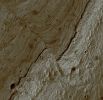
TRA_000823_1720_RED_fault.jpgFault in Jus Chasma (Natural Colors; credits: Lunar Explorer Italia)78 visitenessun commentoMareKromium
(3 voti)
|
|

ESP_013049_0950_RED_abrowse.jpgSouth Polar Spiders (Natural Colors; credits: Lunar Explorer Italia)60 visiteThis image is part of an ongoing seasonal monitoring effort in this location in the Southern Polar Region of Mars.
Mars’ South Polar Region changes significantly during the Martian Year. During the Southern Hemisphere’s Winter, the Polar Cap increases dramatically as the lowered temperatures make a large portion of the Atmosphere freeze out into ice.
As Spring approaches and the Polar Region begins to warm once again, the Cap recedes revealing terrains like those visible in this image. The polygonal features in this image are termed “Spiders” and their origin is still unknown (although there are several hypotheses).
One possible hypothesis for the black fan-shaped features is that they may be formed by a geyser-like process. As the Sun heats the ground layer below the Carbon Dioxide ice, the ice on the bottom begins to sublimate, or turn directly from a solid to a gas.
This gas then builds up in pressure as more of it sublimates, until a critical pressure is achieved and it erupts through the ice layer much as a geyser would, spewing the debris that is thought to make up the dark fan shaped features.MareKromium
(3 voti)
|
|
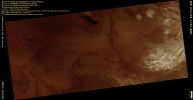
ESP_011728_1735_RED_abrowse.jpgFerric Oxide and Sulphates (Natural Colors; credits: Lunar Explorer Italia)57 visitenessun commentoMareKromium
(3 voti)
|
|

ESP_012997_1445_RED_abrowse.jpg"8"! (Natural Colors; credits: Lunar Explorer Italia)69 visiteThis image shows two craters in the Southern Hemisphere just South of Sirenum Fossae.
The Northern Crater (the one that is an upper position) is smaller, appears more degraded, and is partially filled with sediments that form a hummocky surface. Dunes have formed subsequently on this Surface. Some incipient gully-like features have formed midway along the Southern Crater Wall and expose Layers that are more resistant to erosion.
The larger crater to the South is eroded by Gullies on its Northern Slope while the Southern Slope Region lacks them. Most Gullies in this scene appear to emanate from more resistant Layers, although the larger Gullies have eroded back almost to the Crater Rim.
The nature of the Layers and their connection to the water that formed the Gullies is unknown.
Gullies typically form when flowing water erodes sediments and soft rocks in a channelized flow. Because Mars is very cold and dry, it is unknown where the water came from to form the Gullies.MareKromium
(3 voti)
|
|
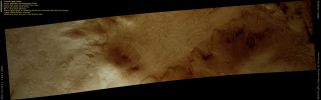
ESP_013071_1365_RED_abrowse.jpgCentral Peak Gullies (Natural Colors; credits: Lunar Explorer Italia)61 visitenessun commentoMareKromium
(3 voti)
|
|
| 2235 immagini su 187 pagina(e) |
 |
|
|
|
|
109 | |
|
|
|
|





