| Piú votate - Mars Reconnaissance Orbiter (MRO) |
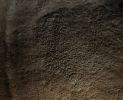
PSP_004867_1220_RED_abrowse-01.jpgIce Processes in Amphitrites Patera (EDM - Natural Colors; elab. Lunexit)58 visiteThe Martian Atmosphere was dusty at the time this image was acquired, so small imperfections in the processing are very visible in the standard image products.
MareKromium
(3 voti)
|
|
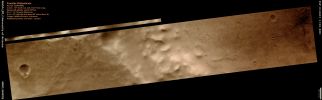
ESP_014447_1720_RED_abrowse.jpgPossible Phillosilicate (Natural Colors; credits: Lunexit)59 visitenessun commentoMareKromium
(3 voti)
|
|

ESP_014436_0920_RED_abrowse-00.jpgIcy Impact (CTX Frame - Natural Colors; credits: Lunexit)59 visiteA thick (approx. 3 Km or a little less than 2 miles) sequence of ice and dust, stacked like a layer cake, covers the South Pole of Mars. Impact craters that form here experience slightly different processes of modification and degradation than those that form in rocky areas.
One example of such a process is sublimation. Most of the material that makes up an icy crater is volatile, meaning it can melt or sublimate (change directly from a solid to a gas) if heated. Sublimation is more common on Mars because of its thin and dry Atmosphere.
Crater walls facing the Sun receive more direct light than their surroundings, and are therefore more easily warmed. If the ice in the walls sublimates, the rim structure of the crater becomes degraded.MareKromium
(3 voti)
|
|
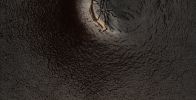
ESP_014436_0920_RED_abrowse-01.jpgIcy Impact (EDM - Natural Colors; credits: Lunexit)69 visiteThe Impact Crater in this image is roughly 900 meters (a little over 0,5 mile) across.
The remaining Raised Rim of the Crater is illuminated from the bottom right of the image, causing preferential heating of the interior of the Rim structure.
The ice appears thin here (more brown material is exposed), with an even thinner cover on the remaining exterior Rim.
This could be caused by a number of possibilities: perhaps the Exterior Wall is steeper than the Interior Wall, resulting in more direct exposure to sunlight, causing more efficient sublimation when the Sun shines on that Wall.
Once ice begins to melt, darker dustier material is exposed. The darker material absorbs more heat than white ice (just like standing in the Sun wearing a black shirt makes you warmer than wearing a white shirt, which reflects the Sun's light), causing more and more ice to sublimate near the dark material.MareKromium
(3 voti)
|
|

ESP_014298_1105_RED_abrowse.jpgUSGS Dune Database Entry Number 3327-692 (Natural Colors; credits: Lunexit)82 visitenessun commentoMareKromium
(3 voti)
|
|

ESP_014432_1685_RED_abrowse.jpgTerraced Unnamed Crater (Natural Colors; credits: Lunexit)68 visitenessun commentoMareKromium
(3 voti)
|
|
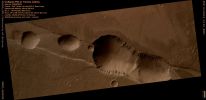
ESP_014432_2110_RED_abrowse.jpgCollapse Pits in Tractus Catena (Natural Colors; credits: Lunexit)67 visitenessun commentoMareKromium
(3 voti)
|
|

ESP_014139_2070_RED_abrowse-01.jpgFumes, North of Mawrth Vallis (Natural Colors; credits: Dr M. Faccin)112 visiteUna splendida ed affascinante (nonchè ECCEZIONALE) visione di "fumi" che si sollevano da una regione di modeste dimensioni situata a Nord della famosa Mawrth Vallis. La scoperta - perchè di scoperta si tratta - è del nostro Marco Faccin; la NASA, purtroppo, sebbene da noi sollecitata al riguardo, non ha - evidentemente... - ancora trovato il tempo di rispondere e di darci qualche delucidazione su quello che staremmo guardando.
Il dettaglio in oggetto non è assolutamente visibile/distinguibile osservando il full-frame MRO in formato JPEG, ma bisogna aprire il file in JP2 e "mettersi a cercare".
I "fumi" che vedete in questa colorizzazione (fatta al TOP delle nostre possibilità, miscelando la tecnica di colorizzazione in Colori Naturali STD con la Tecnica MULTISPECTRUM) sono stati da noi identificati come tali (e NON, quindi, come nebbie) in quanto riteniamo di aver individuato i punti esatti di emanazione.
Lo spettacolo che stiamo osservando, quindi ed a nostro parere, potrebbe costituire l'evidenza oggettiva di una Caldera Attiva (simile, concettualmente, alle cosiddette "Solfatare" di Pozzuoli - NA).
Morale: Marte è tutt'altro che morto...MareKromium
(3 voti)
|
|
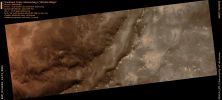
ESP_014260_1675_RED_abrowse.jpgUnnamed Crater intersecting a "Wrinkle Ridge" (Natural Colors; credits: Lunexit)86 visiteWrinkle Ridges are topographic structures produced by Subsurface faulting; they are commonly found on both the Moon and Mars.
This image shows a site where a Wrinkle Ridge intersects a Crater; the Ridge is a large feature and extends well outside this observation. The spur just inside the Crater Rim is roughly in line with the Wrinkle Ridge structure and probably represents enhanced crater collapse along the fault line.
An alternative possibility is that this spur was created by movement of the Wrinkle Ridge fault after the Crater formed, but this is unlikely because the Outer Rim of the Crater is not cut. Observations like this help constrain the relative timing of events on Mars.MareKromium
(3 voti)
|
|

ESP_014139_2070_RED_abrowse-00.jpgPhyllosilicates Deposit North Mawrth Vallis (Natural Colors)65 visitenessun commentoMareKromium
(3 voti)
|
|
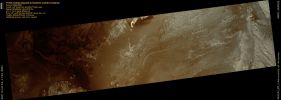
ESP_014154_1730_RED_abrowse.jpgFerric Oxide-Rich Deposit in East Candor Chasma (Natural Colors; credits: Lunexit)60 visitenessun commentoMareKromium
(3 voti)
|
|
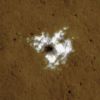
SubsurfaceIce-PIA12220.jpgMaterial excavated by a "Fresh Impact" is identified as Water Ice (Natural Colors; credits: Lunexit)56 visiteThe bright material conspicuous in this image was excavated from below the Surface and deposited nearby by a 2008 impact that dug a crater about 8 meters (26 feet) in diameter.
The extent of the bright patch was large enough for the Compact Reconnaissance Imaging Spectrometer for Mars, an instrument on NASA's Mars Reconnaissance Orbiter, to obtain information confirming the material to be water ice.
This image, covering an area 50 meters (164 feet) across, was taken on Nov. 1, 2008, by the High Resolution Imaging Science Experiment on the same Orbiter. The time frame for the crater-forming impact to have occurred was bracketed by before-and-after images (not shown) taken by the Thermal Emission Imaging System camera aboard NASA's Mars Odyssey Orbiter on Jan. 26, 2008, and by the Context Camera on the Mars Reconnaissance Orbiter on Sept. 18, 2008.
This Crater is at 55,57° North Latitude and 150,62° East Longitude (Vastitas Borealis Region). MareKromium
(3 voti)
|
|
| 2235 immagini su 187 pagina(e) |
 |
|
|
|
|
107 | |
|
|
|
|





