| Piú votate - Mars Reconnaissance Orbiter (MRO) |
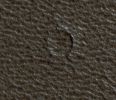
PSP_001406_2680_red-01.jpgLonely and (almost) buried crater in the North Polar "Permanent Cap" (EDM - Natural Colors; credits: Dr Paolo C. Fienga - Lunexit Team)59 visitenessun commentoMareKromium
(3 voti)
|
|
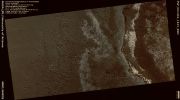
PSP_001493_1815_RED_abrowse-1.jpgTerra Meridiani (possible True Colors; credits: Dr Paolo C. Fienga - Lnexit Team)57 visiteThis HiRISE image shows dark sand covering bright Bedrock in the Terra Meridiani (Meridiani Planum) Region of Mars.
The MER Opportunity Rover is currently exploring Meridiani, but is located about 500 Km to the West-South/West from this area.
There are three broad classes of Terrain in this image: the regular spacing of the Dark Ridges, with one side of the Ridges (in this case generally facing North/West) shallower than the other, indicates that the material is windblown sand deposited in the form of Dunes or large Ripples. On the slopes of and in between the Dunes and Ripples are smaller-scale Ripples.
The dark orangish tone of the Sand and the analysis of analogous material by Opportunity indicates that is composition might be Basaltic and this is in contrast to most sand on Earth, which is dominated by Quartz.MareKromium
(3 voti)
|
|

ESP_013951_1955_RED_abrowse-00.jpgDark Syrtis Major (CTX Frame - Natural Colors; credits: Dr Paolo C. Fienga - Lunexit Team)57 visiteOn 13 October 1659, Dutch Astronomer Christiaan Huygens turned one of his telescopes towards a bright orange spot in the sky and produced what Percival Lowell would later call “the first drawing of Mars worthy of the name ever made by man”.
Huygens included a "dark spot" in his drawing that is thought to represent Syrtis Major, a small sliver of which is visible in this HiRISE image.
Syrtis Major is a Shield Volcano and its dark color comes from the dark Basaltic Rock present in the area, visible because it lacks the Dust that paints the rest of the Planet its distinct, rusty orangish color. By tracking this "dark spot" in repeated observations, Huygens concluded that Mars rotated every 24 hours: a time not too far off from its true rotation period of approx. 24 hours and 39,58 minutes.MareKromium
(3 voti)
|
|

ESP_013951_1955_RED_abrowse-01.jpgDark Syrtis Major (EDM - Natural Colors; credits: Dr Paolo C. Fienga - Lunexit Team)57 visiteIn this EDM of Syrtis Major, ancient Noachian Bedrock is exposed. This is rock made in the early Soles of Martian History.
An Impact Crater (about 50 Km in diameter) into this rock exposes Layers along its Wall. These Layers may be made from several different geologic materials, such as Lava Flows, Debris from nearby impact craters, or deposits of Dust or Sand.
They may also represent different periods of deposition and erosion. The Layers are of varying thickness: some of the lighter, resistant units are less than 10 meters thick, while some of the darker layers might be over 100 meters thick.MareKromium
(3 voti)
|
|
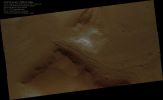
PSP_001420_2045_RED_browse-00~0.jpgSmall Channel in Tartarus Colles (CTX Frame - Natural Colors; credits: Lunexit)59 visiteThis observation shows a thin channel between knobs in the Northern Hemisphere. These knobs are part of a local group of knobs called the "Tartarus Colles".
Both knobs visible in this image have dark slope streaks. It was originally thought that slope streaks might be locations of surface water wetting and darkening soil, but it is now commonly believed that slope streaks are mini-avalanches of dust. Slope streaks fade over time as wind erosion blends them in with their surroundings.MareKromium
(3 voti)
|
|

PSP_001602_1700_red-00~0.jpgThe "Central Uplift" of Oudemans Crater (CTX Frame - possible Natural Colors; credits: Lunexit)58 visiteBased on estimates of the depth of excavation for a crater the size of Oudemans, these Layers originated from just as deep as those exposed in Valles Marineris and possibly deeper.
A comparison of the Layers in Valles Marineris and in the Oudemans Central Uplift may prove that they are similar rock types that share the same mode of origin. The fact that these Layers are so well intact gives planetary scientists specific clues regarding the Subsurface and history of the general area.
Additionly, three other craters, Martin (21,2° S and 290,7° E), Mazamba (27,3° S and 290,2° E) and a yet unnamed crater (28,4° S and 305° E) also possess finely Layered Materials in their Central Uplift features and lie within the circum-Tharsis Region.
The preservation of the layering and geographical occurrence of these 4 craters suggests that they could be ash layers deposited from numerous episodes from the Tharsis Volcanoes.
Voluminous volcanic episodes could have produced large volumes of Layered Rock that could have been rapidly buried and protected from cratering.MareKromium
(3 voti)
|
|

PSP_001602_1700_red_01~0.jpgThe "Central Uplift" of Oudemans Crater (EDM - possible Natural Colors; credits: Lunexit)57 visiteThis HiRISE image covers a portion of the Central Uplift of the 120-Km diameter Oudemans Crater.
Oudemans is located at the Western end of Valles Marineris and just South of the Great Canyon System by the Noctis Labyrinthus.
Images from the Mars Orbital Camera (MOC) were the first to reveal that this large impact crater exposed Layered Rock in its Central Uplift Feature.
Such beautifully preserved Layered Rocks, although rare, are no surprise to planetary scientists.
First, Layered Rocks exposed in the Central Uplifts are common in terrestrial impact structures. Secondly, there is abundant layering exposed in the nearby Valles Marineris Canyon System — a gash that exposes layering down to 7 Km beneath the mean Surface.
This suggests that Layered Materials exist to great depths in the Subsurface, which is supported by the Oudemans Central Uplift observation. MareKromium
(3 voti)
|
|

PSP_001410_2210_RED_abrowse.jpgUnnamed Craters with Layered Deposits in Utopia Planitia (Natural Colors; credits: Lunexit)58 visiteThis image shows an Unnamed Impact Crater located in Utopia Planitia (Northern Hemisphere of Mars) that is filled with layered material.
The layered character of these Deposits is consistent with episodic deposition. Each distinct layer represents a period of sediment deposition. The layers are parallel to each other, indicating that deposition occurred by material settling onto the Surface, rather than being blown across the Surface in Sand Dunes.
The hummocky texture of these deposits suggests that volatiles (such as Carbon Dioxide Ice) are mixed in with the rocky sediment.MareKromium
(3 voti)
|
|

PSP_001414_2165_RED_abrowse.jpgThe Dichotomy Boundary (Natural Colors; credits: Lunexit)56 visiteThis observation crosses over a part of the so-called "Dichotomy Boundary" of Mars, which is a Region of the Red Planet that separates the low-lying Northern Plains from the older Southern Highlands.
In the northern part of the scene (Dx), much of the surface is covered with small boulders, most only 1 to 2 meters wide (1 meter is approx. 1 yard). In other areas, it appears that sand or dust has accumulated in depressions, forming light patches. These areas also show short sinuous or linear features, likely ripples formed from wind-blown material.
The southern part (Sx) contains an old valley, now mantled by later deposits, and has a pitted texture due to erosion.
It has been proposed that the Lowlands were once filled by an ocean. If that is the case, then several arcuate or linear features along the Boundary slope could be old shorelines - but this interpretation is still debated. The features have been modified by erosion, and in some cases appear to slope towards the Highlands.MareKromium
(3 voti)
|
|

PSP_001390_2290_RED_abrowse.jpgLobate Debris Apron in Tempe Terra/Mareotis Fossae (Natural Colors; credits: Lunexit)99 visiteThis image shows a portion of a large Lobate Debris Apron along the bottom of a hill in the Tempe Terra/Mareotis Fossae Region of Mars.
Debris Aprons were first discovered in Regions of "Fretted Terrain" from analyses of images sent back by the Viking Orbiter Spacecrafts in the 1970s. Features in areas of Fretted Terrain appear "softened" as if some geologic process(es) had smoothed and rounded features that normally would be sharply defined, such the crest of a narrow, steep ridge.
Scientists inferred that the processes causing this degradation must have involved the incorporation and creep of ice in the surface materials. If so, these mixtures of ice and debris could have flowed away from topographically high areas leaving features much less sharply-defined.
The flow behavior described here is similar to slow-moving glacial or permafrost features on Earth. The Debris Apron in this image also has several subtle "ridge" features on its surface from low Sun illumination. The Ridges are roughly parallel to the base of the hill and their shapes mimic one another along their lengths.
Similar Ridges are seen on other Debris Aprons in this Region where the Aprons are located directly below large piles of debris accumulating along the bottom of hillslopes. These observations have led to the hypothesis that Ridges on Debris Aprons are accumulated piles of debris from a period of abnormally high erosion. If this was indeed the case, each Ridge may indicate a change in the climate or local environment that would have implications for our overall understanding of the Martian Climate.MareKromium
(3 voti)
|
|

PSP_001390_1735_RED_abrowse.jpgCandor Chasma (Natural Colors; credits: Lunexit)73 visitenessun commentoMareKromium
(3 voti)
|
|
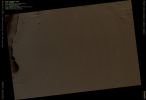
PSP_001408_1900_RED_abrowse.jpgFlows in Athabasca Valles (Natural Colors; credits: Lunexit)57 visiteThin Flows cover the Plains just North of the Source Region for the Athabasca Valles Channel System. The Flows are mostly confined by a Scarp (Cliff) that can be seen in the North-Western corner of the image.
The more heavily Cratered Terrain above the Scarp is part of a tectonic ridge known as a "Wrinkle Ridge". A few Flows can be seen atop the Wrinkle Ridge, but they are not as ubiquitous as those on the Plains below. The Flows on the Plains frequently intersect, with younger ones cutting across older ones.
The prominent dark swathes along their edges have particularly rough textures.
The darker shade is due to thousands of shadows cast by small bumps on the Surface, which HiRISE is able to resolve.
Dozens of bright, narrow Rifts (Cracks) zigzag across the Flows. They appear bright because they are filled with light-toned, windblown material. Wind-sculpted Knobs and Ridges of similar light-toned material are scattered throughout the imaged area.
The orientations of the Ridges indicate that the Winds primarily blow from the South-East. Several impact craters are captured in this image, the largest being about 50 meters (160 feet) in diameter. Many bear the distinctive bright rays characteristic of secondary craters associated with the larger impact crater, Zunil.
Some craters penetrated the surface of the Flows, and the boulders strewn around them suggest that the material they excavated was rocky.MareKromium
(3 voti)
|
|
| 2235 immagini su 187 pagina(e) |
 |
|
|
|
|
104 | |
|
|
|
|





