| Piú votate - Mars Reconnaissance Orbiter (MRO) |

ESP_017736_1550_RED-EB-PCF-LXTT1.jpg15-Km Diameter Unnamed Impact Crater (Absolute Natural Colors; credits: Dr Paolo C. Fienga - Lunexit Team)58 visitenessun commentoMareKromium
(3 voti)
|
|

PSP_002630_1695_RED_abrowse.jpgMelas Chasma (Natural Colors; credits for the additional process. and color.: Dr Paolo C. Fienga - Lunexit Team)57 visiteThis observation shows an Outcrop of bright material in Melas Chasma, part of the giant Valles Marineris Trough (Canyon) System.
These Troughs contain many bright Deposits, often layered. The origin of these materials is still not known, but is the subject of much study because answering this question will provide important information regarding the Geologic History of Mars.
In this image, some layers are visible, but much of the surface has a strange scalloped texture.
The cause of this texture is unclear, but it is likely related to the mechanism of erosion of these Deposits as well as their physical nature. These materials are being eroded by winds, forming elongated ridges called Yardangs.
These winds may also be responsible for the small-scale scalloped texture.
Also, Landslides have produced some Talus Cones, composed of piles of loose debris; these are visible in places, mostly near the base of the Mound, as wedge-shaped features containing many Boulders.MareKromium
(3 voti)
|
|

PSP_002419_1675_RED_abrowse-01.jpgLayers and Dark Debris in Melas Chasma (EDM - Natural Colors; credits for the additional process. and color.: Dr Paolo C. Fienga - Lunexit Team)98 visiteThis EDM shows layering in a light-toned deposit in Melas Chasma.
The layers are sedimentary in origin, but there are many processes that could have deposited them, such as volcanic airfall from explosive eruptions, or dust-size particles settling out of the Atmosphere due to cyclic changes, and deposition in standing bodies of water.
By looking at the slopes in the layers and how the layers intersect each other, scientists can rule out various origins. A darker material can be seen covering much of the Layered Deposit.
Some of this dark material is loose and can be seen accumulating as debris aprons at the base of steep slopes. Other dark material appears indurated and has been eroded by the wind to form etched edges with topographic expressions.
The lack of impact craters on the Layered Deposit indicates that it is a relatively young deposit, or the craters have been removed by the wind, or the deposit was quickly buried and is now being exhumed.MareKromium
(3 voti)
|
|

Volcanoes-Olympus_Mons-PIA12992.jpgOlympus' Edge (Extremely Enhanced Absolute Natural Colors; credits for the additional process. and color.: Dr Paolo C. Fienga - Lunexit Team)61 visiteThis image covers the Northern Edge of the largest Volcano of the Solar System: Olympus Mons.
The margin of Olympus Mons is defined by a massive Cliff which is several kilometers tall. At this location, the Cliff is nearly 7 Km (about 23.000 feet) tall.
The Cliff exposes the guts of the volcano, revealing interbedded hard and soft layers. The hard layers are Lava and the soft layers may be Dust (from large Dust Storms) or Volcanic Ash.
The High Resolution Imaging Science Experiment (HiRISE) camera on NASA's Mars Reconnaissance Orbiter recorded this image on March 2, 2010.
Most scientists think the the Cliffs formed by Landslides. This collapse is driven by the weight of the huge volcano exceeding the strength of the rocks it is built of.
This image covers a swath of ground about 1 Km (such as approx. two-thirds of a mile) wide. It is a portion of HiRISE observation ESP_016886_2030, which is centered at 22,95° North Lat. and 224,76° East Long. The season on Mars is Northern-Hemisphere Spring.
Other image products from this observation are available at http://hirise.lpl.arizona.edu/ESP_016886_2030.MareKromium
(3 voti)
|
|

PSP_001808_1875_RED_abrowse-00.jpgSlope Streaks in Terra Sabaea (CTX Frame - Natural Colors; credits: Dr Paolo C. Fienga - Lunexit Team)59 visiteThis observation shows part of the rim of an Unnamed Crater in the Terra Sabaea Region - Northern Hemisphere of Mars. MareKromium
(3 voti)
|
|
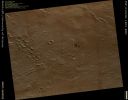
PSP_010200_1805_RED_abrowse-00.jpgFresh Crater Cluster (CTX Frame - Natural Colors; credits: Dr Paolo C. Fienga - Lunexit Team)58 visiteAlthough most of the craters HiRISE usually images are ancient, impact cratering is an ongoing process on the Martian Surface.
While very large craters are rare, smaller ones with diameters of a few meters form on timescales rapid enough for Mars missions to confirm the presence of a new crater. Data from the Mars Orbiter Camera (MOC) on the (now defunct) Mars Global Surveyor, the Context Camera (CTX) on MRO, and HiRISE have dated craters to within a few years or even months, based on repeat images that show no craters in the earlier image and craters present in the later image.
Most of the new craters identified by CTX and HiRISE have been located in Mars' dustiest areas, where a new impact will scour dust from the Surface and reveal darker underlying rock. This color difference makes the craters easier to spot. Other, less dusty areas of Mars are certainly being bombarded as well, but the size of the craters makes them difficult to detect without stark color contrasts.
Once a new dark spot has been identified by CTX, HiRISE will take a follow-up image to confirm that the dark spots are in fact Impact Craters.MareKromium
(3 voti)
|
|

ESP_016173_2005_RED_abrowse-1.jpgSmall Shield Volcano with "Summit Caldera" (CTX Frame - Saturated and Enhanced Natural Colors; credits: Dr Paolo C. Fienga - Lunexit Team) 59 visitenessun commentoMareKromium
(3 voti)
|
|
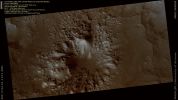
ESP_016136_1525_RED_abrowse-00.jpgColourful Streaks (CTX Frame - Natural Colors; credits: NASA/JPL/Univ. of Arizona and Dr Paolo C. Fienga - Lunexit Team)58 visiteThis is an image of the Central Pit of an Unnamed Impact Crater located in the ancient Southern Highlands.
The Central Uplifts of large Impact Craters often collapse to form Pits on Mars, but they are still structural Uplifts and often expose deep Bedrock with diverse rock types which, like in this case (see the EDM that follows) may show a variety of colors.MareKromium
(3 voti)
|
|

ESP_016136_1525_RED_abrowse-01.jpgColourful Streaks (EDM - possible True Colors; credits: NASA/JPL/Univ. of Arizona and Dr Paolo C. Fienga - Lunexit Team)82 visiteIn this enhanced True Color EDM, we see colorful Streaks, where the bedrock is eroding, moving downhill a bit, then getting swept by the wind.MareKromium
(3 voti)
|
|

PSP_007454_2020.jpgPossible Phyllosilicates in Mclaughlin Crater (High-Def-3D and Natural Colors; credits: Dr M. Faccin - Lunexit Team)59 visiteAcquisition date: 28 February 2008
Mars Local Time: 14:47 (early afternoon)
Latitude (centered): 21,7° North
Longitude: 337,8° East
Range to target site: approx. 287,5 km (about 179,7 miles)
Original image scale range: 28,8 cm/pixel (with 1 x 1 binning) so objects ~86 cm across are resolved
Map projected scale: 25 cm/pixel and North is up
Map projection: EQUIRECTANGULAR
Emission Angle: 0,2°
Phase (Sun-Target-Spacecraft) Angle: 40,1°
Solar incidence angle: 40° (with the Sun about 50° above the Local Horizon)MareKromium
(3 voti)
|
|

PSP_007962_2635_RED_abrowse-01.jpgNorthern Dunes (EDM - Possible Natural Colors; credits: NASA/JPL/Univ. of Arizona and Dr Paolo C. Fienga - Lunexit Team)59 visiteIn this EDM, falling material has kicked up a small cloud of dust. The color of the ice surrounding adjacent streaks of material suggests that dust has settled on the ice at the bottom after similar events.
Also discernible here are Polygonal Cracks in the ice formed on the Dunes (of course the cracks shall disappear when the ice is gone).MareKromium
(3 voti)
|
|
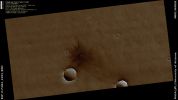
ESP_015962_1695_RED_abrowse-00.jpgRelatively fresh Impact Crater (CTX Frame - Natural Colors; credits: Dr Paolo C. Fienga - Lunexit Team)75 visiteThis image shows a very fresh-looking Impact Crater with an extensive Radial Ejecta Blanket.
The Crater was first seen in an image acquired with MRO's Context Camera (CTX). The best image of this Region prior to CTX was from one of the Viking Orbiters, and the Crater is not visible in it.
This could either mean that the Crater formed sometime between 1976 and 1999, or that there might have been more Dust on the Surface in 1976, or that maybe the air could have been hazy, thus obscuring the Crater.
Based on the HiRISE image, we suspect that the Crater is more than several decades old, because at full resolution we see a "Textured Surface" (see EDM n.2) that is common in Dust-Mantled Regions of Mars, but absent in the youngest craters.MareKromium
(3 voti)
|
|
| 2235 immagini su 187 pagina(e) |
 |
|
|
|
|
103 | |
|
|
|
|





