| Piú votate - Mars Reconnaissance Orbiter (MRO) |

ESP_019560_1650_RED_abrowse-PCF-LXTT.jpgDunes of Coprates Chasma (Absolute Natural Colors; credits for the additional process. and color.: Dr Paolo C. Fienga - Lunexit Team)85 visitenessun commentoMareKromium
(3 voti)
|
|
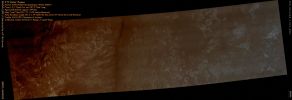
PSP_004384_1705_RED_abrowse-PCF-LXTT.jpgN/W Melas Chasma (Absolute Natural Colors; credits for the additional process. and color.: Dr Paolo C. Fienga - Lunexit Team)82 visiteThis HiRISE image covers a portion of the Wallrock and Canyon Floor in South-Western Melas Chasma.
Along the Floor of Melas Chasma is an unusual Blocky Deposit composed of light-toned Blocks in a darker matrix. The HR provided by the HiRISE camera reveals Layers only a few meters thick in some of the light-toned Blocks. The Blocks vary in size but most fall between approx. 100 up to 500 mts in diameter. Although most Blocks appear rounded, others have angular edges and can be very elongate. The morphologies of the Blocks suggest ductile deformation, such as from a flow or by tectonic disruption after emplacement. Aeolian Ripples are interspersed between the Blocks in the darker Matrix.
Small valleys can be seen along the Wallrock. The Wallrock is a mixture of two geologic units that differ mainly in their reflectance. The light-toned unit appears to be thinner and only exposed in localized spots. Several of the light-toned Deposits are seen only in the Valleys, suggesting they were either deposited or are exposed by erosion.MareKromium
(3 voti)
|
|
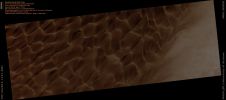
PSP_002824_1355_RED_abrowse-00.jpgDunefield inside Rabe Crater (CTX Frame - Natural Colors; credits for the additional process. and color.: Dr Paolo C. Fienga - Lunexit Team)100 visiteMareKromium
(3 voti)
|
|

ESP_019372_2300_RED_abrowse-00.jpgFeatures of Lyot Crater (Absolute Natural Colors; credits for the additional process. and color.: Dr Paolo C. Fienga - Lunexit Team)89 visitenessun commentoMareKromium
(3 voti)
|
|

ESP_019151_1385_RED_abrowse-02.jpgUnnamed Shallow Craters in Northern Argyre Planitia (EDM n.2 - Absolute Natural Colors; credits for the additional process. and color.: Dr Marco Faccin - Lunexit Team)98 visiteMars Local Time: 15:36 (middle afternoon)
Coord. (centered): 41,1° South Lat. and 313,1° East Long.
Spacecraft altitude: 257,6 Km (such as about 161 miles)
Original image scale range: 51,5 cm/pixel (with 2 x 2 binning) so objects ~155 cm across are resolved
Map projected scale: 50 cm/pixel
Map projection: EQUIRECTANGULAR
Emission Angle: 9,2°
Sun-Mars-Spacecraft (or Phase) Angle: 83,0°
Solar Incidence Angle: 76° (meaning that the Sun is about 14° above the Local Horizon)
Solar Longitude: 139,4° (Northern Summer)
Credits: NASA/JPL/University of Arizona
Additional process. and coloring: Dr Marco Faccin - Lunexit TeamMareKromium
(3 voti)
|
|

ESP_019197_2290_RED_abrowse-03.jpgExtremely unusually-looking Unnamed Northern Crater (EDM n.2 - Absolute Natural Colors; credits for the additional process. and color.: Drr Gianluigi Barca and Paolo C. Fienga - Lunexit Team)85 visitenessun commentoMareKromium
(3 voti)
|
|

ESP_019360_1780_RED_abrowse-01.jpgFeatures of Meridiani Planum (EDM n.1 - Natural Colors; credits for the additional process. and color.: Dr Paolo C. Fienga - Lunexit Team)98 visitenessun commentoMareKromium
(3 voti)
|
|
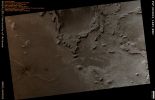
PSP_004091_1845_RED_abrowse.jpgRidges in Terra Meridiani (Absolute Natural Colors; credits for the additional process. and color.: Dr Paolo C. Fienga - Lunexit Team)97 visiteThis HiRISE image shows an arcuate ridge in Terra Meridiani. The ridge is most likely a former streambed, now exposed in inverted relief; the wandering path is not expected for an exhumed fault or volcanic dyke. The stream that formed this ridge must have been ancient as the ridge is buried by brighter rocks, which are themselves very old, having been thickly deposited and then heavily eroded.
The Mars Exploration Rover Opportunity landed in the same region of Mars, and the rocks it has examined are likely part of a sequence similar to that exposed here. The rocks exposed at the Opportunity landing site are mostly aeolian (wind-deposited) sandstone, but show evidence of past water, reaching the surface at times. Opportunity has access to only a few meters of a stack of sediments that is hundreds of meters thick.
Since water was present at times at the Opportunity landing site, surface water elsewhere in the sequence of sediments is perhaps not too surprising. However, evidence like this may indicate that sediments were deposited by a broader range of processes than just those inferred at the Opportunity site. This is important for unraveling the entire history of the region.
A stream channel could become inverted in several ways. Chemicals precipitating from the water could bind the streambed together, lava could fill the channel, or the bed could contain large boulders. In each case, the relatively resistant material of the stream channel could remain as the surrounding rock eroded. Here, the ridge is distant from any volcanic vent, and appears fractured, particularly in the southern portion. This indicates that the ridge material is consolidated and has some strength. Thus, the most likely mechanism for formation of this ridge is deposition of a chemical "cement" which hardened the streambed rock.
The plains surrounding the ridge are also fractured, indicating some degree of consolidation. These cracks could form by desiccation (water loss) from wet sediment or tensile fracturing as the weight of overlying rocks was removed. Cracks like this can also form in permafrost due to seasonal temperature changes; ground ice is unlikely this close to the equator, but it is possible that the cracks are a remnant of different climate conditions from the past.MareKromium
(3 voti)
|
|
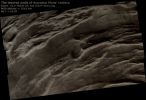
PSP_001444_1915_red.jpgThe Layered Walls of Ascraeus Caldera (Absolute Natural Colors; credits for the additional process. and color.: Dr Paolo C. Fienga - Lunexit Team)70 visitenessun commentoMareKromium
(3 voti)
|
|

ESP_019256_1530_RED_abrowse-00.jpgThe "White Cliffs" of Holden Crater (CTX Frame - Natural Colors; credits for the additional process. and color.: Dr Paolo C. Fienga - Lunexit Team)67 visitenessun commentoMareKromium
(3 voti)
|
|
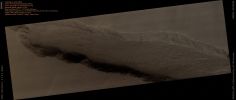
PSP_004412_1715_RED_abrowse-PCF-LXTT.jpgArsia "Dusty" Layers (Absolute Natural Colors; credits for the additional process. and color.: Dr Paolo C. Fienga - Lunexit Team)72 visiteThis image covers a Pit in the lower West Flank of Arsia Mons, one of the 4 giant Volcanos of the Tharsis Region.
Many Layers are exposed in the Pit, probably marking individual Lava Flows that overlapped (meaning: ONE Layer - ONE Flow), and provide information about the nature of the volcanic eruptions. This image was acquired in the middle of large regional Dust Storms on Mars, but the Atmosphere over this image is only moderately dusty because the altitude is 6,5 Km higher than the Planetary Mean (-----> media altitudine planetaria), so the air is quite thin and cannot hold as much Dust.
Although the Atmosphere is not too dusty, the Surface is buried by a Dust Layer that might be meters thick. These high-altitude locations on Mars have thick Dust Deposits because the thin air cannot blow away the Dust, or at least not as fast as it accumulates. On Earth the Oceans serve as "Dust Traps", while on Mars such Traps are the highest Volcanoes. MareKromium
(3 voti)
|
|
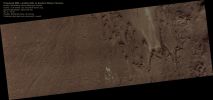
PSP_003843_1680_RED_abrowse.jpgPossible MSL Landing Side in Eastern Melas Chasma (Natural Colors; credits for the additional process. and color.: Dr Paolo C. Fienga - Lunexit Team)68 visitenessun commentoMareKromium
(3 voti)
|
|
| 2235 immagini su 187 pagina(e) |
 |
|
|
|
|
100 | |
|
|
|
|





