| Piú votate - The Universe Inside |

Voyagers-01.gifTowards the "Terra Incognita" (2)100 visiteIt is appropriate to consider the VIM as three distinct phases: the termination shock, heliosheath exploration, and interstellar exploration phases. The two Voyager spacecraft began the VIM operating, and are still operating, in an environment controlled by the Sun's magnetic field with the plasma particles being dominated by those contained in the expanding supersonic solar wind. This is the characteristic environment of the termination shock phase. At some distance from the Sun, the supersonic solar wind will be held back from further expansion by the interstellar wind. The first feature to be encountered by a spacecraft as a result of this interstellar wind/solar wind interaction will be the termination shock where the solar wind slows from supersonic to subsonic speed and large changes in plasma flow direction and magnetic field orientation occur.
Passage through the Termination Shock ends the Termination Shock Phase (TSP) and begins the Heliosheath Exploration Phase (HEP). Voyager 1 in 2004 completed the TSP of the mission when the spacecraft was 94 AU from the Sun. After passage through the Termination Shock, the spacecraft will be operating in the Heliosheath environment which is still dominated by the Sun's Magnetic Field and particles contained in the Solar Wind. The HEP ends with passage through the Heliopause which is the outer extent of the Sun's Magnetic Field and Solar Wind. The thickness of the Heliosheath is uncertain and could be tens of AU thick taking several years to traverse. Passage through the Heliopause begins the Interstellar Exploration Phase (IEP) with the spacecraft operating in an interstellar wind dominated environment. This interstellar exploration is the ultimate goal of the Voyager Interstellar Mission.MareKromium
(17 voti)
|
|

CloudsandStars.jpgIn the twilights...74 visitenessun commentoMareKromium
(17 voti)
|
|
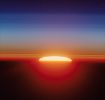
In the Mind-1.jpgIn the mind107 visitenessun commento
(17 voti)
|
|

Tomorrow.jpgTomorrow never dies...92 visitenessun commento
(17 voti)
|
|

Aurora Borealis - Norway.jpgBlack Aurora over Norway92 visiteDa "NASA - Picture of the Day" del 29 Marzo 2006:"What causes gaps between aurora curtains? These unusual gaps can make auroral displays appear more detailed and intricate. Research using data from four Cluster Spacecraft orbiting the Earth has likely found the secret: auroral gaps, sometimes knows as "black auroras", are actually anti-auroras. In normal auroras, electrons and/or predominantly negatively charged particles fall toward Earth along surfaces of constant magnetic field. They ionize the Earth's atmosphere on impact, causing the bright glows. In auroral gaps, however, negatively charged particles may be sucked out from the Earth's ionosphere along adjoining magnetic field lines. These dark anti-auroras can climb to over 20.000 Km and last for several minutes. Pictured above, a series of well-defined auroral gaps is seen dividing green aurora curtains high above Harstad, Norway, earlier this month".
(17 voti)
|
|
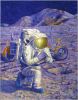
ALANBEAN-PRAYER.jpgLunar Prayer194 visitenessun commento
(17 voti)
|
|
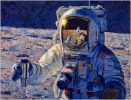
ALANBEAN-CORETUBE.jpgCore-Tube130 visiteDalla Galleria Pittorica dell'Astronauta Alan Laverne Bean: un Omaggio alla Luna ed a quei pochi che ebbero il coraggio, la fortuna ed il privilegio di camminarci sopra.
Ma lasciamo che sia "Alan" a raccontarci questa storia: la "Sua Storia"...
"...When my book, "Apollo, An Eyewitness Account", was published in October of 1998, I felt an overall sense of satisfaction. I was, in fact, preserving some of my special memories of the Apollo Program. This was the reason I resigned from NASA to become an artist.
I was moving right along but I noticed my goals for the future were even more ambitious. I wanted to paint the Moon more beautifully than I had done so far, as colorful as it could be painted, and still look like the Moon to me, a worthy but elusive goal.
I stopped painting commissions and began painting several series of studies to explore and develop new color techniques and combinations. This intense and dedicated effort consumed me for the better part of a year with the resulting changes first coming to full fruition in this painting.
Sometimes when I look at this painting I wonder if the changes were all that much. I question if anyone other than me can see them or even care? I don't know. Was it worth the time? I hope so...".
(17 voti)
|
|
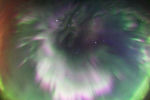
Aurora_Borealis-Coronal_Aurora-sep11aurora_moussette_f.jpgNorthern Lights over Canada75 visiteSo far, the Aurora Borealis - or "Northern Lights" - have made some remarkable visits to September's Skies. The reason, of course, is the not-so-quiet Sun. In particular, a large solar active region now crossing the Sun's disk has produced multiple, intense flares and a large Coronal Mass Ejection (CME) that triggered wide spread auroral activity just last weekend. This colorful example of spectacular curtains of aurora was captured with a fish-eye lens in skies over Quebec, Canada, on September 11, 2005.
Also featured is the planet Mars, the brightest object above and left center. Seen near Mars (just below and to the right) is the tightly knit Pleiades star cluster.
Although they can appear to be quite close, the Northern Lights actually originate at extreme altitudes, 100 Km or so above the Earth's surface.
(17 voti)
|
|

Sunrise.jpgCrepuscular Rays Over Utah83 visiteDa "NASA - Picture of the Day", del 31 Agosto 2005:"What could cause such rays of dark? Dark sky rays were caught in spectacular fashion earlier this month above Utah, USA. The cause is something surprisingly familiar: shadows. Clouds near the horizon can block sunlight from reflecting off air, making columns outward from the Sun appear unusually dark. Cloud shadows can be thought of the complement of the more commonly highlighted crepuscular rays, also visible above, where sunlight pours though cloud holes. Sometimes, on the opposite side of the sky, anticrepuscular rays can also be seen".
(17 voti)
|
|

YoungMoon.jpgYoung Moon144 visite'Luna Giovane'. L'ultima 'Luna Giovane' risale al 9 Maggio scorso (AD 2005) e questa fotografia la riprende mentre essa è giunta alla sua 34ma ora (e 18') di 'vita'.
In effetti, quando si calcola l'età della Luna durante una completa lunazione (ossia un intero "ciclo di tutte le sue fasi") - dalla Luna Nuova alla Luna Piena e quindi ancora alla Luna Nuova - la Luna non 'invecchia' mai più di 29 giorni e 12 ore.
A parte questa piccola curiosità, ci piace sottolineare che la Luna Giovane, quando appare come una sottilissima falce nel nostro cielo, non è solo un grande spettacolo offerto dalla Natura (ed un grande piacere 'visivo'!), ma è anche un momento assai propizio - come accade durante le eclissi - per cercare di vedere dei TLP o anche di cogliere dei bagliori da impatti sul suo lato in ombra.
Certo, ci vuole una grande dose di fortuna per cogliere questi rarissimi fenomeni mentre accadono ma...Se non si prova neppure quando il momento è favorevole, allora non si riuscirà mai a vederli!
O no?!?
(17 voti)
|
|

Sun pillar.jpgAnother light Sun Pillar92 visitenessun commento
(17 voti)
|
|

AlphaCentauriOne.pngUnder Alpha Centauri...83 visitenessun commentoMareKromium
(16 voti)
|
|
| 495 immagini su 42 pagina(e) |
 |
|
|
|
|
9 | |
|
|
|
|








