| Piú votate - The Universe Inside |

SolarHalo-2-MF.jpgSolar Halo (credits: Dr Marco Faccin)91 visitenessun commentoMareKromium
(18 voti)
|
|

SolarHalo-3-MF.jpgSolar Halo (credits: Dr Marco Faccin)104 visitenessun commentoMareKromium
(18 voti)
|
|

M-45~0.jpgM 45 and Venus89 visite"...L'Opium agrandit ce qui n'a pas de bornes,
Allonge l'Illimité,
Approfondit le Temps, creuse la Volupté,
Et de plaisirs noirs et mornes
Remplit l'ame au-delà de sa capacité..."
Charles Baudelaire (1821 - 1867) - "Le Poison" (1857)
(18 voti)
|
|

The_Sun~0.jpgNorouz...82 visiteCaption NASA:"Clouds covered the eastern horizon on Monday, when the Sun rose over the expansive Touran Wildlife Reserve in North-Eastern Iran. Of course, on that day the Moon rose with the Sun, creating a widely enjoyed partial solar eclipse. Along with a mountainous horizon, the cloud cover lent a dramatic aspect to this eclipse sunrise and made it possible for astronomer Babak Tafreshi to record these telephoto images without using a filter. Advancing north in planet Earth's sky, the Sun itself was also approaching the equinox, the astronomical marker for the first day of Northern Hemisphere Spring and the beginning of Norouz, the Persian New Year".
(18 voti)
|
|
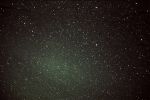
Counter-glow.jpgThe Gegenshein (or "Counter Glow") Effect in Pisces77 visiteDa "NASA - Picture of the Day", del 26 Dicembre 2006:"If you look carefully enough, you can even see the glow of the Sun in the opposite direction. At night this glow is known as the Gegenschein (German for "Counter Glow"), and can be seen as a faint glow in an extremely dark sky. The Gegenschein is sunlight back-scattered off small interplanetary dust particles. These dust particles are millimeter sized splinters from asteroids and orbit in the ecliptic plane of the planets.
Pictured above, the gegenschein is seen superposed toward the constellation of Pisces. The Gegenschein is distinguished from Zodiacal Light by the high angle of reflection. During the day, a phenomenon similar to the Gegenschien - called "The Glory" - can be seen in reflecting air or clouds opposite the Sun from an airplane".MareKromium
(18 voti)
|
|

SPACEVISION-P-019-05703.jpgSpace-Vision72 visite
(18 voti)
|
|

Polar Flash.jpgPolar "Flash"84 visitenessun commento
(18 voti)
|
|

Earthly Sky.jpgNot a "Nebular Cloud"...Just a "cloud"!132 visitenessun commento
(18 voti)
|
|

SN 1006-1.jpgSN 1006: A New Sun over the Ocean...92 visite...Si tratta soltanto di una - riuscita - ricostruzione/falsificazione, ma il risultato finale è comunque molto bello e ci dimostra, una volta ancora, che se si è capaci di "giocare" con le immagini, si può creare qualsiasi cosa e si può ingannare chiunque...
Caption originale:"A new star, likely the brightest supernova in recorded human history, appeared in planet Earth's sky about 1000 years ago, in 1006 AD. The expanding debris cloud from the stellar explosion is still visible to modern astronomers, but what did the supernova look like in 1006? In celebration of the millennial anniversary of SN1006, astronomer Tunc Tezel offers this intriguing suggestion, based on a photograph he took on February 22, 1998 from a site overlooking the Mediterranean Sea, south of Antalya, Turkey. On that date, bright Venus and a waning crescent Moon shone in the early morning sky. Adopting calculations which put the supernova's apparent brightness between Venus and the crescent Moon, he digitally superposed an appropriate new star in the picture. He placed the star at the supernova's position in the southerly constellation of Lupus and used the water's reflection of moonlight in the final image".
(18 voti)
|
|

Sun_Pillar_in_blue_and_violet.jpgSun Pillar from Lake Tahoe - Nevada State Park (USA)132 visiteCaption originale NASA: "Sometimes the unknown is beautiful. In 2000 February near Lake Tahoe, Nevada, two amateur photographers noticed an unusual red column of light rise mysteriously from a setting sun. During the next few minutes, they were able to capture the pillar and a photogenic sunset on film. Pictured above, the red column is seen above a serene Lake Tahoe and snow-capped mountains across from Lake Tahoe-Nevada State Park. The mysterious column, they learned later, is a Sun Pillar, a phenomenon where sunlight reflects off of distant falling ice crystals".
(18 voti)
|
|

Sun_Pillar.jpgA light "Sun-pillar" from somewhere in USA104 visiteCaption originale NASA. "Have you ever seen a sun pillar? When the air is cold and the Sun is rising or setting, falling ice crystals can reflect sunlight and create an unusual "column of light". Ice sometimes forms flat, stop-sign shaped crystals as it falls from high-level clouds; air resistance causes these crystals to lie nearly flat much of the time as they flutter to the ground. Then sunlight reflects off crystals that are properly aligned, creating the so-called "Sun-pillar" effect".
(18 voti)
|
|

Colourful_Earth.jpgEarth, from Monochrome to Polychrome (by Roberto Tremolada)75 visitenessun commentoMareKromium
(17 voti)
|
|
| 495 immagini su 42 pagina(e) |
 |
|
|
|
|
8 | |
|
|
|
|








