| Piú votate - The Universe Inside |

SUN___VENUS.jpgVenus and the Sun: the transit of June, 9, 2004 (1)205 visiteUn'immagine molto suggestiva che testimonia il recente transito (9 Giugno 2004) del Pianeta Venere davanti al Sole.
Le immagini che Vi mostriamo (questa e le due seguenti), forse a causa della "fama comune" che il Pianeta Venere possiede (anche in ragione del nome che porta), suggeriscono quiete, dolcezza e, comunque, calma.
Ma Venere non è affatto così, anzi... 
(24 voti)
|
|

Earth___Mars.jpgEarth and Mars213 visiteDa "NASA - Picture of the Day" del 12 Aprile 2005:"Which image is Earth and which is Mars? One of the above images was taken by the robot Spirit Rover currently climbing Husband Hill on Mars. The other image was taken by a human across the desert south of Morocco on Earth. Both images show vast plains covered with rocks and sand. Neither shows water or obvious signs of life. Each Planet has a surface so complex that any one image does not do that planet justice. Understanding either one, it turns out, helps understand the other. Does the one on the left look like home? Possibly not, but it is Earth".
Una splendida immagine, un'intelligente comparazione, una ovvia domanda: siamo proprio certi che Marte sia un Pianeta "morto"?!?
(23 voti)
|
|

Coscientia.jpgCoscientia213 visite"...Sublata Conscientia, iacent omnia..."
(Cicerone)
(37 voti)
|
|

ZW-The Moon and Jupiter.jpgMoon and Jupiter146 visiteUn'immagine amatoriale davvero eccellente che ci arriva dalla cittadina di Atmore - Alabama, USA - e pubblicata sul Sito NASA - Picture of the Day del giorno 9 Dicembre 2004.
Ben visibili, accanto a Giove, guardando il versante superiore della Luna (e, per l'esattezza, quella sua parte che ci appare debolmente illuminata a causa del "chiaro di Terra"), riusciamo a vedere due "Satelliti Galileiani": Ganymede (quello più prossimo a Giove) e Callisto.
Complimenti al Sig. Westlake per l'immagine!
(18 voti)
|
|

Il Volo~0.jpgIl Volo214 visiteTecnica realizzativa: mista (acquarelli e china)
Dimensioni: 100 x 70
Realizzato su: cartoncino
(34 voti)
|
|
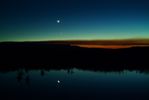
Inner_Worlds-jul8_westlake_f.jpgInner Worlds, in the Sunset...142 visiteDa "NASA - Picture of the Day" del 15 Luglio 2005:" Only Mars is missing from this reflective view of the major rocky bodies of the Inner Solar System. Captured on July 8th, the serene, twilight picture looks out over the Flat Tops Wilderness area from near Toponas, Colorado, USA and includes planets Mercury, Venus, Earth and Earth's large natural satellite, the Moon. The Moon is in a young crescent phase about 3° above bright planet Venus. Forest fires contribute to a layer of smoke in Earth's sky that almost hides planet Mercury, still visible very near the horizon.
Just a week earlier Venus and Mercury were joined by Saturn, forming a notable grouping in the West also enjoyed by skygazers across planet Earth".
(16 voti)
|
|

lake_of_legends_1600.jpgNevermore...162 visite
(44 voti)
|
|

VENUS___SUN_3.jpgVenus and the Sun148 visiteMa c'é dell'altro: la temperatura superficiale del Pianeta è stabile attorno ai 900 F (pari a circa 480/90° C); la pressione al suolo è circa 90 volte maggiore di quella Terrestre al livello del mare e, ultimo ma non meno importante dato, il Pianeta è quasi costantemente innaffiato da una pioggia corrosiva a base di Acido Solforico (H2SO4, per gli amanti delle formulette...).
E' a causa di queste condizioni di estrema ostilità che tutte le Missioni finalizzate ad un landing su Venere sono, almeno con la tecnologia sino ad oggi in nostro possesso, destinate all'insuccesso anche se, a dire il vero, ben 4 Sonde Sovietiche - Venera 9, 10, 13 e 14 - riuscirono a scendere sul Pianeta e, prima di perire, furono comunque capaci di inviarci qualche prezioso fotogramma.
(21 voti)
|
|

Sunset-PCF-00.jpgSunset from Legnano (Natural Colors; credits: Dr Paolo C. Fienga)214 visitenessun commento
(32 voti)
|
|

Jupiter_and_Europa.jpgFather and Son (by Roberto Tremolada)89 visitenessun commentoMareKromium
(7 voti)
|
|

Polygons.jpgMartian Polygons (by Michael Hager)119 visitenessun commentoMareKromium
(7 voti)
|
|

ZA-Green flash from the Sun.jpgAnother "green flash" from the Sun (Finland)157 visiteThe same phoenomenon represented by the previous picture.
(32 voti)
|
|
| 496 immagini su 42 pagina(e) |
 |
|
|
|
|
|
|
39 | |
|
|








