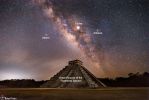
Equinox_at_the_Pyramid_of_the_Feathered_Serpent.jpgEquinox at the Pyramid of the Feathered Serpent (Image Credit & Copyright: Robert Fedez - Credits for the Author of lyrical prose: Dr. Paolo C. Fienga)165 visiteWhat If…
(…Justice, according to some, is Truth, while Others believe that Justice means Vengeance.
Now, since I know the Truth and I want Justice, I will seek for Revenge.
And Revenge shall be mine…)
§§§
When I was a child, long ago, my Father taught me to watch the Sky, learn the name of the Stars and Constellations.
He taught me to love the Infinite above us and ask myself lots of questions.
I had to do that, even though I had to know that I could have never get any answer. But I was supposed to watch, learn, and meditate. No matter what the outcome of all those efforts might have been.
Now, after many years have come and gone, I still do the same.
When I lay down, in my bed, at night, I see the Stars, lost in a never-ending Darkness.
When I wake up, at dawn, and I look around and what I’m supposed to do, I only see emptiness. Banalities. Misery. Insane disputes that have their foundation in our unfathomable ignorance and stupidity.
I hear inane chatters, dialogues full of commonplaces, empty promises, and clear nonsenses.
Then I ask myself, every day, what actually powers the World, and I understand that our World is not powered by Faith, Energy, Beauty, Love or Empathy and Pity.
Our World runs on lies.
The same lies that make us go through miserable and dead-slow days, spent in an often-desperate search of what we believe is good for us.
We believe that everything will work fine and that, in the end, we shall get our well-deserved reward.
We shall be prompt, precise, on time, rightful and forgiving.
This, all this is what we have been taught that we needed and useful to survive.
So, we also believe that everything we have studied and learned, is the Truth.
And the Truth shall make us free.
We believe in an endless Universe that works like a clock. Only that this Clock is eternal. Immutable. Fixed.
We believe that the Universe does not need to be fully explained, because it explains itself just by the fact that it exists, and we can see it.
At least, a small part of it.
The books explain this in many ways.
And those explanations are the Truth.
A Truth that makes us worthy of living.
But…
What if our teachers lied to us?
And the same was done by our loved ones, when they said they loved us?
Do we have to believe in Love just because of the fact that Love is something eternal and endless?
Do we have to believe that Love is something fit to explain all our hopes, illusions, disappointments, mistakes, and misconducts?
What if our engine, what we have named “Love”, is just something deeply false and nonexistent?
And, if it really does exist, is simply wrong in its foundations and is actually malfunctioning, pushing us at doing and believing in things we do not truly care and believe in?
What if all our dreams, and sacrifices, and good actions, are just illusions founded on a profound misunderstanding?
A misperception of Reality?
What if we are all misled by Love because Love simply does not exist and, if it does, it is something we just dream of, at night, when the blanket of our deepest Truths disappears, thus leaving us surrounded by the sick and naked Reality?
The Reality that we are all alone, eternally lost in a Universe that only lives in our minds?
In our unachievable dreams?
In our fake and fading pity and empathy?
In our empty and opportunistic Faith, perhaps?
What if the Truth is that there is no Truth at all?
What if we are all the unwanted sons of a way too demanding Mother and a mischievous Father?
What if nothing is actually real or, at least, not as real as we thought it was?
That is why we need lies.
We need them to justify our misdeeds and still unpunished intellectual arrogance.
But, above all, we need lies to justify our own pathetic existence that has no other and further meaning, but depriving Others from their good right to believe that we were deeply wrong.
We need lies to explain our lack of capacity to see things for what they really are, such as nothing.
The Universe is empty.
Like the Paradise and Hell: they are all empty.
Like us.
And now, in my old age, and now, that all my tears have been shed and dried up, and now, that all the pains that my flesh is heir to have come and gone, I can finally open my eyes and look around.
But there is nothing to see.
Nothing to live or fight for.
Nobody to hate, and nobody to love, anymore.
I’m alone, in this endless nothing that wraps the whole and inexistent Universe.
I’m alone.
The Universe does not exist.
And, if it ever existed, it’s now passed away.
And so did I.
Amen.
MareKromium
(3 voti)
|
|

Grigna-WhatsApp_Image_2019-11-16_at_22_27_10_(4).jpgEternity does not mean Forever (by Giovanni Casile)153 visite"...C'é chi crede di sapere, c'é chi sa di non sapere, c'é chi dice di sapere e non sa, e c'é chi veramente sa e non lo dice...".
Luciano Meran DonatoniMareKromium
(3 voti)
|
|
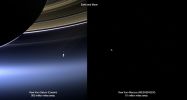
Us.jpgIn loving Memory99 visiteToday, July 15, 2026, my father Ugo and my mother Jolanda would have celebrated 65 years of marriage. However, they've been gone for years. I like to think that, one day, I'll see them again. Happy and together again.
For now, I send a prayer for them into the Cosmos, with all the Love in the Universe.
Dr. Paolo C. FiengaMareKromium
(2 voti)
|
|
Y__Klein_On-Fire.jpgThe Fire of the Human Mind (Credits: Yves Klein)58 visiteAlbert Einstein: „Gott würfelt nicht mit dem Universum.“
Niels Bohr (Antwort): „Hört auf, Gott vorzuschreiben, was er mit seinen Würfeln machen soll!“
(Traduzione)
Albert Einstein: "Dio non gioca a dadi con l'universo.
Niels Bohr (rispondendogli): "Smetti di dire a Dio cosa dovrebbe fare con i suoi dadi!"MareKromium
(1 voti)
|
|

OPP-SOL718-1P191898778EFF64KWP2733L1M1-1.jpgMartian Sky (Abstraction by Paolo C. Fienga)259 visite"A pessimist is a man who would complain about the noise if fortune knocked at his door."
(anonymous author)MareKromium
(1 voti)
|
|

Sunset-128565.jpgReddish Clouds (Credits: Tatiana Balbiani)204 visite"...Do you think quantum physics has the answer?
Excuse me, but what good is it to me that time and space are exactly the same thing?
I mean, I ask someone what time it is and they say, "6 kilometers." What the hell is that?..."
Woody Allen, in Anything Else, 2003MareKromium
(1 voti)
|
|

Sunset-128564-1.jpgAfter Betelgeuse goes Supernova (Fantasy - Credits: Tatiana Balbiani)206 visite"...Those who aren't shocked when they first encounter quantum theory most likely haven't understood it.
And if quantum physics doesn't confuse them, then they certainly haven't understood it..."
(Traduzione)
"Coloro che non rimangono sconvolti quando si imbattono per la prima volta nella teoria quantistica molto probabilmemte non l'hanno capita.
E se la fisica quantistica non li confonde, allora sicuramente non l'hanno capita".
Niels BohrMareKromium
(1 voti)
|
|

home_land_1600.jpgMy Homeland7558 visite
(79 voti)
|
|








