| Piú votate - The Universe Inside |

The_Moon~2.jpgFull Moonlight (Credits & Copyright: Zhengjie Wu and Jeff Dai - TWAN)125 visiteThe Full Moon is the brightest lunar phase, and tonight you can stand in the light of the first Full Moon of 2026. In fact, the Moon's full phase occurs on January 3 at 10:03 UTC, while only about 7 hours later planet Earth reaches its 2026 perihelion, the closest point in its elliptical orbit around the Sun, at 17:16 UTC. January's Full Moon was also not far from its own perigee, or closest approach to planet Earth. For this lunation the Moon's perigee was on January 1 at 21:44 UTC.MareKromium
(3 voti)
|
|

Dyson_Swarm_-_03.jpgThe Dyson Sphere174 visiteHow It Works: each satellite in the Swarm absorbs or reflects the star’s sunlight and beams it to where it is needed—such as to an inhabited planet or orbital space stations.
Uses: the captured energy could power an entire civilization, propel massive spaceships using photon sails, or run planetary-scale supercomputers and artificial intelligence networks.
Materials: constructing a comprehensive Swarm requires a staggering amount of raw materials. Theorists suggest that disassembling an entire rocky planet, like Mercury, could provide enough mass to build the initial stages of a Swarm.
Gradual Build: our Civilization wouldn't build a full Swarm all at once. We would likely start with a "proto-swarm" consisting of space-based solar arrays, expanding it over thousands of years.MareKromium
(3 voti)
|
|

Dyson_Swarm_-_01.jpgThe Dyson Swarm146 visiteSome have suggested that Dyson Sphere habitats could be built around white dwarfs or pulsars.
In 2022 it was suggested that a Dyson Swarm around the Sun could be launched from either Mercury or Mars.
In order to transmit the energy back (Microwaves and high frequency IR Radiations maybe?), far-field radiative wireless power transfer was proposed, a technology that is not yet fully developed. But the question remains open...
A Dyson swarm is a hypothetical megastructure that orbits a star to capture its radiant energy. Proposed as an alternative to the solid, unbuildable "Dyson Sphere," it consists of a vast cloud of independent satellites or habitats that harness massive amounts of stellar power.
The Inspiration: Physicist Freeman Dyson first proposed the concept in 1960. He theorized that highly advanced alien civilizations would require exponentially more energy than a single planet could provide, prompting them to build structures around their host star.
Dyson Sphere vs. Dyson Swarm: Dyson Sphere vs. Dyson Swarm: While a traditional "Dyson sphere" is often imagined in sci-fi as a single, solid shell around a star, this is mechanically impossible due to immense gravitational stresses. A swarm solves this by using millions or billions of independent solar collectors, mirrors, and space habitats traveling in their own individual orbits. MareKromium
(3 voti)
|
|
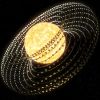
Dyson_Swarm_-_04.jpegThe Dyson Swarm169 visiteBecause these megastructures absorb so much starlight, they would emit a unique infrared signature (waste heat). Astronomers look for these anomalies when searching for highly advanced, Extraterrestrial Civilizations (so-called "Technosignatures").MareKromium
(3 voti)
|
|

Dyson_Sphere_-_07.jpegThe Dyson Sphere197 visiteAlthough Dyson Spheres in the form of a swarm are theoretically possible, building a stable megastructure around the Sun is currently far beyond humanity's engineering capacity. The number of craft required to obtain, transmit, and maintain a complete Dyson sphere exceeds present-day industrial capabilities.
Dyson Spheres have prompted speculation into the feasibility of a class of proposed stellar engines, hypothetical megastructures whose purpose is to extract useful energy from a star, sometimes for specific purposes.
For example, Matrioshka brains have been proposed to use energy extracted by Dyson Spheres for computation, while Shkadov thrusters would extract energy for propulsion. Some proposed stellar engine designs are based on the Dyson Sphere. Futurist George Dvorsky has advocated the use of self-replicating robots to overcome the limitation of humanity's engineering capacity in the relatively near term.MareKromium
(3 voti)
|
|

Dyson_Sphere_-_06.jpegThe Dyson Sphere180 visiteOn October 14, 2015, Planet Hunters' citizen scientists discovered unusual light fluctuations of the star KIC 8462852 raising press speculation that a Dyson sphere may have been discovered. However, subsequent analysis showed that the results were consistent with the presence of dust.
In 2024 there was press speculation that potential signs of interstellar Dyson spheres had been discovered.
The seven objects of interest – all located within a thousand light-years of Earth – were M-dwarfs, a class of stars that are smaller and less luminous than the Sun. However, the authors of the findings were careful not to make any overblown claims. Despite this, many media outlets picked up on the story.
Less fantastical explanations included a suggestion that the detected infrared was caused by distant dust-obscured galaxies.MareKromium
(3 voti)
|
|

Dyson_Sphere_-_03.jpgThe Dyson Sphere (here: Complex and interconnected Dyson Swarm)168 visiteDyson-style energy collectors around a distant star would absorb and re-radiate energy from the star. The wavelengths of such re-radiated energy may be atypical for the star's spectral type, due to the presence of heavy elements not naturally occurring within the star.
If the percentage of such atypical wavelengths were to be significant, an alien megastructure could be detected at interstellar distances. This could indicate the presence of what has been called a Type II Kardashev civilization.
SETI has looked for such infrared-heavy spectra from solar analogs, as has Fermilab. Fermilab discovered 17 potential "ambiguous" candidates, of which four were in 2006 called "amusing but still questionable". Later searches also resulted in several candidates, all of which remain unconfirmed.MareKromium
(3 voti)
|
|

Dyson_Sphere_-_02.jpgThe Dyson Sphere241 visiteSince Dyson's paper, many variant designs involving an artificial structure or series of structures to encompass a star have been proposed in exploratory engineering or described in science fiction, often under the name "Dyson sphere". Fictional depictions often describe a solid shell of matter enclosing a star – an arrangement Dyson himself considered impossible. The sphere he imagined consisted of a loose collection or swarm of objects traveling on independent orbits around the star, an arrangement that has become known as a Dyson Swarm.MareKromium
(3 voti)
|
|

Dyson_Sphere_-_01.jpgThe Dyson Sphere (here: Dyson Revolving Rings)179 visiteDyson speculated that such structures would be the logical consequence of the escalating energy needs of a technological civilization and would be a necessity for its long-term survival. A signature of such spheres detected in astronomical searches would be an indicator of extraterrestrial intelligence.MareKromium
(3 voti)
|
|

Dyson_Sphere_-_00_jpg.jpegThe Dyson Sphere181 visiteA Dyson Sphere is a hypothetical megastructure that encompasses a star and captures a large percentage of its power output. The concept is a thought experiment that attempts to imagine how a spacefaring civilization would meet its energy requirements once those requirements exceed what can be generated from the home planet's resources alone. Because only a tiny fraction of a star's energy emissions reaches the surface of any orbiting planet, building structures encircling a star would enable a civilization to harvest far more energy.
The earliest modern imagining of such a structure was by Olaf Stapledon in his science fiction novel Star Maker (1937). The same concept was later used by physicist Freeman Dyson in his 1960 paper "Search for Artificial Stellar Sources of Infrared Radiation". Dyson speculated that such structures would be the logical consequence of the escalating energy needs of a technological civilization and would be a necessity for its long-term survival. MareKromium
(3 voti)
|
|

Voyager_1A.jpgFarewell...132 visiteOn April 17, 2'26, engineers at NASA’s Jet Propulsion Laboratory (JPL) in Southern California sent commands to shut down an instrument aboard Voyager 1 called the Low-energy Charged Particles experiment, or LECP. The nuclear-powered spacecraft is running low on power, and turning off the LECP is considered the best way to keep humanity’s first interstellar explorer going.
The LECP has been operating almost without interruption since Voyager 1 launched in 1977 — almost 49 years. It measures low-energy charged particles, including ions, electrons, and cosmic rays originating from our solar system and galaxy. The instrument has provided critical data about the structure of the interstellar medium, detecting pressure fronts and regions of varying particle density in the space beyond our heliosphere. The twin Voyagers are the only spacecraft that are far enough from Earth to provide this information.
Like Voyager 2, Voyager 1 relies on a radioisotope thermoelectric generator, a device that converts heat from decaying plutonium into electricity. Both probes lose about 4 watts of power each year. After almost a half-century in space, power margins have grown razor thin, requiring the team to conserve energy by shutting off heaters and instruments while making sure the spacecraft don’t get so cold that their fuel lines freeze.
During a routine, planned roll maneuver on Feb. 27, Voyager 1’s power levels fell unexpectedly. Mission engineers knew any additional drop in power could trigger the spacecraft’s undervoltage fault protection system, which would shut down components on its own to safeguard the probe, requiring recovery by the flight team — a lengthy process that carries its own risks.
The Voyager team needed to act first.
“While shutting down a science instrument is not anybody’s preference, it is the best option available,” said Kareem Badaruddin, Voyager mission manager at JPL. “Voyager 1 still has two remaining operating science instruments — one that listens to plasma waves and one that measures magnetic fields. They are still working great, sending back data from a region of space no other human-made craft has ever explored. The team remains focused on keeping both Voyagers going for as long as possible.”
Far-out plan
The choice of which instrument to turn off next wasn’t made in the heat of the moment. Years ago, the Voyager science and engineering teams sat down together and agreed on the order in which they would shut off parts of the spacecraft while ensuring the mission can continue to conduct its unique science. Of the 10 identical sets of instruments that each spacecraft carries, seven have been shut off so far. For Voyager 1, the LECP was next on that list. The team shut off the LECP on Voyager 2 in March 2025.
Because Voyager 1 is more than 15 billion miles (25 billion kilometers) from Earth, the sequence of commands to shut down the instrument will take 23 or so hours to reach the spacecraft, and the shutdown process itself will take about three hours and 15 minutes to complete. One part of the LECP — a small motor that spins the sensor in a circle to scan in all directions — will remain on. It uses little power (0.5 watts), and keeping it running gives the team the best chance of being able to turn the instrument back on someday if they find extra power.
What comes next
Engineers are confident that shutting down the LECP will give Voyager 1 about a year of breathing room. They are using the time to finalize a more ambitious energy-saving fix for both Voyagers they call “the Big Bang,” which is designed to further extend Voyager operations. The idea is to swap out a group of powered devices all at once — hence the nickname — turning some things off and replacing them with lower-power alternatives to keep the spacecraft warm enough to continue gathering science data.
The team will implement the Big Bang on Voyager 2 first, which has a little more power to spare and is closer to Earth, making it the safer test subject. Tests are planned for May and June 2026. If they go well, the team will attempt the same fix on Voyager 1 no sooner than July. If it works, there is even a chance that Voyager 1’s LECP could be switched back on.MareKromium
(3 voti)
|
|

AuroraTree_Wallace_960.jpgThe Aurorae Tree (Image Credit & Copyright: Alyn Wallace)152 visiteDeath Will Come And Will Have Your Eyea
Death will come and will have your eyes.
This death that accompanies us
From morning to night, sleepless,
Deaf, like an old remorse,
Or an absurd vice.
Your eyes will be a vain word,
A silent cry, a silence.
This is how you see them every morning,
When you bend over yourself alone,
In the mirror.
O dear Hope,
That day we too will know
That you are life and you are nothing.
Death has a gaze for everyone.
Death will come and will have your eyes.
It will be like giving up a vice,
Like seeing in the mirror,
Reemerging, a dead face.
Like listening to a closed lip.
And we will descend, into the whirlpool, silent.
(Cesare Pavese, March 22, 1950)
MareKromium
(3 voti)
|
|
| 496 immagini su 42 pagina(e) |
 |
|
|
|
|
37 | |
|
|
|
|








