| Piú votate - The Universe Inside |

StillWaters2.JPGStill Waters n. 2 (by Roberto Tremolada)70 visitenessun commentoMareKromium
(8 voti)
|
|

Orion_s_Dawn.jpgOrion's Dawn72 visitenessun commentoMareKromium
(8 voti)
|
|

HUMANMARK-MF_LXT.jpgThe Human Mark (by Dr Marco Faccin)97 visitenessun commentoMareKromium
(8 voti)
|
|

The-Holographic-Principle.gifThe Holo...what?!?122 visiteNella caption NASA (che leggerete a fine intervento), ecco un esempio di quella che alcuni chiamano "Psico-Fisica", ossìa una sorta di StranaScienza che viaggia a metà strada fra la Razionalità, l'Irrazionalità e le baggianate da "Lab-Rats".
Per quanto attiene la nozione ed il contenuto del Principio Olografico, i riferimenti fatti dalla NASA nella caption Vi saranno sufficienti per trovare abbondanti informazioni al riguardo; per quanto attiene le implicazioni fisiche del suddetto Principio, invece...Vi suggeriamo di non sforzarVi troppo.
Siamo nel regno della Meccanica Quantistica (secondo i Fisici Classici), o della Fisica Teorica (a detta dei – chiamiamoli così – “Filosofi” della Fisica).
Oppure siamo in quello, molto più vasto e variegato, della Fisica da “Bar dell’Ateneo”: un regno fatto di baggianate suggestive ma indimostrabili e popolato da “scienziati” più vicini alle favole New Age piuttosto che a Planck, Bohr o ad Einstein (e, a proposito, un consiglio: attenzione a quelli che parlano e scrivono di “Oloscienza”…).
Morale: riempirsi la bocca di parole, a quanto pare, conferisce tono, carisma e popolarità (sia ai Grandi della Scienza, sia ai Politici); tuttavia si può comunque notare che non sempre una bocca piena di parole, se si ascolta con la dovuta attenzione ed il necessario spirito, riesce ad esprimere un concetto (che sia uno) di senso compiuto.
Pensiamoci e pensateci sopra...
Caption NASA:”Is this picture worth a thousand words? According to the Holographic Principle, the most information you can get from this image is about 3x1065 bits for a normal sized computer monitor. The Holographic Principle, yet unproven, states that there is a maximum amount of information content held by regions adjacent to any surface. Therefore, counter-intuitively, the information content inside a room depends not on the volume of the room but on the area of the bounding walls. The principle derives from the idea that the Planck length, the length scale where quantum mechanics begins to dominate classical gravity, is one side of an area that can hold only about one bit of information. The limit was first postulated by physicist Gerard 't Hooft in 1993.
It can arise from generalizations from seemingly distant speculation that the information held by a black hole is determined not by its enclosed volume but by the surface area of its event horizon. The term "holographic" arises from a hologram analogy where three-dimension images are created by projecting light though a flat screen. Beware, other people looking at the above image may not claim to see 3 x 1065 bits -- they might claim to see a teapot”.
MareKromium
(8 voti)
|
|

Under_The_Stars.jpgOld Faithful...85 visite
Caption NASA:"You don't have to be at Yellowstone to see a sky this beautiful, but it helps. Only at Yellowstone National Park in Wyoming, USA, would you see the picturesque foreground of the famous "Old Faithful Geyser" erupting in front an already picturesque sky. Old Faithful Geyser, visible in the foreground, is seen propelling a stream of hot water over 30 mt up in the air. This happens predictably for a few minutes about every 90 minutes. Also predictable are the brightest orbs that popular the nighttime sky, although those visible at any one time keep changing. Visible far in the background sky of this mid-June image are the plane of our Milky Way Galaxy on the left, and the bright planet Jupiter on the right. Jupiter is the brightest celestial object in the entire image. Old Faithful has been erupting at least since the late 1800s".
Nota: siamo curiosi di vedere quando la NASA "ipotizzerà" (ironizziamo, poichè le evidenze fotografiche in nostro possesso sono già innumerevoli) che alcuni fenomeni attualmente catalogati come "minicicloni" o "Dust Devils" (DD) sono, in realtà (ed in maniera particolare nelle aree presso-polari), dei geysers.
Geysers che, a volte, eruttano fango e ghiaccio e, altre volte - forse - acqua calda ed idrocarburi.
Staremo a vedere...MareKromium
(8 voti)
|
|

ZQ-MercuryTransit.jpgThe "Transit" of Mercury99 visiteDa "NASA - Picture of the Day" del 14-11-2006:" What's that dot on the Sun? If you look closely, it is almost perfectly round. The dot is the result of an unusual type of solar eclipse that occurred last week. Usually it is the Earth's Moon that eclipses the Sun. Last week, for the first time in over three years, the planet Mercury took a turn. Like the approach to New Moon before a solar eclipse, the phase of Mercury became a continually thinner crescent as the Planet progressed toward an alignment with the Sun. Eventually the phase of Mercury dropped to zero and the dark spot of Mercury crossed our parent star. The situation could technically be labeled a Mercurian Annular Eclipse with an extraordinarily large ring of fire. From above the cratered planes of the night side of Mercury, the Earth appeared in its fullest phase. Hours later, as Mercury continued in its orbit, a slight crescent phase appeared again. The next Mercurian solar eclipse will occur in 2016". MareKromium
(8 voti)
|
|

Moonlight.jpgDistortions... (Image Credit & Copyright: Giacomo Venturin)163 visite"...L'usanza comune a molti letterati di disprezzare il mondo moderno e' una maniera dissimulata di presumersi degni di un altro migliore..."
Aristide GabelliMareKromium
(7 voti)
|
|
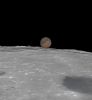
Mars_setting_from_the_Moon.jpg...Sinking behind the Moon...298 visiteMolto bella, ma ha un quid che non va. "Puzza" di falso (fatto BENISSIMO, ma falso).MareKromium
(7 voti)
|
|

Drake_Frank.jpgIn Loving Memory: Frank Drake176 visiteE’ morto Frank Drake, l’astronomo e astrofisico pioniere della ricerca di civiltà aliene, padre del programma Seti, dedicato alla ricerca di forme di intelligenza extraterrestri. È sua e porta il suo nome la celebre equazione che permette di stimare il numero delle civiltà aliene capaci di comunicare. La notizia della morte di Drake, avvenuta il 2 settembre scorso, è stata diffusa su Twitter da decine di studiosi e appassionati di scienza e fantascienza. All’età di 92 anni, Drake è morto per cause naturali nella sua casa di Aptos, in California.
Insieme al suo collega Carl Sagan (1934 – 1996), Drake era stato il padre del progetto Seti (Search for Extraterrestrial Intelligence), che si basava sull’idea che si potessero forse rilevare le emissioni di onde radio delle civiltà extraterrestri nella Via Lattea e forse anche comunicare con loro scambiandosi messaggi. Drake è stato per 19 anni presidente del consiglio di amministrazione del Seti Institute, nato nel 1974, a Mountain View, in California, un’organizzazione senza scopo di lucro che si occupa di ricerca delle forme di vita oltre la Terra. Lo scienziato è conosciuto anche per l’equazione che porta il suo nome (equazione di Drake), riferita alla possibilità dell’esistenza di forme di vita intelligenti extraterrestri. Drake iniziò la carriera intraprendendo la ricerca radioastronomica al National Radio Astronomy Observatory a Green Bank nella Virginia Occidentale e in seguito al Jet Propulsion Laboratory, conducendo importanti misurazioni che rilevarono la presenza della magnetosfera e della ionosfera gioviana.
Nel 1960, condusse la prima ricerca radio di un’intelligenza extraterrestre, nota come Progetto Ozma: non venne, tuttavia, trovata alcuna evidenza di segnali alieni. Drake considerava il “contatto” sotto forma di segnali luminosi o radio inevitabile negli anni a venire. Nel 1961, assieme a J. Peter Pearman, presentò la sua famosa equazione, un tentativo di stimare il numero di civiltà extraterrestri intelligenti presenti nella nostra Galassia con le quali potremmo pensare di entrare in contatto. Drake prese parte ai primi studi sulle pulsar, fu professore alla Cornell University (1964-84) e direttore dell’Osservatorio di Arecibo. Nel 1972, poi, Drake disegnò assieme a Carl Sagan la piastra collocata sulle sonde Pioneer 10 e 11, il primo messaggio fisico inviato nello spazio; la piastra venne progettata per essere comprensibile da un eventuale extraterrestre che avrebbe potuto incontrarla.
In seguito, supervisionò anche la creazione del Voyager Golden Record come professore di astronomia e astrofisica all’Università della California. È stato presidente della Società astronomica del Pacifico e membro dell’Accademia Nazionale per le Scienze degli Stati Uniti.MareKromium
(7 voti)
|
|

Solaris-4.pngSolaris227 visite"...Science? Nonsense!
In this situation, mediocrity and genius are equally useless!
I must tell you that we really have no desire to conquer any cosmos. We want to extend the Earth up to its borders. We don't know what to do with other worlds. We don't need other worlds. We need a mirror. We struggle to make contact, but we'll never achieve it. We are in a ridiculous predicament of man pursuing a goal that he fears and that he really does not need..."MareKromium
(7 voti)
|
|

Solaris-3.jpgSolaris164 visite"I only know one thing. When I... When I sleep, I know no fear, no hope, no trouble, no bliss, Blessings on him he who invented sleep. The common coin that purchases all things, the balance that levels shepherd king, fool and wise man. There is only one bad thing about sound sleep. They say it closely resembles death".MareKromium
(7 voti)
|
|

Solaris-2.jpgSolaris191 visiteKris Kelvin: "To ask is always the desire to know. Yet the preservation of simple human truths requires mystery. The mysteries of happiness, death, and love. To think about it is to know one's day of death".
Dr. Snaut: "Maybe you're right, but try not to think about all that now".
Kris Kelvin: "Not knowing that day makes us practically immortal".MareKromium
(7 voti)
|
|
| 496 immagini su 42 pagina(e) |
 |
|
|
|
|
30 | |
|
|
|
|








