| Piú votate - The Universe Inside |

Almahata-Sitta15_2048.jpgAlmahata Sitta 1596 visiteDa "NASA - Picture of the Day", del giorno 28 Marzo 2009:"Small Asteroid 2008 TC3 fell to Earth at dawn on October 7, 2008, tracking through the skies over the Nubian Desert in Northern Sudan. That event was remarkable because it was the first time an asteroid was detected in space before crashing into planet Earth's Atmosphere.
It was generally assumed the asteroid itself had completely disintegrated to dust. But, based on satellite and ground observations of the atmospheric impact event, Dr. Mauwia Shaddad of the University of Khartoum, aided by Dr. Peter Jenniskens of the SETI Institute and NASA Ames Research Center, led an expedition of students and staff to the area, combing the desert for surviving fragments.
On December 6, 2008, 2 hours after their search began, the first meteorite was found. The team ultimately collected some 280 small meteorites, now called Almahata Sitta, with a total mass of about 5 kilograms -- the first material recovered from a known asteroid. In stark contrast to the lighter-colored stones, the black fragment in the picture is Almahata Sitta meteorite number 15. About 4 centimeters in diameter, it is seen as it came to rest on the desert floor".
Nota Lunexit: la fotografia, sebbene suggestiva, presenta - a nostro parere - delle notevoli incongruenze di texture e colore. In altre parole, sembra più un image-composite che un vero e proprio single still.
Abbiamo quindi leggermente modificato la colorizzazione del frame, adattando il suolo al colore tipico della superficie del Deserto Sudanese (la "fotografia" originale sembra essere parecchio sovrasaturata) ed il colore blu del cielo è stato leggermente abbassato di tonalità ed intensificato (così ricreando - in visione - le condizioni atmosferiche tipiche dei cieli che sovrastano regioni desertiche in cui l'Atmosfera è estremamente secca e l'Opacità - Atmosferica - bassissima o nulla).MareKromium
(11 voti)
|
|

PurpleRain.jpgPurple Rain (by Marco Faccin)75 visitenessun commentoMareKromium
(11 voti)
|
|

Venus_and_the_Moon.jpgNight Lovers'...89 visitenessun commentoMareKromium
(11 voti)
|
|

Pseudomars.jpgPseudo-Mars (by Dr Marco Faccin)83 visitenessun commentoMareKromium
(11 voti)
|
|

Sunset~1.jpgUntitled (by Brian Cameron)78 visitenessun commentoMareKromium
(11 voti)
|
|

Giants-2.jpgOn the shoulders of Giants (by Roberto Tremolada)105 visite"...Dov'è la Grandezza dell'Uomo, se non nella sua Capacità di Sognare?!?..."
MareKromium
(11 voti)
|
|

Mars_Orion.jpgMars and Orion over Monument Valley83 visite"...Consuetudine levior est labor..."
(Livio)
"...Con l'abitudine, il (ogni) lavoro appare meno pesante..."MareKromium
(11 voti)
|
|

Iridescent_Cloud.jpgIridescent Cloud114 visiteCaption NASA:"Why would a cloud appear to be different colors? A relatively rare phenomenon known as "Iridescent Clouds" can show unusual colors vividly or a whole spectrum of colors simultaneously. These clouds are formed of small water droplets of nearly uniform size. When the Sun is in the right position and mostly hidden by thick clouds, these thinner clouds significantly diffract sunlight in a nearly coherent manner, with different colors being deflected by different amounts. Therefore, different colors will come to the observer from slightly different directions. Many clouds start with uniform regions that could show iridescence but quickly become too thick, too mixed, or too far from the Sun to exhibit striking colors.
This iridescent cloud was photographed above Boulder, Colorado last week".MareKromium
(11 voti)
|
|

EyesintheSky-W00037024.jpgLike "Eyes", in the Space of Saturn...76 visite"...Nec te quaesiveris extra..."
(Persio)
"...Non cercarti fuori da te stesso..."MareKromium
(11 voti)
|
|
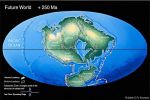
PangeaUltima_scotese_big.jpgA VERY far, distant and yet possible Future: Pangea Ultima77 visiteIs this what will become of the Earth's surface? The surface of the Earth is broken up into several large plates that are slowly shifting.
About 250 MY ago, the plates on which the present-day continents rest were positioned quite differently, so that all the landmasses were clustered together in one supercontinent now dubbed Pangea. About 250 MY from now, the plates are again projected to reposition themselves so that a single landmass dominates.
The above simulation from the PALEAOMAP Project shows this giant landmass: Pangea Ultima.
At that time, the Atlantic Ocean will be just a distant memory, and whatever beings inhabit Earth will be able to walk from North America to Africa.MareKromium
(11 voti)
|
|

StairWaytoHaeven.jpgStairway to Haeven...68 visite"...Ciò che mi muove, in questa Vita, è la curiosità.
La curiosità di "vedere che cosa c'é oltre".
Oltre questa Terra, questo Mare, questo Cielo...Oltre questo Oggi ed oltre il Domani che verrà.
Oltre le nostre idee, le nostre paure, le nostre ipotesi e le nostre convinzioni.
Ti faccio un esempio: se, un giorno, mi capitasse di imbattermi in una scala che, poggiata sulla terra nuda, si alza verso l'Infinito, non credo che mi porrei troppe domande sulla sua Origine ed i suoi Scopi.
Penso che la guarderei, per qualche istante, e poi inizierei a salire, così, un gradino dopo l'altro, senza guardare giù...
Così: tanto per vedere sino a che punto sarei capace di arrivare, prima di sentire un brivido scorrere lungo la schiena ed il collo, e quindi rendermi conto che il mio Tempo, al pari del mio Cammino, è finito..."
P.C. Floegers - "Conversations"MareKromium
(11 voti)
|
|

Venus_Moon.jpgNight Lovers87 visitenessun commentoMareKromium
(11 voti)
|
|
| 496 immagini su 42 pagina(e) |
 |
|
|
|
|
21 | |
|
|
|
|








