| Piú votate - The Universe Inside |

Never Alone.jpgNever Alone...84 visitenessun commento
(14 voti)
|
|

Soviet-LTP-Map1.jpgThe Moon over Moscow...101 visiteI suoi occhi erano chiari e belli
Brillanti, come le notti di Luna piena
E le sue labbra, amaramente dolci
Come uno spicchio di arancio verde
Come una lacrima caduta nello zucchero ...
Le sue mani erano fresche e sicure
Mi stringevano, ma senza farmi male
E la sua pelle, così liscia e calda
Come la sabbia di un vicino deserto
Come le onde di un prossimo mare ...
Quante menzogne, per salvare i ricordi
La voglia di partire e di cercarla
Sapendo che è laggiù, da qualche parte
E lei non sa che io le penso ancora
Ed io non so che lei è andata via ...
Ed è bello pensare a quello che accade
Quando tutto sembra definito, ecco
Il Destino ci viene incontro
E ci prende per mano, leggermente
E ci accompagna, laggiù, dove vorremmo andare ...
Ed è bello pensare a quello che accade
Quando tutto sembra ormai deciso, ecco
Il Destino ci viene incontro
E ci prende per mano, leggermente
E ci porta via, laggiù, dove dobbiamo tornare...
Paolo C. Fienga – “Poesie”
(14 voti)
|
|

ZZ-ZZ-ZZ-Venus, Mercury and Saturn.jpgVenus, Mercury and Saturn from Cerro Paranal (Chile)94 visiteDa "NASA - Picture of the Day" del 17 Agosto 2005:"Very bright planets and very large telescopes are part of this sunset view of Paranal Observatory. The observatory's four, massive 8,2 meter telescope units are situated on top of the 2.600 meter high mountain, Cerro Paranal, in the dry Atacama Desert in northern Chile. The individual unit telescopes can be used separately or in combination and are named Antu, Kueyen, Melipal and Yepun. Together they are fittingly known as the European Southern Observatory's Very Large Telescope. Of course, the very bright planets are Venus (near center), joined by Mercury (below) and Saturn (left) in late June's western evening skies".
(14 voti)
|
|
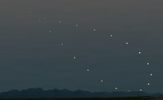
ZZ-ZZ-ZZ-ZZ-LunarAnalemma_richins_f.jpgMoon's analemma (New Mexico)183 visiteDa "NASA - Picture of the Day" del 13 Luglio 2005:"An analemma is an 8-like curve that is gotten when you mark the position of the Sun at the same time each day for 1 year. To imaging an analemma of the Moon it is necessary to understand that, on average, the Moon returns to the same position in the sky about 51' later each day. So, photographing the Moon 51' later on successive days, over one lunation (or Lunar month) it will trace out an analemma-like curve as the actual position of the Moon wanders compared to the average - due to the Moon's tilted and elliptical orbit. (...) Multiple exposure image required some digital manipulation, particularly to include thin crescent phases in daytime skies".
(14 voti)
|
|

ZZ-ZZ-ZZ-Venus_Co_.jpgVenus, Mercury and Saturn from Brighton (Australia)102 visiteDa "NASA - Picture of the Day" del 2 Luglio 2005:"On Tuesday, June 28th, the setting Sun flooded the horizon with a beautiful warm light in this view from the beach beside the pier at Brighton in Adelaide, South Australia. The Sun also illuminated 3 planets gathered in the Western Sky, such as Mercury, Venus and Saturn. From this perspective Mercury is at the highest point in the celestial triangle, brilliant Venus is just below, and Saturn stands farther to the left and below the close pair. Of course, the Planets only appear close together on the sky but are actually quite far apart in space. The orbits of Mercury and Venus are both interior to Earth's orbit, while gas giant Saturn lies in the outer Solar System, over 9 AU from the Sun. Late next week, Venus and Mercury will share Western Skies with the young crescent Moon".
(14 voti)
|
|

ZZ-Sun Halo.jpgA Sun "Halo" in Tennessee93 visiteDal "NASA - Picture of the Day" del 9 Marzo 2005:"Sometimes it looks like the Sun is being viewed through a large lens. In the above case there are actually millions of lenses: ice crystals. As water freezes in the upper atmosphere, small, flat, six-sided, ice crystals might be formed. As these crystals flutter down, much time is spent with their faces flat, parallel to the ground. An observer may pass through the same plane as many of the falling ice crystals near sunrise or sunset. During this alignment, each crystal can act like a miniature lens, refracting sunlight into our view. Dramatically visible behind neighborhood houses and trees and above the cloud deck is the 22° halo created by sunlight reflecting off of atmospheric ice crystals".
L'alone è spiegato in modo preciso ed accurato, ma esso non è l'unico fenomeno visibile in questa foto: alla Vostra Sx si vedono - e bene! - 2 scie chimiche. E quelle come le spieghiamo? Vapori e cristalli?!?
(14 voti)
|
|
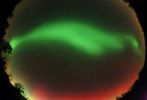
Aurora_Borealis-Coronal_Aurora.jpgCoronal Aurora near Warrensbourg - Missouri (USA)91 visiteIn relazione a quanto detto e scritto solo pochi giorni fa, ecco una nuova Aurora la quale, oltre ad essere stata particolarmente intensa (come potete ben vedere), è accaduta ad un latitudine che di Polare o presso-Polare non ha proprio nulla. La NASA dice che è un fenomeno inusuale ma "normale", vista l'attività solare di questi giorni. Permetteteci, a questo riguardo, una battuta: è proprio il fatto che sia la NASA a dire di non preoccuparci che ci fa preoccupare... EccoVi il commento originale da "NASA - Picture of the Day" del giorno 12.11.2004: "(...) Amazing! Unbelievable!, The best I've ever seen! ... They aren't talking about a movie, though. Instead, even casual sky critics are remarking on November's stunning auroral displays, visible with surprising intensities well beyond the confines of high latitudes where auroral activity is normally observed (...)". Vedete?!? Entusiasmo, eccitazione, linguaggio più da show che da Scienza e dintorni: è il nuovo corso della NASA...
(14 voti)
|
|
Aurora_Borealis-Coronal_Aurora-1.jpg"Auroral Corona" from l'Observatoire de la Découverte in Val Belair near Quebec - Canada87 visiteDa "NASA - Picture of the Day" del 9 Novembre 2004: "...This fisheye picture captures a particularly active and colorful 'Auroral Corona' that occurred on November 7, 2004 (...) The above aurora has an unusually high degree of detail, range of colors and breadth across the sky. The vivid green, red, and blue auroral colors are likely caused by high atmospheric oxygen and hydrogen reacting to incoming electrons. The trigger events were magnetically induced explosions on the Sun from sunspot region 696 over the past few days. Continued activity from this active solar region could mean more auroras visible to northern observers over the next few days. Early in the morning but far in the background, planets, stars and the Moon will be simultaneously putting on their own show".
Una piccola (nostra) nota di commento: dietro la vivace bellezza dell'immagine ed i "romantici" commenti, c'è un nuovo incremento dell'attività solare in un periodo in cui, invece, il nostro Sole è usualmente calmo.
(14 voti)
|
|

Max-019.jpgDreams never die...170 visitenessun commentoMareKromium
(13 voti)
|
|

Max-011.jpgDreams never die...186 visitenessun commentoMareKromium
(13 voti)
|
|

Max-006.jpgDreams never die...179 visitenessun commentoMareKromium
(13 voti)
|
|

Max-002.jpgDreams never die...350 visitenessun commentoMareKromium
(13 voti)
|
|
| 496 immagini su 42 pagina(e) |
 |
|
|
|
|
14 | |
|
|
|
|








