| Piú votate - Mars through the eyes of Soujourner-Pathfinder |

SOU-SOL002-80827_full.jpgBig Rock - Sol 1 (MULTISPECTRUM; credits: Lunexit)89 visiteUn esempio di come il "foto-mosaico" manuale realizzato dalla NASA sia uno strumento di analisi delle immagini non solo "imperfetto" (portate il frame sino al full-size e quindi guardate gli innumerevoli vizi di "cucitura" (--> "seaming") delle singole immagini -, di "luminosità" - poichè i singoli frames sono stati evidentemente ottenuti a diverse ore del giorno locale, ergo in diverse condizioni di illuminazione e, probabilmente, attraverso diversi filtri/colore - e di "messa a fuoco"), ma anche del tutto inidoneo a subire un processo di colorizzazione ex-post.
Ad ogni modo, e muovendoci al massimo delle nostre capacità di elaborazione in colori naturali ai quali viene abbinata la tecnica MULTISPECTRUM, il risultato che vedete in questo quadro lo riteniamo comunque "abbastanza buono" e "realistico" per quanto riguarda sia i colori veri e propri del Landing Site, sia per ciò che attiene la "luminosità media" del Landing Site medesimo, tenuto conto dell'ora locale (tarda, a ridosso del tramonto) della maggioranza dei frames e della stagione.MareKromium
(4 voti)
|
|

SOU-SOL001-1-Pathfinder-LandingSite-Viking1-00.jpgThe Pathfinder Landing Site, from Viking 1 (1)116 visitenessun commento
(4 voti)
|
|

SOU-SOL022.jpgEnd of the day, time to "rest"... - Sol 2274 visiteCaption NASA originale:"An End-Of-Sol Soujourner image. This was taken on Sol 22 after the Rover had placed its APXS in the dark soil surrounding the rock named Lamb".
(4 voti)
|
|

SOU-SOL035-2.jpgFrom the "Pathfinder Frames" to the "Real Colors of Mars"69 visiteUn'estrapolazione "datata", ma non per questo trascurabile, del bravo Ricercatore Don Davis. Essa è basata sulle immagini di Marte ottenute dalla Sonda Pathfinder. Un lavoro discutibile, certo, ma molto attento ed interessante (oltre che originale).
Caption originale:"Sampling the above distinct colors as labeled, I have attempted to extrapolate from the Pathfinder results the global colors of Mars. The assumption is made that the major distinct colors of Mars are sampled at the Pathfinder site and most of a global map of Mars could be made by the use of these colors. This may or may not be true, as some Regions may well have more variety of rock color. Once more of the planet is photographed from orbit and the surface in RGB color such a color chart will undoubtedly grow in variety".
(4 voti)
|
|
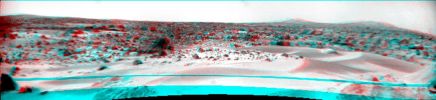
SOU-SOL076-Roverdunes_glyph_sol76.JPG"Twin-Peaks" and the rim of "Big Crater" - Sol 76 (3D)76 visitenessun commento
(4 voti)
|
|

SOU-SOL072-northview_right.jpgChimp-Rock & Companions - Sol 7277 visiteCaption NASA originale:"This image, taken on Sol 72 (such as September 15, 1997) from the Soujourner Rover's Front Camera, shows areas of the Pathfinder landing site never before seen. The large rock on the right is Chimp".
(4 voti)
|
|

SOU-SOL008-81448_full.jpg"Monster-Pan" in 3-D (20) - Sol 866 visitenessun commento
(4 voti)
|
|
SOU-SOL008-81447_full.jpg"Monster-Pan" in 3-D (19) - Sol 879 visitenessun commento
(4 voti)
|
|

SOU-SOL008-81446_full.jpg"Monster-Pan" in 3-D (18) - Sol 880 visitenessun commento
(4 voti)
|
|

SOU-SOL008-81442_full.jpg"Monster-Pan" in 3-D (14) - Sol 878 visitenessun commento
(4 voti)
|
|

SOU-SOL008-81441_full.jpg"Monster-Pan" in 3-D (13) - Sol 870 visitenessun commento
(4 voti)
|
|

SOU-SOL008-81440_full.jpg"Monster-Pan" in 3-D (12) - Sol 869 visiteIncredibile, però: come già dicemmo e stigmatizzammo (!) in passato - usando, come ora, un'abbondante dose di ironia... - alla NASA ci sono Uomini che riescono ad immaginare e costruire razzi capaci di portare Uomini e mezzi sulla ISS e Sonde a guida remota a centinaia di milioni di Km di distanza; Uomini che concepiscono a tavolino dei piani di volo i quali, poi, vengono realizzati in maniera brillante da queste piccole astronavi che svolgono delicatissime operazioni e quindi riescono, dopo arditissimi landings, anche a scattare fotografie ed a trasmetterle a Terra.
Eppure, accanto a costoro, alla NASA ci sono anche degli uomini che non riescono ad attaccare decentemente una foto all'altra per formare un collage fotografico: un'attività che, con ogni probabilità, verrebbe svolta in maniera brillante anche da qualche bambino che va ancora alla scuola elementare.
Strano...
(4 voti)
|
|
| 149 immagini su 13 pagina(e) |
 |
|
|
|
|
7 | |
|
|
|
|








