| Piú votate - Mars through the eyes of Soujourner-Pathfinder |

SOU-SOL024-PIA01547.jpgSunset on Mars from Pathfinder and...A Star-Like Object! - Sol 24 (True Colors; credits: NASA/JPL)441 visiteCaption NASA:"The brownish gray sky as it would be seen by an observer on Mars in this four-frame, True Color mosaic taken on sol 24 (at approximately 16:10 M.L.T.). The Twin Peaks can be seen on the horizon. The sky near the sun is a pale blue color. Azimuth extent is 60° and elevation extent is approximately 12°. A description of the techniques used to generate this color image from IMP data can be found in Maki et al., 1999.
(29 voti)
|
|

SOU-SOL039-3-DD.jpgIce-clouds from Soujourner Site - Sol 39 (Natural Colors; credits for the additional process. and color.: Don Davis)143 visiteHigh altitude clouds loom above the dusty morning twilight.
Note: on Mars the 'Raleigh scattering' - which colors our sky blue - is greatly diminished by the low atmospheric pressure.
(23 voti)
|
|

marspath_81977.jpgA "bright" Mistery from Pathfinder113 visiteIn tanti (a cominciare dal Prof. Richard Hoagland ed i suoi Discepoli) si sono chiesti che cosa fosse quella brillante luce che, in più di una occasione (a quanto ne sappiamo), si era accesa sulla sommità di una delle due collinette note come Twin Peaks. Si trattava forse di un riflesso dei raggi del Sole su una superficie altamente riflettente? Forse si e, immagini alla mano, questa ci sembra l'ipotesi non solo più verosimile, ma anche più probabile.
Quale fosse, tuttavia, la reale natura (cristallina o metallica?) dell'area della superficie Marziana capace di generare un simile bagliore, purtroppo, non lo sappiamo.
Peccato...MareKromium
(15 voti)
|
|

SOU-SOL024-GB-1.jpgSunset over Ares Vallis - Sol 24 (possible True Colors; credits: Dr G. Barca & Lunexit)70 visitenessun commentoMareKromium
(13 voti)
|
|

SOU-SOL018-PAN01.jpgPresidential Panorama - Late Afternoon -, Part II - Sol 18 (possible True Colors; credits: Dr G. Barca & Lunexit)93 visitenessun commentoMareKromium
(13 voti)
|
|

SOU-SOL015-81696-2.jpgAres' Horizon... - Sol 15 (possible True Colors; credits: Dr G. Barca)105 visiteLa Filosofia di Lunar Explorer Italia la conoscete: studiare, migliorare e divulgare. Molto semplice.
E allora come non provare (almeno!) a studiare e migliorare le "visioni" di Marte ottenute durante la Missione Soujourner-Pathfinder? Delle "Visioni" che, se lasciate al solo color processing "Ufficiale" della NASA", sono unanimemente ed assolutamente conosciute e riconosciute come la PEGGIORI ELABORAZIONI A COLORI IN ASSOLUTO!
Il Dr Barca ha quindi iniziato un faticosissimo (ma non per questo poco gratificante) lavoro di ricostruzione dei "colori naturali" di Ares Vallis e questo è il PRIMO RISULTATO. Un risultato lusinghiero, a nostro parere, e di valore incomparabile rispetto alle "brutture" NASA (delle autentiche falsità, secondo noi).
Congratulazioni al Dr Barca, quindi, e...Via con una nuova "Mission Impossible"!MareKromium
(13 voti)
|
|

SOU-SOL024-SUNSET-GB.JPGSunset over Ares Vallis - Sol 24 (possible True Colors; credits: Dr G. Barca)72 visitenessun commentoMareKromium
(12 voti)
|
|
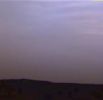
SOU-SOL015.jpgClouds... - Sol 1585 visiteThese clouds from Sol 15 have a new look: as water ice clouds cover the sky, the sky takes on a more bluish cast. This is because small particles (perhaps 1/10th the size of the Martian dust, or 1/1000th the thickness of a human hair) are bright in blue light, but almost invisible in red light. Thus, scientists expect that the ice particles in the clouds are very small. The clouds were imaged by the Imager for Mars Pathfinder (IMP).
(12 voti)
|
|

SOU-SOL008-PIA01004.jpgDeflated Airbags and Skyline - Soles 8, 9 and 10 (Natural Colors; credits: NASA/JPL)144 visiteCaption NASA originale:"This is a sub-section of the geometrically improved and color enhanced version of the 360° panorama known as the "Gallery Pan", the first contiguous, uniform panorama taken by the Imager for Mars Pathfinder (IMP) over the course of Soles 8, 9 and 10. Different regions were imaged at different times over the 3 Martian days to acquire consistent lighting and shadow conditions for all areas of the panorama.
The IMP is a stereo imaging system that, in its fully deployed configuration, stands 1,8 mt above the Martian surface and has a resolution of 2 mm at a range of 2 mt. In this geometrically improved version of the panorama, distortion due to a 2,5° tilt in the IMP camera mast has been removed, effectively flattening the horizon. The IMP has color capability provided by 24 selectable filters -- twelve filters per "eye". Its red, green, and blue filters were used to take this image. The color was digitally balanced according to the color transmittance capability of a high-resolution TV at the Jet Propulsion Laboratory (JPL), and is dependent on that device. In this color enhanced version of the panorama, detail in surface features are brought out via changes to saturation and intensity, holding the original hue constant. A threshold was applied to avoid changes to the sky".
(12 voti)
|
|

SOU-SOL015-marspath_yogi_rov.jpgYogi and Soujourner - Sol 1587 visiteCaption NASA originale:"The Soujourner Rover is taking its Alpha Proton X-Ray Spectrometer measurement.
It clearly shows the "two-toned" surface of this large rock.
The nature of this color difference is not known, however.
It might consist of wind-blown dust accumulated on the surface (the rock is leaning into the prevailing wind) or might be evidence of a break from a larger boulder as it was deposited in the ancient flood that scoured this area".
(11 voti)
|
|

SOU-SOL011-marspath_sunset3.jpgThree moments of the Sunset - Sol 11102 visiteCrepuscolo Marziano, in tre momenti distanti solo pochi secondi l'uno dall'altro.
Colori naturali, ma "enhanced" (diciamo "forzati" nelle loro sfumature essenziali).
(11 voti)
|
|

SOU-SOL011-marspath_sunset.jpgMartian Sunset... - Sol 11107 visiteColori veri, quasi-veri o falsi?
Uno scorcio bellissimo, comunque, di un Cielo Marziano che si tinge di un intenso color rosso-fuoco, nelle ore del tardo pomeriggio.
Caption NASA originale:"This highly color-enhanced and horizontally stretched image shows layering of dust in the Martian Atmosphere brought out by the Martian Sunset of Sol 11 at the Pathfinder Landing Site. The dust is distributed high in the martian atmosphere, causing the sky to remain light over an hour after Sunset. The point of Sunset is off the right side of the frame".
(11 voti)
|
|
| 149 immagini su 13 pagina(e) |
1 |
 |
|
|
|
|
|
|
|
|
|








