| Piú votate - The Sun: just a star, like many others... |

Solar_Corona_vangorp_big.jpgSolar Corona83 visiteDa "NASA - Picture of the Day" del giorno 26 Luglio 2009:"Most photographs don't adequately portray the magnificence of the Sun's Corona. Seeing the Corona first-hand during a Total Solar Eclipse is best. The human eye can adapt to see features and extent that photographic film usually cannot.
Welcome, however, to the digital age. The above picture is a combination of 33 photographs that were digitally processed to highlight faint features of a Total Eclipse that occurred in March of 2006. The images of the Sun's Corona were digitally altered to enhance dim, outlying waves and filaments. Shadow seekers need not fret, though, since as yet there is no way that digital image processing can mimic the fun involved in experiencing a Total Solar Eclipse.
Last week, a spectacular Total Solar Eclipse occurred over Southern Asia, while the the next Total Solar Eclipse will be visible from the South Pacific on July, 11, 2010".MareKromium
(4 voti)
|
|

Sunspots-090602.jpgSunspots and Clouds in Solar Cycle 2475 visiteDa "NASA - Picture of the Day" del giorno 4 Giugno 2009:"On June 2nd, 2009, clouds over Stuttgart, Germany parted to reveal what has become a relatively rare sight, spots on the Sun. In fact, the roughly 11-year solar activity cycle is still in a surprisingly deep minimum and the years 2008 and 2009 have had the lowest Sunspot counts since the 1950s. Even the latest prediction is that the new cycle, Solar Cycle 24, will reach a maximum in May 2013 with a below-average sunspot count. The Solar Cycle 24 Sunspots recorded here are in active region AR 1019.
Previously, only two cycle 24 active regions with Sunspots, AR 1018 and AR 1017, were seen in May".MareKromium
(4 voti)
|
|

The_Sun-01.jpgThe Sun in 3D81 visitenessun commentoMareKromium
(4 voti)
|
|
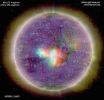
The_Sun-00.jpgThe Sun in 3D105 visitenessun commentoMareKromium
(4 voti)
|
|

Sunjet.jpgA Jet from the Sun90 visiteCaption NASA:"What powers the Solar Wind? Our Sun is known to emit a powerful wind of particles with gusts that can even affect astronauts and satellites orbiting Earth. The cause of the Solar Wind has been debated for decades but is thought to be rooted in Alfvén Waves generated by the ever changing Magnetic Field of the Sun.
Newly released images from the Japanese Hinode satellite appear to bolster this hypothesis, imaging an average of 240 daily plasma jets that are excellent candidates to fuel the outwardly moving Alfvén Waves.
The jets and waves are themselves ultimately created by magnetic reconnection events, rapid events where lines of constant magnetic field suddenly move extremely rapidly, dragging electrons and protons along with them.
On the image left, one such jet is visible in X-ray light. Bright spots show relatively energetic regions elsewhere on the Sun".MareKromium
(4 voti)
|
|

The_Sun-PIA09321.jpgDisk Image of the Sun, March 26, 2007 (Anaglyph)66 visitenessun commentoMareKromium
(4 voti)
|
|

The_Sun-PIA09320.jpgFull Disk Image of the Sun (March 26, 2007)81 visitenessun commentoMareKromium
(4 voti)
|
|
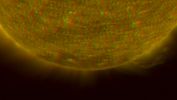
The_Sun-PIA09331.jpgThe South Pole of the Sun66 visiteThis image is a composite of left and right eye color image pairs taken by the SECCHI Extreme UltraViolet Imager (EUVI) mounted on the STEREO-B and STEREO-A Spacecraft.
STEREO-B is located behind the Earth, and follows the Earth in orbit around the Sun, This location enables us to view the Sun from the position of a virtual left eye in space.
STEREO-A is located ahead of the Earth, and leads the Earth in orbit around the Sun, This location enables us to view the Sun from the position of a virtual right eye in space.
The EUVI imager is sensitive to wavelengths of light in the extreme ultraviolet portion of the spectrum.
EUVI bands at wavelengths of 304, 171 and 195 Angstroms have been mapped to the red blue and green visible portion of the spectrum and processed to emphasize the three-dimensional structure of the solar material.MareKromium
(4 voti)
|
|

Sunspot~0.jpgAn Active Sunspot Viewed Sideways76 visiteCaption NASA:"Why are there dark spots on the Sun? Although noted for thousands of years, sunspots have been known for decades to be regions of the Sun that are slightly depressed and cooled by the Sun's complex and changing Magnetic Field.
High resolution pictures like the above image from Japan's new Sun-watching Hinode satellite, however, are helping to increase modern understanding. In the center of the above image is a sunspot, but not seen in the usual orientation - this sunspot is seen sideways.
Of particular interest is erupting glowing gas that shows how the Sun's Magnetic Field comes right out of the spot center, but curves markedly around the spot edges. Better understanding of how the Sun ejects particles into space may result in more accurate predictions of solar storms that affect satellites, astronauts and even power grids on Earth".
(4 voti)
|
|

Sun_Shock-Wave.gifThe "Moreton Wave"75 visiteCaption NASA originale:"Tsunamis this large don't happen on Earth. One week ago (Dec. 2006), a large solar flare from an Earth-sized sunspot produced a tsunami-type shock wave that was spectacular even for the Sun. Pictured above, the tsunami wave was captured moving out from active region AR 10930 by the Optical Solar Patrol Network (OSPAN) telescope in New Mexico, USA. The resulting shock wave, known technically as a Moreton Wave, compressed and heated up gasses including Hydrogen in the photosphere of the Sun, causing a momentarily brighter glow.
The above image was taken in a very specific red color emitted exclusively by hydrogen gas. The rampaging tsunami took out some active filaments on the Sun, although many re-established themselves later.
The solar tsunami spread at nearly 1 MKM per hour, and circled the entire Sun in a matter of minutes".MareKromium
(4 voti)
|
|

The Sun-UvcseitG_c.jpgOur "restless" Sun... (12)74 visitenessun commento
(4 voti)
|
|

The Sun-TricutG-1.jpgOur "restless" Sun... (11)67 visitenesun commento
(4 voti)
|
|
| 144 immagini su 12 pagina(e) |
 |
|
|
|
|
|
8 | |
|
|
|








