| Piú votate - The Sun: just a star, like many others... |

The Sun-C2_EIT_Nov8_00G.jpgOur "restless" Sun... (2)73 visitenessun commento
(5 voti)
|
|
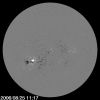
Sunspot-reversed-0.jpgSunspot-905: a sign of an incoming new "Solar Cycle"? (1)70 visiteDa "NASA - Picture of the Day" del 30 Agosto 2006:"Why is sunspot-905 backwards? Perhaps it is a key marker for the beginning of a new Magnetic Cycle on our Sun.
Every 11 years, our Sun goes through a Magnetic Cycle, at the end of which its overall magnetic orientation is reversed. An 11-year Solar Cycle has been observed for hundreds of years by noting peaks and valleys in the average number of sunspots.
Just now, the Sun is near Solar Minimum, and likely to start a long progression toward the most active time, called Solar Maximum, in about 5,5 years".
(5 voti)
|
|
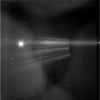
The Sun-W00011347.jpgThe Sun from Cassini64 visiteOriginal caption:"W00011347.jpg was taken on October 23, 2005 and received on Earth October 24, 2005. The camera was pointing toward SATURN-E-RING at approximately 6.847.402 kilometers away and the image was taken using the CL1 and IRP0 filters. This image has not been validated or calibrated".
Secondo noi questa è un'immagine del Sole e non un'istantanea relativa all'Anello E di Saturno. Un'immagine ottenuta casualmente: uno scatto nel buio, mentre una delle fotocamere di Cassini "cercava" l'Anello E.
(5 voti)
|
|

ZB-The_Sun_1.jpgPlasma Waves (1)207 visiteDue stupende immagini che ci mostrano il Sole come mai lo avevamo visto prima: provengono dall'Inouye Solar Telescope. Tuttavia, l'importanza scientifica di questo strumento è comunque oggetto di controversia.
Esso è stato costruito sul vulcano Maui, Haleakalā, che è culturalmente e spiritualmente importante per i Nativi Hawaiani. Una parte della popolazione, infatti, sembra averlo accettato eppure c'è chi lo considera un affronto e una costruzione dei colonizzatori bianchi. E forse i Nativi hanno ragione...
MareKromium
(4 voti)
|
|

ZB-The_Sun_2.jpgPlasma Waves (2)190 visiteOnde di Plasma che fluiscono nella Corona da una sorta di schema di pori a nido d'ape. Queste "bolle di Plasma" sono anche conosciute come "Granuli" e ciascuna è larga circa 1.600 Km. Ognuno di questi due frame è largo circa 82.500 Km.
MareKromium
(4 voti)
|
|

The_Sun-489332main_euvfilament-20101016-3.jpgIntense Solar Activity on the Sun: Sunspot 1112 and Solar Flares82 visiteImage of Sunspot Region 1112 (dated October, 18. 2010) as it continues to rotate towards the South Eastern Rim of the Sun.MareKromium
(4 voti)
|
|

The_Sun-489332main_euvfilament-20101016-4.jpgIntense Solar Activity on the Sun: Sunspot 1112 and Solar Flares84 visitePartial Filament Eruption.MareKromium
(4 voti)
|
|

Sun_Spot.jpgA really beautiful and DEEP SunSpot96 visitenessun commentoMareKromium
(4 voti)
|
|

Athmosferic_Corona-Schneider.jpgDiamond Ring and Shadow Bands81 visiteDalla Rubrica "NASA - Picture of the Day" del giorno 24 Luglio 2010:"As the total phase of July ,11th, 2010 Solar Eclipse came to an end, Sunlight streaming past the edge of the Moon's silhouette created the fleeting appearance of a glistening Diamond Ring in the sky.
Seen through a thin cloud layer from the French Polynesian atoll of Hao it also produced remarkable Shadow Bands, flickering across the dramatic scene. Projected onto the cloud layer, the Shadow Bands are parallel to the sliver of Sunlight emerging from behind the Moon's edge.
Caused by turbulence in Earth's Atmosphere refracting the sliver of Sunlight, the narrow bands were captured in this brief, 1/400th second exposure. Shining through the cloud droplets, the Sunlight also produced a luminous atmospheric corona, not to be confused with the Solar Corona seen during Eclipse Totality.
The Atmospheric Corona is centered on the bright diamond of emerging Sunlight".MareKromium
(4 voti)
|
|

The_Sun-Texture.jpgThe "Texture" of the Sun66 visiteUp close, the Solar Surface is a striking patch work of "granules" in this very High Resolution picture of the quiet Sun. Caused by convection, the granules are hot, rising columns of plasma edged by dark lanes of cooler, descending plasma. But the HR view reveals that the dark lanes are dotted with many small, contrasting bright points. Constantly present on the Solar Surface, the bright points do not seem to be related to Sunspots that come and go with the Magnetic Solar Cycle.
Nonetheless, the bright points are regions of concentrated Magnetic Fields and are bright because the magnetic pressure opens a window to hotter deeper layers below the Photosphere. For scale, the white bar at the lower left corresponds to approx. 5000 Km across the Sun's Surface.
The sharp, narrow-band image was recorded in September, 2007 using the Swedish Solar Telescope on the astronomical island of La Palma.MareKromium
(4 voti)
|
|

Solar_Prominence~0.jpgSolar Prominence85 visiteCaption NASA, da "NASA - Picture of the Day" del giorno 23 Marzo 2010:"Dramatic Prominences can sometimes be seen looming just beyond the edge of the Sun.
Such was the case last week as a Giant Prominence, visible above on the right, highlighted a Sun showing increased activity as it comes off an unusually quiet Solar Minimum. A changing carpet of hot gas is visible in the Chromosphere of the Sun in the above image taken in a very specific color of light emitted by Hydrogen.
A Solar Prominence is a cloud of Solar Gas held just above the Surface by the Sun's Magnetic Field. The Earth would easily fit below the Prominence on the right. Although very hot, Prominences typically appear dark when viewed against the Sun, since they are slightly cooler than the Surface.
A quiescent Prominence typically lasts about a month, and may erupt in a Coronal Mass Ejection (CME) expelling hot gas into the Solar System. The next day, the same prominence looked slightly different".MareKromium
(4 voti)
|
|

Solar_Eclipse~0.jpgA "Diamond Ring" among the clouds69 visiteDa "NASA - Picture of the Day" del giorno 8 Agosto 2009:"Cloudy skies over Wuhan, China hid the delicate Solar Corona during July's Total Eclipse of the Sun. Still, the Moon's silhouette was highlighted by these glistening diamonds as the Total Eclipse Phase ended. Caused by bright Sunlight streaming through dips and valleys in the irregular terrain along the Moon's edge, the effect is known as Baily's Beads, named after Francis Baily who called attention to the phenomenon in 1836.
The dramatic appearance of the beads at the beginning or end of a Total Solar Eclipse is also known as the Diamond Ring effect. In this remarkable image, a small, pinkish solar prominence can also be seen along the edge, below the diamonds".MareKromium
(4 voti)
|
|
| 144 immagini su 12 pagina(e) |
 |
|
|
|
|
7 | |
|
|
|
|








