| Piú votate - The Sun: just a star, like many others... |

Solar_Eclipse-Tse2008_200_mo1_big.jpgAugust 2008 Total Solar Eclipse82 visiteCaption NASA:"For a moment on August 1st, the daytime sky grew dark along the path of a Total Solar Eclipse. While watching the geocentric celestial event from Mongolia, photographer Miloslav Druckmuller recorded multiple images with two separate cameras as the Moon blocked the bright solar disk and darkened the sky.
This final composition consists of 55 frames ranging in exposure time from 1/125 to 8 seconds. It spans nearly 12°, with the relative position of the Moon and Sun corresponding to mid-eclipse. On the left is bright planet Mercury, but many stars are also visible, including the Praesepe Star Cluster (also known as M44 or the Beehive Cluster) in Cancer, above and to the right of the silhouetted Moon. Remarkably, the nearly perfect conditions and wide range in individual exposures allow the composite picture to register the lunar surface and follow the delicate solar corona out to a distance of nearly 20 times the radius of the Sun. In fact, the composite presents a range in brightness beyond what the eye could see during the eclipse".MareKromium
(5 voti)
|
|

Sunspot-1002.jpgActive Region 100279 visiteCaption NASA:"Why has the Sun been so quiet recently? No one is sure. Our Sun has shown few active regions -- that house even fewer associated sunspots -- for over a year now, and such a period of relative calm is quite unusual.
What is well known is that our Sun is in a transitional period between solar cycles called a Solar Minimum, where solar activity has historically been reduced.
The stark lack of surface tumult is unusual even during a Solar Minimum, however, and activity this low has not been seen for many decades. A few days ago, however, a "Bona-Fide Active Region! -- complete with Sunspots --appeared and continues to rotate across the Sun's face. Visible above, this region, dubbed "Active Region 1002" (AR 1002), was imaged in ultraviolet light yesterday by the SOHO Spacecraft, which co-orbits the Sun near the Earth.
Besides the tranquility on the Sun's surface, recent data from the Ulysses Spacecraft, across the Solar System, indicate that the intensity of the Solar Wind blowing out from the Sun is at a 50 year low. Predictions hold, however, that our Sun will show more and more active regions containing more and more Sunspots and Flares until Solar Maximum occurs in about 4 years from now (such as in the year 2012)".MareKromium
(5 voti)
|
|
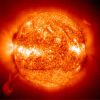
SunFlare-prom1743_eit_big.jpgA Twisted Solar Eruptive Prominence69 visiteCaption NASA:"Ten Earths could easily fit in the "claw" of this seemingly solar monster. The monster, though, visible on the lower left, is a huge Eruptive Prominence seen moving out from our Sun. The above dramatic image taken early in the year 2000 by the Sun-orbiting SOHO satellite. This large prominence, though, is significant not only for its size, but its shape. The twisted figure eight shape indicates that a complex magnetic field threads through the emerging solar particles. Differential rotation inside the Sun might help account for the surface explosion.
Although large prominences and energetic Coronal Mass Ejections (CMEs) are relatively rare, they are occurred more frequently near Solar Maximum, the time of peak sunspot and solar activity in the eleven-year Solar Cycle".MareKromium
(5 voti)
|
|

Solar-Cycle.jpgA "Full Solar Cycle", from SOHO (extreme UV Light)74 visiteCaption NASA:"Every 11 years, our Sun goes through a Solar Cycle.
A complete Solar Cycle has now been imaged by the Sun-orbiting SOHO Spacecraft, celebrating the 12th anniversary of its launch yesterday (December, 12th, 2007).
A Solar Cycle is caused by the changing Magnetic Field of the Sun, and varies from Solar Maximum, when Sunspot, Coronal Mass Ejection, and Flare phenomena are most frequent, to Solar Minimum, when such activity is relatively infrequent.
Solar Minimums occurred in 1996 and 2007, while the last Solar Maximum occurred in 2001.
Pictured above is a SOHO image of the Sun in extreme ultraviolet light for each year of the last Solar Cycle, with images picked to illustrate the relative activity of the Sun".MareKromium
(5 voti)
|
|

The_Sun.jpgNever too close, never too far...67 visiteCaption NASA:"When is the Sun most distant from Earth? It happened again just this past weekend.
A common misconception is that the Sun is most distant during the Winter, when it's the coldest. In truth, however, the seasonal temperatures are more greatly influenced by the number of daylight hours and how high the Sun rises.
For example, during Northern Winter, the tilt of the Earth causes the Sun to be above the horizon for a shorter time and remain lower in the sky than in Northern Summer. The picture compares the relative size of the Sun during Earth's closest approach in January (Northern Winter) on the left, and in July (Northern Summer) on the right. The angular size of the Sun is noticeably smaller during July, when it is farther away. If the Earth's orbit was perfectly circular, the Sun would always appear to be the same size.
These two solar images were taken from Spain during 2006, but the same effect can be seen in any year from any Earth-bound location".MareKromium
(5 voti)
|
|

The_Sun-PIA09324.jpgCloser View of the Equatorial Region of the Sun (March 24, 2007)67 visitenessun commentoMareKromium
(5 voti)
|
|

The_Sun_from_SOHO_-_Coronal_Mass_Ejection.jpgCoronal Mass Ejection66 visiteCaption NASA originale:"What's happening to our Sun? Another Coronal Mass Ejection (CME)!
The Sun-orbiting SOHO spacecraft has imaged many erupting filaments lifting off the active solar surface and blasting enormous bubbles of magnetic plasma into space. Direct light from the sun is blocked in the inner part of the above image, taken in 2002, and replaced by a simultaneous image of the Sun in ultraviolet light.
The field of view extends over 2 MKM from the Solar Surface. While hints of these explosive events, called Coronal Mass Ejections or CMEs, were discovered by spacecraft in the early 70s, this dramatic image is part of a detailed record of this CME's development from the presently operating SOHO spacecraft.
Near the minimum of the Solar Activity Cycle CMEs occur about once a week, but near solar maximum rates of two or more per day are typical. Strong CMEs may profoundly influence space weather. Those directed toward our Planet can have serious effects".
(5 voti)
|
|

The_Sun_and_Mercury.jpgThe Sun and Mercury76 visiteEnjoying the transit of Mercury from Dallas, Texas, astronomer Phil Jones recorded this detailed image of the Sun. Along with a silhouette of the innermost Planet, a network of cells and dark filaments can be seen against a bright solar disk with spicules and prominences along the Sun's edge. The composited image was taken through a telescope equiped with an H-alpha filter that narrowly transmits only the red light from Hydrogen atoms. Such images emphasize the Solar Chromosphere, the region of the Sun's atmosphere immediately above its Photosphere or normally visible surface. Left of center, the tiny disk of Mercury seems to be imitating a small sunspot that looks a little too round. But in H-alpha pictures, sunspot regions are usually dominated by bright splotches (called plages) on the Solar Chromosphere.
(5 voti)
|
|

Earth&Sun-000-sunearth_01G.jpgMagnetic Fields... (1)83 visitenessun commento
(5 voti)
|
|

The Sun-EITquadsA.jpgMulticolor and Multispectrum...80 visitenessun commento
(5 voti)
|
|

The Sun-C3bulb_crop.jpgOur "restless" Sun... (5)69 visitenessun commento
(5 voti)
|
|

The Sun-C2helixG.jpgOur "restless" Sun... (4)68 visitenessun commento
(5 voti)
|
|
| 144 immagini su 12 pagina(e) |
 |
|
|
|
6 | |
|
|
|
|
|








