| Piú votate - The Sun: just a star, like many others... |

The Sun-P-021-01450.jpgJapanese Sun66 visitenessun commento
(9 voti)
|
|

ZZ-ZZ-HybridEclypse-Espenak_tse2005_1.jpgAn unusual "Hybrid Solar Eclipse" (1)67 visiteDa "NASA - Picture of the Day" del 6 Maggio 2005:"April's spectacular geocentric celestial event was a rare Hybrid Eclipse of the Sun - such as a total or an annular eclipse could be seen depending on the Observer's location.
For Fred Espenak, aboard a gently swaying ship within the middle of the Moon's shadow track about 2.200 Km west of the Galapagos, the eclipse was total, the lunar silhouette exactly covering the bright solar disk for a few brief moments.
His camera captured a picture of totality revealing the extensive Solar Corona and prominences rising above the Sun's edge".
(9 voti)
|
|

Coronal Mass Ejection.jpgA "Coronal Mass Ejection"82 visiteCaption NASA originale:"Magnetic fields buckle releasing previously constrained hot material from the upper atmosphere of the Sun. As a result, hot gas streams out into the Solar System, impacting planets, moons, spacecraft, and making space a dangerous place for astronauts. Known as "Coronal Mass Ejections" (CMEs), billions of tons of scathing plasma can be accelerated to millions of miles per hour. CMEs are more common but less intense than solar flares".
(9 voti)
|
|

Sun-Equinox 2002.jpgThe Sun during the 2002 Equinox63 visiteCaption NASA originale:"The active Sun near the March Equinox, the beginning of Autumn in the south and Spring in the northern hemisphere. Recorded in a band of extreme ultraviolet light emitted by highly ionized iron atoms, the Sun's upper atmosphere (or solar corona) shines with an array of active regions and plasma loops suspended in magnetic fields. The bright coronal structures and loops seen here have temperatures of about 1.500.000° K".
(9 voti)
|
|

The Sun from SOHO.jpgAnagliph of the Sun83 visitenessun commento
(8 voti)
|
|
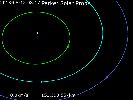
Parker_Solar_Probe_trajectory.gifThe Parker Solar Probe's Trajectory105 visiteInteressante.MareKromium
(7 voti)
|
|

Sunspot-10982.jpgSunspot 1098269 visiteDa "NASA - Picture of the Day", del giorno 6 Febbraio 2008:"A new Solar Cycle has begun on our Sun. Over the past year, the Sun's Magnetic Field has reset and now a new 11 year period is beginning.
Pictured above in a specific color of light emitted by Hydrogen is Sunspot 10982, one of the first sunspots of the new Solar Cycle. The two dark lines visible just above and to either side of the bright sunspot are cool filaments held aloft by the Sun's Magnetic Field. Hot and cold regions are shown as regions of relative light and dark, respectively.
A Solar Cycle is caused by the changing Magnetic Field, and varies from Solar Maximum (when sunspots, coronal mass ejections and flare phenomena are most frequent), to Solar Minimum (meaning when such activity is relatively infrequent).
Solar Minima occurred in 1996 and 2007, while the last Solar Maximum occurred in 2001 (...)".MareKromium
(7 voti)
|
|

Earth&Sun-001-magfieldG_b.jpgMagnetic Fields... (2)63 visitenessun commento
(7 voti)
|
|

Solar Flare.jpgLoops over the Sun69 visiteCaption originale:"How can gas float above the Sun? Twisted magnetic fields arching from the Solar Surface can trap ionized gas, suspending it in huge looping structures. These majestic plasma arches are seen as prominences above the Solar Limb. In September 1999, this dramatic and detailed image was recorded by the EIT experiment on board the space-based SOHO observatory in the light emitted by ionized Helium. It shows hot plasma escaping into space as a fiery prominence breaks free from magnetic confinement a hundred thousand kilometers above the Sun. These awesome events bear watching as they can affect communications and power systems over 100 MKM away on Planet Earth".
(7 voti)
|
|
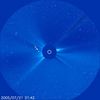
Sun-Saturn-IMG001612-br500.jpgSaturn's "superior conjunction"67 visiteIn this SOHO image taken July 21, 2005, the Sun is represented by the white circle in the center. Saturn is the bright object to the left of the Sun. Interestingly, the streak accompanying Saturn is not the rings but a distortion caused by Saturn's brightness. Saturn is approaching "superior conjunction," that is, it will be almost directly behind the Sun from Earth - thus the Cassini spacecraft, in orbit around Saturn, will not be able to send or receive transmissions normally. Regular science data collection has been temporarily suspended.
As Cassini passes closest by the limb of the Sun on July 24 PDT, all the communications will be impossible because of the Sun's radio noise. The spacecraft will regain full communication with Earth on July 27, once again returning Saturn science data. In the meantime, controllers are sending approximately 100 commands per day to test communication status. Cassini radio scientists are taking advantage of this opportunity to study the Sun's corona from its effects on the radio signals that reach Earth.
SOHO (Solar and Heliospheric Observatory Satellite) orbits the Sun parked in one of the five gravitational-neutral spots, called Lagrange Points. This specific spot, called L1, stays in the same place relative to the Sun and the Earth, offering a continuously uninterrupted view of the Sun.
(7 voti)
|
|

Hungarian Eclypse.jpgMoments of the last Total Eclipse82 visiteCaption NASA originale:"Only in the fleeting darkness of a total solar eclipse is the light of the Solar Corona easily visible from Earth. Normally overwhelmed by the bright solar disk, the expansive corona, the Sun's outer atmosphere, is an alluring sight. But the subtle details and extreme ranges in the corona's brightness discernible to the eye are notoriously difficult to photograph. In this series of images recorded from Siofok, Hungary during the total phase of the August 11, 1999 eclipse, progressively longer exposures (top left to bottom center) have been used to more faithfully capture different regions of the elusive solar corona. The final image (at bottom right) shows light from the solar disk emerging from behind the moon's edge at the end of totality".
(7 voti)
|
|

At the edge of the Sun.jpgAt the edge of the Sun79 visiteCaption NASA originale: "Dramatic prominences can sometimes be seen looming just beyond the edge of the Sun. A Solar Prominence is a cloud of solar gas held just above the surface by the Sun's magnetic field. The Earth would easily fit below the prominence on the left. A quiescent prominence typically lasts about a month and may erupt in a Coronal Mass Ejection (CME) expelling hot gas into the Solar System. Although very hot, prominences typically appear dark when viewed against the Sun, since they are slightly cooler than the surface. The above image - in false color - was taken on June 1st, 2003, from Stuttgart, Germany, with a simple amateur telescope and camera".
(7 voti)
|
|
| 144 immagini su 12 pagina(e) |
 |
3 | |
|
|
|
|
|
|
|
|








