| Piú votate - The Sun: just a star, like many others... |
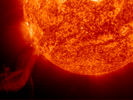
SunFlame-Soho.jpgSolar Prominence72 visiteCaption NASA originale:"What happened to the Sun? Nothing very unusual: the strange-looking solar appendage on the lower left is actually just a spectacular looking version of a common solar prominence. A solar prominence is a cloud of solar gas held above the Sun's surface by the Sun's magnetic field. Pictured above in 2002 October, NASA's Sun-orbiting SOHO spacecraft imaged an impressively large prominence hovering over the surface, informally dubbed a flame. Over 40 Earths could line up along the vast length of the fireless flame of hovering hot gas. A quiescent prominence typically lasts about a month, and may erupt in a Coronal Mass Ejection (CME) expelling hot gas into the Solar System. Although somehow related to the Sun's changing magnetic field, the energy mechanism that creates and sustains a Solar prominence is still a topic of research".
(11 voti)
|
|

ZZ-ZZ-Annular_seip_big.jpgThe "Annular Eclipse" of October, 3rd, 2005 (HR)68 visiteDa "NASA - Picture of the Day" del 5 Ottobre 2005:"On Monday, part of the Sun went missing. The missing piece was no cause for concern because the Moon was only momentarily in the way. The event was not a total eclipse of the Sun for any Earth-bound sky enthusiast but rather, at best, an annular eclipse, where the Moon blocked most of the Sun. Because of the relatively large distance to the Moon during this Earth-Moon-Sun alignment, the Moon did not have a large enough angular size to block the entire Sun. Those who witnessed the solar eclipse from a narrow path through Spain and Africa, however, were lucky enough to see the coveted Ring of Fire, a dark Moon completely surrounded by the brilliant light of the distant Sun. Pictured above is a Ring of Fire captured two days ago in unusually HR above Spain. The resulting image shows details of the granular solar surface as well as many prominences around the Sun".
(11 voti)
|
|

The Solar Spectrum_noao.jpgThe Solar Spectrum and the "missing colors"...67 visiteDa "NASA - Picture of the Day" del 27 Febbraio 2005:"It is still not known why the Sun's light is missing some colors. Shown above are all the visible colors of the Sun, produced by passing the Sun's light through a prism-like device. The above spectrum was created at the McMath-Pierce Solar Observatory and shows, first off, that although our yellow-appearing Sun emits light of nearly every color, it does indeed appear brightest in yellow-green light. The dark patches in the above spectrum arise from gas at or above the Sun's surface absorbing sunlight emitted below. Since different types of gas absorb different colors of light, it is possible to determine what gasses compose the Sun. Helium, for example, was first discovered in 1870 on a solar spectrum and only later found here on Earth. Today, the majority of spectral absorption lines have been identified - but not all".
(11 voti)
|
|

Sun - Coronal holes.jpgCoronal "Holes"66 visiteCaption NASA originale:"The ominous, dark shapes haunting the left side of the Sun are coronal holes - low density regions extending above the surface where the solar magnetic field opens freely into interplanetary space. Studied extensively from space since the 1960s in ultraviolet and x-ray light, coronal holes are known to be the source of the high-speed solar wind, atoms and electrons which flow outward along the open magnetic field lines. During periods of low activity, coronal holes typically cover regions just above the Sun's poles. These coronal holes, however, have just moved into view near the Sun's equator, and particles escaping them have already caused notable aurora here on Earth. Coronal holes like this one may last for a few solar rotations before the magnetic fields shift and change configurations. Shown in false-color, this picture of the Sun on March 9, 2003, was made in extreme ultraviolet light by the EIT instrument on board the space-based SOHO observatory".
(11 voti)
|
|

Solar Flares.jpgSolar Flares82 visiteCaption NASA originale:"On June, 14th, 1999, SOHO observatory recorded this stunning view of an immense prominence erupting from the Sun's southern latitudes. The false-color image was made in the extreme Ultraviolet light produced by ionized Helium atoms in the solar plasma".
(11 voti)
|
|

Sun & Comet (dtl-mgnf).jpgA comet approaching the Sun (from SOHO) - detail mgnf83 visiteCaption NASA originale:"Based on their similar orbits, as first worked out by 19th century German astronomer Heinrich Kreutz, all "sungrazers" are believed to originate from a single large "parent comet" which broke up during a perihelion passage perhaps 2.000 years ago. Over time, pieces have continued to split off producing a family of smaller comets which seem to travel in the same orbit".
(11 voti)
|
|

Sun & Comet (2).jpgA comet approaching the Sun (from SOHO)72 visiteCaption NASA originale:"SOHO, the space-based SOlar and Heliospheric Observatory, has become by far the reigning champion facility for discovering comets, its total having reached more than 200. As might be expected of a solar observatory, most of the SOHO discovered comets are "sungrazers", such as comets destined to dive within a mere 50.000 Km or so of the solar photosphere.
At that range the intense heat and gravitational forces make it unlikely these primitive chunks of ice and dust will survive".
(11 voti)
|
|

Sun & Comet.jpgA comet approaching the Sun (from SOHO)72 visiteCaption NASA originale:"These 3 frames from SOHO's coronograph were taken two hours apart from each other on April 29, 2000. They show a "sungrazer" (SOHO comet discovery number 111) with a long, bright tail headed toward its fiery encounter.
The Sun itself is hidden behind the coronograph's occulting disk at each frame's upper right".
(11 voti)
|
|
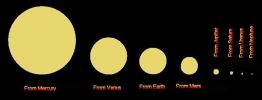
000-The_Sun_from_Space.JPGThe Sun from all the Planets of the Solar System183 visiteCome appare (o meglio: "Quanto grande" dovrebbe apparire) il Disco Solare allorchè osservato da un Mondo diverso dalla Terra?
Senza pretesa di assolutezza matematica, questa Tavola dovrebbe fornirVi un'idea più precisa della questione su cui tanto ci siamo arrovellati sino ad ora.
Nota: i diversi diametri sono stati ipotizzati ragionando in termini di UA (Unità Astronomiche), laddove 1 UA = distanza Sole / Terra = 149.597.970 Km
ergo la distanza fra il Sole e Mercurio viene fatta mediamente pari a (circa *) 0,4 UA
fra il Sole e Venere è mediamente pari a (circa) 0,7 UA
fra il Sole e Marte è mediamente pari a (circa) 1,5 UA
fra il Sole e Giove è mediamente pari a (circa) 5,2 UA
fra il Sole e Saturno è mediamente pari a (circa) 9,5 UA
fra il Sole ed Urano è mediamente pari a (circa) 19,6 UA
fra il Sole e Nettuno è mediamente pari a (circa) 30 UA
fra il Sole ed il Sistema Binario Plutone-Caronte è mediamente pari a (circa) 39 UA
* diciamo circa perchè le orbite dei diversi Pianeti attorno al Sole NON descrivono cerchi perfetti (e quindi con raggio - distanza dal Sole - fisso), bensì delle ellissi più o meno allungate (le quali implicano l'esistenza di un "perielio" - o punto di massima vicinanza del Corpo Celeste considerato rispetto al Sole - ed un "afelio" - o punto di massima lontananza del Corpo Celeste considerato rispetto al Sole.MareKromium
(10 voti)
|
|

ZZ-The Sun.jpgAutumnal Equinox 199466 visiteDa "NASA - Picture of the Day" del 20 Marzo 2005:"Today, the Sun crosses the celestial equator heading North, marking the Vernal Equinox - such as the 1st day of Spring in the Northern Hemisphere and Autumn in the south. Equinox means equal night and with the Sun on the celestial equator, Earthlings will experience 12 hours of daylight and 12 hours of darkness. For those in the Northern Hemisphere, the days will continue to grow longer with the Sun marching higher in the sky as Summer approaches. A few weeks after the northern Autumnal Equinox of 1994, the Crew of the Shuttle Endeavor recorded this image of the Sun poised above the Earth's limb. Glare illuminates Endeavor's vertical tail (pointing toward the Earth) along with radar equipment in the payload bay. The space shuttle is expected to return to flight later this year with the launch of STS-114".
(10 voti)
|
|

Sun filaments.jpgSun filaments70 visiteCaption NASA originale, da NASA Picture of the Day del 6 Dicembre 2004:"Two unusually long filaments crossed part of the Sun last week. The filaments are actually relatively cool and dark prominences of solar plasma held up by the Sun's magnetic field but seen against the face of the Sun. Filaments typically last a few weeks before falling back. Pictured above, the two filaments are visible on the Sun's right side. It would take twenty Earths, set end-to-end, to match the length of one of the filaments. Also visible are bright hot regions called plages and a carpet of hundreds of granules that provide the Sun's texture. The above image was taken early last week through a small telescope in a very specific color of light emitted primarily by hydrogen".
(10 voti)
|
|

A-The Sun from Spitzer - spicules_sst_big.jpgSun "Spicules" from the Sptizer Space Telescope (SST)145 visiteCaption NASA originale: "Pictured above is perhaps the highest resolution image yet of the enigmatic "Solar Flux Tubes" known as "Spicules". Spicules dot the above frame of solar active region, but they are particularly evident as a carpet of dark tubes on the right. Time-sequenced images have recently shown that spicules "Life-span" is of about 5 minutes, starting out as tall tubes of rapidly rising gas but eventually fading as the gas peaks and falls back down to the Sun".
(10 voti)
|
|
| 144 immagini su 12 pagina(e) |
2 |  |
|
|
|
|
|
|
|
|
|








