| Piú votate - The Sun: just a star, like many others... |

Coronal Loops-TRACE.jpgCoronal loops85 visiteDa "NASA - Picture of the Day" del 14 Agosto 2005:"Why is the Corona of the Sun so hot? Extending above the photosphere or visible surface of the Sun, the faint, tenuous Solar Corona can't be easily seen from Earth, but it is measured to be hundreds of times hotter than the photosphere itself. Astronomers have long sought the source of the Corona's heat in magnetic fields which loft monstrous loops of solar plasma above the photosphere. Detailed observations of coronal loops from the orbiting TRACE satellite are pointing more closely to the unidentified energy source. Recorded in extreme ultraviolet light, this and other TRACE images indicate that significant heating occurs low in the corona, near the bases of the loops as they emerge from and return to the solar surface. This tantalizing TRACE image shows clusters of the majestic, hot coronal loops which span 30 or more times the diameter of planet Earth".
(13 voti)
|
|

ZA-Sunspot.jpgSunspot and Solar "granules" (detail mgnf)101 visiteCaption NASA originale:"Sometimes, small regions of the Sun appear unusually dark. Visible above is a close-up picture of a sunspot, a depression on the Sun's face that is slightly cooler and less luminous than the rest of the Sun. Sunspots can be larger than the Earth and usually last for only a few days. As you can see, the Sun's face is a bubbling sea of separate cells of hot gas. These cells are known as "granules" and a solar "granule" is about 1000 Km across and "lives" for + or - 10 minutes, then explodes".
(16 voti)
|
|
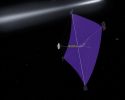
ZA-Solar Sail.jpgThe "Solar Sail"83 visiteNelle more del lancio del vettore Cosmos 1 (realizzato dalla Planetary Society in collaborazione con lo Space Research Institute -IKI- di Mosca), il quale dovrebbe portare nello spazio la prima sonda capace di usare il Vento Solare quale strumento di propulsione, noi ci domandiamo se questa trovata sia davvero un colpo di genio, oppure una delle "bufale" che, ogni tanto, la NASA o qualche altra Agenzia Spaziale si inventa per giustificare la spendita di fondi e gettare fumo negli occhi del pubblico...
(16 voti)
|
|

The Sun in Hydrogen-Alpha light (2).jpgThe Sun in Hydrogen-Alpha light91 visiteCaption NASA originale:"The above image, taken in a single color of light called Hydrogen Alpha, records a great amount of detail of the simmering surface of our parent star. The gradual darkening towards the Sun's edge, called limb darkening, is caused by increased absorption of relatively cool solar gas. Further over the edge, a giant prominence is visible, while a different prominence can be seen in silhouette as the dark streak near the image center. Two active areas of the Sun are marked by bright plages. The above amateur photograph of the Sun was taken just through a small telescope and a standard digital camera".
(14 voti)
|
|

Sunspots - SST.jpgSunspots80 visiteCaption NASA originale:"This stunning image shows remarkable and mysterious details near the dark central region of a planet-sized sunspot in one of the sharpest views ever of the surface of the Sun. Just released, the picture was made using the Swedish Solar Telescope now in its first year of operation on the Canary Island of La Palma. Along with features described as hairs and canals are dark cores visible within the bright filaments that extend into the sunspot, representing previously unknown and unexplored solar phenomena".
(14 voti)
|
|

Sun-PIA03149_modest.jpgSolar Flares from Soho92 visiteCaption NASA originale:"Extreme Ultraviolet Imaging Telescope (EIT) image of a huge, handle-shaped prominence taken on Sept. 14,1999 taken in the 304 angstrom wavelength - Prominences are huge clouds of relatively cool dense plasma suspended in the Sun's hot, thin corona. At times, they can erupt, escaping the Sun's atmosphere. Emission in this spectral line shows the upper chromosphere at a temperature of about 60,000 degrees K. Every feature in the image traces magnetic field structure. The hottest areas appear almost white, while the darker red areas indicate cooler temperatures".
(14 voti)
|
|

The corona.jpgThe Sun's corona from TRACE (Transition Region and Coronal Explorer Satellite)115 visitenessun commento
(14 voti)
|
|

The Sun from Soho.jpgA "Solar Prominence" from Soho83 visiteCaption NASA originale:"A 'Solar Prominence' is a cloud of solar gas held above the Sun's surface by the Sun's magnetic field. The Earth would easily fit under the hovering curtain of hot gas (like the one pictured above). A quiescent prominence typically lasts about one month, and may erupt in a Coronal Mass Ejection (CME) expelling hot gas into the Solar System. Although somehow related to the Sun's changing magnetic field, the energy mechanism that creates and sustains a Solar Prominence is still a mistery".
(16 voti)
|
|

The Sun in Hydrogen-Alpha light.jpgThe Sun in "Hydrogen-alpha" light118 visiteCaption NASA originale:"The above picture was taken in a specific color of light emitted by Hydrogen gas called Hydrogen-alpha. Granules cover the solar photosphere surface like shag carpet, interrupted by bright regions containing dark sunspots. Our Sun glows because it is hot, but it is NOT on fire. Fire is the rapid acquisition of oxygen, and there is VERY LITTLE O2 on the Sun! The energy source of the Sun is the nuclear fusion of Hydrogen into Helium (4H--->1He) deep within its core".
(16 voti)
|
|

The limb of the Sun.jpgThe limb of the Sun91 visiteFotografia amatoriale della corona solare durante l'ultima grande eclissi totale del 1999.
(13 voti)
|
|

The Sun_s Corona.jpgThe "Corona"106 visiteIn sede di commento a questa immagine (amatoriale, ma non per questo meno bella) della corona solare - come visibile durante un'eclissi totale - una piccola curiosità: sapevate che alcune delle sfumature della corona sono visibili (anzi: percepibili) soltanto dall'occhio umano?
(13 voti)
|
|
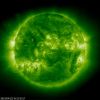
The Sun.jpgThe Sun89 visiteCaption NASA originale:"The ultraviolet light emitted by eleven times ionized iron at temperatures over 2 million degrees Farenheit was used to record the above picture of the Sun on September 22, 2001, the date of that year's autumnal equinox. The image was made by the EIT camera onboard the SOHO spacecraft, a space observatory which can continuously observe the Sun. Eleven times ionized iron is atomic iron with eleven of its electrons stripped away. Here the electrons are stripped by the frantic collisions with other atoms and electrons which occur at the extreme temperatures in the Solar Corona. Since electrons are negatively charged, the resulting ionized iron atom is highly positively charged. Astronomer's "shorthand" for eleven times ionized iron is written "Fe XII", the chemical symbol for iron followed by a Roman numeral 12 (Fe I is neutral iron)".
(13 voti)
|
|
| 144 immagini su 12 pagina(e) |
 |
|
|
|
|
|
|
|
|
12 |
|








