| Piú votate - The Sun: just a star, like many others... |

Sun_Flowers_NSO_1901.jpgFunny-looking Sun152 visiteIs that the Surface of the Sun? Yes it is, believe it or not...MareKromium
(1 voti)
|
|

Black Sun.jpgBlack Sun91 visiteCaption NASA originale:"During a total solar eclipse, Earth's moon blocks the Sun - almost exactly. While the Sun is about 400 times wider than the Moon, it is also about 400 times farther away and each appears to be half a degree or so in diameter. On August 11, 1999 this remarkable coincidence in the apparent size of two vastly different celestial bodies produced tantalizing solar spectacles for denizens of Europe and Asia. For example, prominences along the Sun's limb peer around the Moon's dark edge in this dramatic picture of totality recorded as the lunar shadow swept across Hungary. Subtle structures in the Sun's inner corona are also visible streaming beyond the silhouetted Moon".
(14 voti)
|
|

Solar Corona.jpgThe 2006 Total Solar Eclipse: the Solar Corona64 visiteDa "NASA - Picture of the Day", del 7 Aprile 2006:"During a total Solar Eclipse, the Sun's extensive outer atmosphere (or Corona) is an awesome and inspirational sight. The subtle shades and shimmering features of the corona that engage the eye span a brightness range of over 10.000 to 1, making them notoriously difficult to capture in a single picture. But this composite of 33 digital images ranging in exposure time from 1/8000 to 1/5th of second comes very close to revealing the crown of the Sun in all its glory. The telescopic views were recorded from Side, Turkey, during the March 29, 2006, Solar Eclipse, a geocentric celestial event that was widely seen under nearly ideal conditions.
The composite also captures a pinkish prominence extending just beyond the upper edge of the eclipsed Sun".
(10 voti)
|
|

Active_Sun.jpgActive Sun (Credits: Mehmet Ergün)117 visiteCaption NASA Originale:"Our Sun is becoming a busy place. Only two years ago, the Sun was emerging from a solar minimum so quiet that months would go by without even a single sunspot. In contrast, already this year and well ahead of schedule, our Sun is unusually active, already nearing solar activity levels seen a decade ago during the last solar maximum. Our increasingly active Sun was captured two weeks ago sporting numerous interesting features. The image was recorded in a single color of light called Hydrogen Alpha, color-inverted, and false colored. Spicules carpet much of the Sun's face. The brightening towards the Sun's edges is caused by increased absorption of relatively cool solar gas and called limb darkening. Just outside the Sun's disk, several scintillating prominences protrude, while prominences on the Sun's face are known as filaments and show as light streaks. Magnetically tangled active regions are both dark and light and contain cool sunspots. As our Sun's magnetic field winds toward solar maximum over the next few years, whether the Sun's high activity will continue to increase is unknown".
“Non si presta mai attenzione a ciò che è stato fatto; si vede soltanto ciò che resta da fare"
Marie CurieMareKromium
(8 voti)
|
|
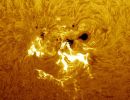
A-The Sun - sunspot_newton_big.jpgSunspots229 visitenessun commento
(8 voti)
|
|

The_Sun_in_Extreme_UV.jpgThe Sun in Extreme UV67 visiteThis wild-looking portrait of the Sun was made on March 30th, 2010, by the recently launched Solar Dynamics Observatory (SDO).
Shown in false-color, the composite view covers Extreme UltraViolet wavelengths and traces hot plasma at temperatures approaching 1 million Kelvins. At full resolution, SDO image data is intended to explore solar activity in unprecedented detail. In fact, SDO will send 1.5 terabytes of data back each day, equivalent to a daily download of about half a million MP3 songs.MareKromium
(7 voti)
|
|

Sunflare.jpgA Sunflare from the Skylab86 visiteUn'immagine d'epoca: l'anno è il 1973 e dallo Skylab (allora conosciuto come "Il Laboratorio Spaziale") ci arriva l'immagine di una "fiaccola" o, se preferite, di un "Solar Flare".
(14 voti)
|
|

A-The Sun-Solar flare from Soho.jpgPowerful solar flare from Soho69 visiteCaption originale NASA: "Seen through the electromagnetic spectrum, the Sun briefly becomes over than 100 times brighter (in the X-rays wavelength) than normal. This is a so-called "Solar Flare" and, when it happens, energetic particles which are emitted from the Sun strike the Earth causing malfunctions in satellite communications or, in some specific areas, a very unusual (and yet very impressive) phoenomenon known as "Aurora Borealis".
(6 voti)
|
|
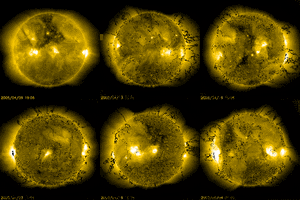
00-The Sun.gifThe Sun259 visite"It is in the Human Nature", qualcuno ha scritto, "to take everything for granted...Until you loose it".
Anche il Sole fa parte di quello che "diamo per scontato", come ovvio, ed è per questo che Vi offriamo questo piccolo filmato GIF - opera del Dr A. Feltri: per ricordare e ricordarVi grazie a 'che cosa', oggi, sin dal momento della nostra nascita e sino all'istante della nostra morte, possiamo dire di essere vivi e, quindi, possiamo vedere, respirare, avere esperienze, fare delle scelte, evolvere o regredire, ridere o piangere etc.
E' il Sole: la nostra Stella, ma solo una delle tante...
(22 voti)
|
|

A-THE SUN-FLUXTUBE.jpgA very unusual "fluxtube" from the Sun123 visiteCaption originale NASA, da "NASA - Picture of the Day" dell'11 Gennaio 1999: "The Earth's orbit is not a perfect, sun-centered circle. At aphelion, the most distant point in Earth's orbit, the Sun is 150 MKMs away and at perihelion, the closest point, Earth approaches the Sun to within about 147 MKMs. While aphelion occurs in July, perihelion for planet Earth comes in January. In fact, inhabitants of the Northern Hemisphere, particularly those wearily weathering winter storms, may be surprised to learn that Earth reached its closest point to the Sun on early January, usually the coldest month of the year. This false-color picture recorded near perihelion is from the earth-orbiting Yohkoh Solar Observatory. It shows an increasingly active Sun in the light of X-rays. A negative color scheme is used, darker colors representing more intense X-ray light". Da notare che il commento NASA non menziona nè spiega - guarda caso... - il dettaglio più intrigante dell'immagine: il "tubo" di plasma e di gas...
(18 voti)
|
|

A-A SUNFLARE.jpgA beautiful Solar Flare244 visitenessun commento
(21 voti)
|
|

A-THE SUN-SOHO.jpgThe Sun, stars and planets from Soho167 visite...che si vede con grande chiarezza nell'immagine più grande, circa ad ore 01:00 del disco solare.
Ricordate quanto scrivemmo, nella Sezione dedicata a Mercurio, a proposito di un enigmatico "corpo celeste" il quale orbiterebbe intorno al Sole lungo un'orbita ancora più interna rispetto a quella dello stesso Mercurio? Ecco, l'immagine da alcuni Studiosi ritenuta come una prova fondamentale dell'esistenza di "qualcosa" nelle immediate vicinanze del Sole (il Decimo Pianeta) è proprio quella che Vi abbiamo offerto nel frame precedente.
(17 voti)
|
|
| 144 immagini su 12 pagina(e) |
 |
|
|
|
|
|
|
|
|
11 |
|








