| Piú votate - The Sun: just a star, like many others... |

Solar_Prominence-STEREO.jpgHuge Solar Prominence67 visiteCaption NASA:"What does a Solar Prominence look like in three dimensions? To help find out, NASA launched the STEREO satellites to keep a steady eye on the Sun from two different vantage points.
The STEREO satellites orbit the Sun nearly along Earth's orbit, but one (dubbed "Ahead" ---> Avanti) currently leads the Earth, while the other (dubbed "Behind" ---> "Dietro") currently trails. Three weeks ago, a powerful Prominence erupted and remained above the Sun for about 30 hours, allowing the STEREO satellites to get numerous views of it from different angles.
Pictured above is a High-Resolution image of the event from the STEREO "Ahead" satellite.
A video of the Prominence erupting as seen from both Spacecrafts can be found at http : // www . youtube . com / watch?v = _RjswBx6ysQ.
The unusually quiet nature of the Sun over the past two years has made large prominences like this relatively rare. The combined perspective of STEREO will help astronomers better understand the mechanisms for the creation and evolution of Prominences, Coronal Mass Ejections, and Solar Flares".
MareKromium
(3 voti)
|
|
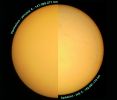
PerihelionAphelion_cervignon800.jpgPerihelion and Aphelion65 visiteDa "NASA - Picture of the Day" del giorno 3 Luglio 2009:"This year Aphelion, the point in Earth's elliptical orbit when it is farthest from the Sun, occurs tomorrow, July 4th.
Of course, that doesn't affect the seasons on our fair Planet, because those are determined by the tilt of Earth's Axis of Rotation and not Earth's distance from the Sun: so July is still Winter in the South and Summer in Northern Hemisphere. But it does mean that on July 4th the Sun will be at its smallest apparent size. This composite neatly compares two pictures of the Sun taken with the same telescope and camera on the dates of Perihelion (closest approach) and Aphelion in 2008.
The image labels include Earth's distance in kilometers from the Sun on the two dates.
Otherwise difficult to notice, the change in the Sun's apparent diameter between Perihelion and Aphelion is clear. The difference amounts to a little over 3%".MareKromium
(3 voti)
|
|

The_Sun-Coronal_Hole.jpgCoronal Hole68 visiteCaption NASA:"The dark expanse below the Equator of the Sun is a Coronal Hole, such as a Low Density Region extending above the surface, where the Solar Magnetic Field opens freely into interplanetary space.
Shown in false color, the picture was recorded on September 19th, 2007, in Extreme Ultraviolet Light by the EIT instrument onboard the space-based SOHO observatory. Studied extensively from space since the 1960s in ultraviolet and x-ray light, Coronal Holes are known to be the source of the high-speed Solar Wind, atoms and electrons that flow outward along the open magnetic field lines.
The Solar Wind streaming from this coronal hole triggered colorful auroral displays on planet Earth begining late last week, enjoyed by spaceweather watchers at high latitudes".MareKromium
(3 voti)
|
|

The_Sun-PIA09328.jpgThe North Pole of the Sun71 visiteNASA's Solar TErrestrial RElations Observatory (STEREO) satellites have provided the first three-dimensional images of the Sun. For the first time, scientists will be able to see structures in the Sun's atmosphere in 3D.
The new view will greatly aid scientists' ability to understand solar physics and thereby improve space weather forecasting.
The EUVI imager is sensitive to wavelengths of light in the extreme ultraviolet portion of the spectrum.
EUVI bands at wavelengths of 304, 171 and 195 Angstroms have been mapped to the red blue and green visible portion of the spectrum; and processed to emphasize the temperature difference of the solar material.
In this picture, a large spicule can be seen. MareKromium
(3 voti)
|
|
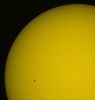
The Sun~0.jpgIn the Sun...63 visiteDa "NASA - Picture of the Day", del 21 Settembre 2006:" Though it's 93 MMs away, the Sun still hurts your eyes when you look at it.
But bright Sunlight (along with accurate planning and proper equipment!) resulted in this sharp silhouette of spaceship and space station.
The amazing telescopic view, recorded on September 17, 2006, captures Shuttle Orbiter Atlantis and the International Space Station in orbit over planet Earth.
At a range of 550 Km from the observing site near Mamers, Normandy, France, Atlantis (left) has just undocked and moved about 200 mt away from the Space Station.
Tomorrow (Sept. 22, 2006), yet another satellite of planet Earth can be seen in silhouette - the Moon will eclipse the Sun. This last eclipse of 2006 will be seen as an annular solar eclipse along a track that crosses Northern South America and the South Atlantic".
(3 voti)
|
|
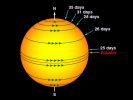
Solar_rotation.jpgThe "uneven" Solar Rotation149 visitenessun commentoMareKromium
(2 voti)
|
|

Sunspots-EB-LXTT.jpgSummer 2011's Sunspots (by Elisabetta Bonora - Lunexit Team)222 visitenessun commentoMareKromium
(2 voti)
|
|

The_Sun-XClass_Flare-SDO20110215_015332_2048_0193.jpgSolar "X-Class" Flare97 visiteCaption NASA:"On February 14, 2011, the Sun unleashed one of its most powerful explosions, an "X-Class Flare". The blast was the largest so far in the new Solar Cycle. Erupting from Active Region AR1158 in the Sun's Southern Hemisphere, the Flare is captured here in this extreme UltraViolet image from the Solar Dynamics Observatory (SDO). The intense burst of electromagnetic radiation momentarily overwhelmed pixels in SDO's detectors causing the bright vertical blemish.
This "X-Class Flare" was also accompanied by a Coronal Mass Ejection (CME), a massive cloud of charged particles traveling outward at nearly 900 Km per second".MareKromium
(2 voti)
|
|

The_Sun-489332main_euvfilament-20101016-0.jpgIntense Solar Activity on the Sun: Sunspot 1112 and Solar Flares93 visitenessun commentoMareKromium
(2 voti)
|
|

The_Sun-489332main_euvfilament-20101016-1.jpgIntense Solar Activity on the Sun: Sunspot 1112 and Solar Flares93 visiteOn Saturday, October 16, 2010, NASA’s Solar Dynamics Observatory captured this stunning image of one of the most intense, Solar Flares seen in the past few months. So far there have been no reports of energetic particles from this M-class Flare interfering with NASA Spacecraft or making their way to Earth.MareKromium
(2 voti)
|
|

The_Sun-SS-HST.jpgThe Sun, Atlantis and Hubble72 visiteCaption NASA, da "NASA - Picture of the Day" del giorno 16 Maggio 2009:"On Wednesday, May 13th 2009, two, tiny, fast moving spots crossed an otherwise featureless Solar Disk. Not Sunspots though, the dark blemishes were silhouettes of the shuttle orbiter Atlantis and the Hubble Space Telescope side by side.
To record this sharp picture of the orbiting pair against the face of the Sun, astronomer Thierry Legault carefully set up his camera and telescope near the center of a 5 Km wide path of visibility about 100 Km South of Kennedy Space Center in Florida. He opened the shutter for 1/8000th second at 12:17 EDT, catching Atlantis and Hubble at a range of 600 Km while they were moving at a relative speed of about 7 Km-per-second.
The total duration of the transit (Sun crossing) was 0,8". Atlantis (top) is approaching Hubble prior to capturing the space telescope. Thursday (May 14, 2009), Astronauts began a series of spacewalks to perform the maintenance as part of the final mission to Hubble".MareKromium
(2 voti)
|
|

The_Sun.JPGCold Sun? (All Filters; credits: SOHO & Dr M. Faccin)78 visitenessun commentoMareKromium
(2 voti)
|
|
| 144 immagini su 12 pagina(e) |
 |
|
|
|
|
|
|
|
10 | |
|








