| Piú votate - The Sun: just a star, like many others... |

A - The Sun.jpgThe Sun (and a "Sun-Grazer") from Soho79 visiteSun Data and Statistics
Mass (kg) = 1.989e+30
Mass (Earth = 1) = 332,830
Equatorial radius = 695.000 Km
Equatorial radius (Earth = 1) = 108,97
Mean density (gm/cm^3) = 1,410
Rotational period (days) = from 25 up to 36
Escape velocity = 618,02 Km per second
Luminosity (ergs/sec) = 3.827e33
Magnitude (Vo) = - 26,8
Mean surface temperature = 6.000°C
Age (billion years) = approx. 4.5
Principal chemistry: Hydrogen 92,1%; Helium 7,8%; Oxygen 0,061%; Carbon 0,030%; Nitrogen 0,0084%; Neon 0,0076%; Iron 0,0037%; Silicon 0,0031%; Magnesium 0,0024%; Sulfur 0,0015%; others 0,0015%
(14 voti)
|
|

Sun-TRACE.jpgThe Sun from TRACE in ultra-violet light87 visiteCaption NASA originale:"Shown in ultraviolet light, the relatively cool dark regions have temperatures of thousands of degrees Celsius. Large sunspot group AR 9169 is visible as the bright area near the horizon. The bright glowing gas flowing around the sunspots has a temperature of over 1.000.000° C. The reason for the high temperatures is still unknown but thought to be related to the rapidly changing magnetic field loops that "channel" solar plasma.
Sunspot group AR 9169 moved across the Sun during September 2000 and decayed in a few weeks".
(14 voti)
|
|

ZZ-PIA00450.jpgThe Sun from 4 Billion Miles - Voyager 279 visiteCaption NASA originale:"This image of the Sun was taken by the Voyager 1 on Feb. 14, 1990, when it was approximately 32° above the plane of the ecliptic and at a slant-range distance of approximately 4BM. It is the first - and may be the only - time that we will ever see our Solar System from such a vantage point. This image is a portion of a wide-angle image containing the Sun and the region of space where the Earth and Venus were at the time. The wide-angle was taken with the camera's darkest filter (a methane absorption band) and the shortest possible exposure (5/1000 sec.) to avoid saturating the camera's vidicon tube with scattered sunlight. The Sun is not large in the sky as seen from Voyager's perspective at the edge of the Solar System but is still 8M times brighter than the brightest star in Earth's sky: Sirius.
The result of the brightness is a bright burned out image with multiple reflections from the optics in the camera. The "rays" around the Sun are just a diffraction effect".
(13 voti)
|
|

Sunrise from Space.jpgSunrise from space...97 visiteCaption NASA originale:"Sunrise seen from low Earth orbit by the shuttle astronauts can be very dramatic indeed. In this view, the Sun is just visible peaking over towering anvil-shaped storm clouds whose silhouetted tops mark the upper boundary of the troposphere, the lowest layer of planet Earth's atmosphere. Sunlight filtering through suspended dust causes this dense layer of air to appear red. In contrast, the blue stripe marks the stratosphere, the tenuous upper atmosphere, which preferentially scatters blue light".
(13 voti)
|
|

Sun surface in 3D.jpgThe "bubbling" surface of the Sun in 3D119 visiteCaption NASA originale" How smooth is the Sun? The new Swedish 1-m Solar Telescope, deployed in the Canary Islands in 2002, allows imaging of objects less than 100-Km across on the Sun's surface. When pointed toward the Sun's edge, surface objects now begin to block each other, indicating true three-dimensional information. Close inspection of the image reveals much vertical information, including spectacular light-bridges rising nearly 500 Km above the floor of sunspots near the top of the image. Also visible in the above false-color image are hundreds of bubbling granules, each about 1000 Km across, and small bright regions known as "faculae".
(13 voti)
|
|

A-The Sun - filament_trace_big.jpgSun's filaments152 visiteCaption originale NASA: "The filament, although small compared to the overall size of the Sun, measures over 100.000 Km in height, so that the entire Earth could easily fit into its outstretched arms. Gas in the filament is funneled by the complex and changing magnetic field of the Sun. After lifting off from the Sun's surface, most of the filamentary gas will eventually fall back".
(13 voti)
|
|

Solar Eclypse 2006-tse2006_ayiomamitis_f.jpgThe "Diamond Ring"67 visiteDa "NASA - Picture of the Day" del 30 Marzo 2006:"The track of totality for the first solar eclipse of 2006 began early yesterday on the East coast of Brazil and ended half a world away at sunset in Western Mongolia. In between, the shadow of the Moon crossed the Atlantic Ocean, Northern Africa, central Asia and so came for a moment to the small Greek island of Kastelorizo in the Eastern Aegean.
Astronomer Anthony Ayiomamitis reports that the islanders and many eclipse-watching visitors were indeed treated to an inspiring display of the beautiful Solar Corona as totality lasted about 3 minutes.
As the total phase of the eclipse ended, he was able to capture this striking "Diamond Ring" image. In it, the first rays of sunlight shining through edge-on lunar valleys create the fleeting appearance of glistening diamonds set in a bright ring around the Moon's silhouette".
(12 voti)
|
|
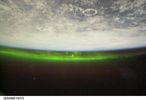
Coronal Aurora - ISS.jpgCoronal Aurora from Space75 visiteOriginal caption:"From the ground, spectacular auroras seem to dance high above. But the International Space Station (ISS) orbits at nearly the same height as many auroras, sometimes passing over them, and sometimes right through them. Still, the auroral electron and proton streams pose no direct danger to the ISS. In 2003, ISS Science Officer Don Pettit captured the green aurora, pictured above in a digitally sharpened image. From orbit, Pettit reported that changing auroras appeared to crawl around like giant green amoebas. Over 300 Km below, the Manicouagan Impact Crater can be seen in northern Canada, planet Earth".
(12 voti)
|
|

ZZ-ZZ-HybridEclypse-Heinsius_Panama_tse2005_1.jpgAn unusual "Hybrid Solar Eclipse" (2)72 visiteDa "NASA - Picture of the Day" del 6 Maggio 2005:"(...) But for Stephan Heinsius, near the end of the shadow track at Penonome Airfield, Panama, the Moon's apparent size had shrunk enough to create an anular eclipse, showing a complete anulus of the Sun's bright disk as a dramatic "Ring of Fire".
(...) How rare is such a Hybrid Eclipse?
Calculations show that during the 21st century just 3,1% (7 out of 224) of Solar Eclipses are hybrid while hybrids comprise about 5% of all Solar Eclipses over the period from 2.000 BC to AD 4.000".
(12 voti)
|
|
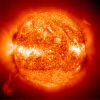
Sun-prom1743_eit_big.jpgAnother "Solar Prominence" from Soho94 visiteCaption NASA originale:"This large prominence is significant not only for its size, but also for its shape. The picture was taken early in the year 2000 by the Sun-orbiting SOHO satellite. Although large prominences and energetic Coronal Mass Ejections (CMEs) are relatively rare, they are occurred more frequently near Solar Maximum, such as the time of peak sunspot and solar activity in the 11 year solar cycle".
(12 voti)
|
|

A-The Sun from Soho~0.jpgA colorful Sun, a Solstice celebration148 visiteCaption NASA originale: "This composite image combines Extreme Ultravoilet Imaging Telescope (EIT)images from three wavelengths(171, 195 and 284 angstrom) into one that reveals solar features unique to each wavelength. Since the EIT images come to us from the spacecraft in black and white, they are color coded for easy identification. For this image, the nearly simultaneous images from May 1998 were each given a color code (red, yellow and blue) and merged into 1. SOHO is a project of international cooperation between ESA and NASA".
(12 voti)
|
|

UV Sun.jpgUltraviolet Sun67 visiteDa "NASA - Picture of the Day" del 10 Luglio 2006:"Is this our Sun?
Yes. Even on a normal day, our Sun is sizzling ball of seething hot gas. Unpredictably, regions of strong and tangled magnetic fields arise, causing sunspots and bright active regions. The Sun's surface bubbles as hot Hydrogen gas streams along looping magnetic fields. These active regions channel gas along magnetic loops, usually falling back but sometimes escaping into the Solar Corona or out into space as the solar wind. Pictured above is our Sun in three colors of ultraviolet light. Since only active regions emit significant amounts of energetic ultraviolet light, most of the Sun appears dark. The colorful portions glow spectacularly, pinpointing the Sun's hottest and most violent regions. Although the Sun is constantly changing, the rate of visible light it emits has been relatively stable over the past 5 BY, allowing life to emerge on Earth".
(11 voti)
|
|
| 144 immagini su 12 pagina(e) |
1 |
 |
|
|
|
|
|
|
|
|
|








