| Piú votate - Walking on Mars with Spirit and Opportunity |

SOL365-2N158775019EFFA2DHP0645R0M1.jpgOne year on Mars: panorama from the Columbia Hills (3)60 visiteTerzo tassello del panorama ed ancora un'enormità di rocce da guardare e da studiare. Qui noi non vediamo anomalie e non ci sembra neppure di cogliere delle forme particolarmente curiose. Forse ci siamo abituati alle peculiarità del "Deserto Arancione", o forse stiamo solo cercando di non gridare "Anomalia! Anomalia!" tutte le volte che ci capita di vedere un sasso dalla forma strana, a differenza di quanto continuano a fare, purtroppo, tanti Ricercatori ed Appassionati in Italia e tanti pseudo-scienziati che hanno voglia di "mettersi in mostra" e che lavorano - più che altro di fantasia - "Oltre Oceano" (non Vi diciamo dove, ma siamo sicuri che sapreste individuare la loro "Missione" con facilità...).
(4 voti)
|
|

OPP-SOL332-1N157664885EFF40B8P1997L0M1.jpgClose encounter with the Heat-Shield - Sol 33288 visiteUna spettacolare e ravvicinatissima ripresa di alcuni frammenti dello Scudo Termico e del suolo di Marte il quale sembra mostrare qualche "ferita" da impatto.
(4 voti)
|
|
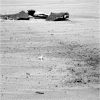
OPP-SOL329-1P157387164EFF40A3P2360L7M1.jpgThe Heat-Shield and its surroundings (6)96 visiteUn enorme quantitativo di scintillanti frammenti dello Scudo Termico, di ogni forma e dimensione, giacciono sparpagliati in ogni direzione nel raggio di qualche decina di metri. Le immagini sono davvero interessanti e stimolano una riflessione: in fondo, ciò che stiamo "guardando ed immortalando", adesso, non è nient'altro che un mucchio di rottami. E allora permetteteci una battuta: che l'opera di "littering" di Marte ad opera dell'Uomo fosse già iniziata?!?...
(4 voti)
|
|

OPP-SOL318-1P156412451ESF3940P2569R2M1.jpgThe Heat-Shield - Sol 318101 visiteBrutta immagine, ma significativa: lo Scudo Termico è a poche decine di metri da Opportunity e brilla sotto il Sole di Marte. Brilla così intensamente che le sue fattezze sono "lavate via" (washed away) dai riflessi di luce (Sun glare). Noi siamo molto interessati a questo "pezzo di metallo"; la NASA, a giudicare dalle tantissime immagini che ha ripreso e che continua a riprendere, forse lo è anche di più...
(4 voti)
|
|

OPP-SOL288-1P153749936EFF37MIP2271R1M1.jpgBurns Cliff - detail mgnf (1)106 visiteUna serie di frames (relativi al Sol 288) che ci fanno vedere da MOLTO vicino la pavimentazione delle pareti interne del Cratere Endurance (area battezzata dai Tecnici NASA come "Burns Cliff"): non ci sono parole valide per descrivere la bellezza di queste immagini le quali, ove portate full size, mostrano degli incredibili dettagli ed un quantitativo davvero strabiliante di possibili anomalie.
(4 voti)
|
|

SOL226-A_P2569_L456-A226R1_br2.jpgRat-holes in "Clovis"81 visite
(4 voti)
|
|
OPP-SOL201-1N146028756EFF3535P1981L0M1.jpgEndurance Crater Panorama (1) - Sol 20184 visitenessun commento
(4 voti)
|
|

SOL213-223-Cahokia_Panorama-PIA06917.jpg"Cahokia" Panorama - The "Columbia Hills" - Soles 213 - 223 (Approximate True Colors; credits: NASA/JPL/Cornell)120 visiteThis stunning image mosaic of the "Columbia Hills" is the first 360-degree panorama taken since the Mars Exploration Rover Spirit arrived at the hills over a month ago. The rover has been busy studying the rocks here, which show evidence of past alteration by water. The dark patch of soil to the right is the spot where Spirit stopped for engineering work on its right front wheel. Spirit's tracks can be followed from there all the way back to "Bonneville Crater" and the original landing site, more than 3 kilometers (1.86 miles) away.
This approximate true-color image, nicknamed the "Cahokia Panorama" after the Native American archaeological site near St. Louis, was acquired between Sol 213 to 223 (such as Aug. 9 to 19, 2004). The panorama consists of 470 images acquired through six panoramic camera filters (750 to 480 nanometers). It took until the week of sol 237 (Sept. 2) to downlink all the data back to Earth. Several more weeks of image processing and geometric mapping by team members at Jet Propulsion Laboratory, Pasadena, Calif., and Cornell University, Ithaca, N.Y., were required to stitch all the images together into this spectacular mosaic.
(19 voti)
|
|

OPP-SOL116-01.jpgEndurance Crater - Sol 116 (HD - Approx. True Colors; credits: NASA/JPL-Caltech)348 visiteNoi non sappiamo quale possa essere il reale impatto visivo di un paesaggio del genere su un occhio umano ma, a ben vedere, la sensazione che ricaviamo dalle immagini che ci arrivano (anche quando sono "elaborate"...) è quella di un Pianeta che "aspetta".
E' vero, sembra un deserto, brullo ed inospitale, eppure c'è qualcosa, dietro le sabbie arancioni, che invita alla scoperta.
Ma forse è solo la nostra immaginazione...
(19 voti)
|
|

SOL330-Spirit-A_DeckPan-A402R1_br2.jpgSpirit's "Self-Portrait" - Sol 330 (Approximate True Colors; credits: NASA/JPL-Caltech)70 visiteCaption NASA originale:"NASA's Mars Exploration Rover Spirit used its panoramic camera to take the images combined into this mosaic view of the rover. The downward-looking view omits the mast on which the camera is mounted. It shows dust accumulation on Spirit's solar panels. The images were taken through the camera's 600-, 530- and 480-nanometer filters during Spirit's 329th and 330th Martian Days, or Sols".
Due immagini simili e due "volti" di Marte completamente diversi da tutti i punti di vista: dal colore, alle condizioni atmosferiche generali. Se i pannelli solari di Opportunity, infatti, sono (sia pure solo relativamente, come dicono alla NASA) puliti, quelli di Spirit sembrano ormai completamente ricoperti di polvere. Dunque alla NASA ci stanno "anticipando" che i Soles di Spirit sono "contati"?
Guardate le immagini e decidete Voi...
(11 voti)
|
|

SOL372-2P159392388ESFA2HPP2541R5M1.jpgSurface ANOMALY: this rock is VERY strange... (2)71 visiteCambia il filtro/colore usato dalla PanCam di Spirit per fotografare questa roccia, ma non cambiano le nostra impressioni ad essa relative. Si tratta di una roccia completamente inusuale la quale, se osservate con attenzione la frattura centrale che la divide in due, ci dà l'impressione di essere piuttosto fragile e sottile.
Purtroppo queste prime immagini non sono eccezionali in termini di qualità e quindi dobbiamo aspettare per formulare altre ipotesi, nella speranza che il Centro Controllo Missione rimanga incuriosito almeno quanto lo siamo noi...
(11 voti)
|
|

ZP-Layered Outcrops-PIA06936_modest.jpgLayered Outcrops in Gusaev Crater150 visite"The Exploration Rover Spirit collected data on morphology, composition and mineralogy of a rock nicknamed Tetl using the microscopic imager, the alpha particle X-ray spectrometer and the Moessbauer spectrometer before moving on. Scientists are discussing a suggestion that this rock outcrop and others on the "West Spur" of the "Columbia Hills" in Gusaev Crater may contain evidence of graded bedding, in which alternate layers of sediment are either coarser or finer depending on the turbulence of the processes that deposited them. Such layers could be deposited by water circulating in rivers or lakes, volcanic ash settling on the surface, wind carrying fine-grained sediments, or a combination of these processes. This view is a mosaic of images that Spirit took with its microscopic imager on the rover's 272nd and 273rd martian days (Oct. 7 and 8, 2004). It has been enhanced to bring out details in the shadows without washing out sunlit areas. The section of rock shown here is approximately 17 cm (6,7") wide".
(11 voti)
|
|
| 5453 immagini su 455 pagina(e) |
 |
|
|
|
|
441 | |
|
|
|
|





