| Piú votate - Walking on Mars with Spirit and Opportunity |

OPP-SOL065-1P2.jpgMartian Sandglasses? - Sol 65 (credits: Dr M. Faccin)103 visiteIl passaggio del medesimo dettaglio attraverso i vari filtri/colore porta - come ben vedete in questo splendido fotomosaico - a "visioni" radicalmente differenti.
Noi, dopo anni di appssionato Lavoro e di riflessioni, stiamo iniziando a districarci in questa "giungla di colori": una giungla creata ad arte, secondo noi, per confondere. Ma grazie alla passione ed alla dedizione dei nostri Grandi Partners Gianluigi Barca e Marco Faccin, ora le nostre idee - al pari delle colorizzazioni - stanno incominciando a diventare più "chiare" e "lineari"...
E' solo questione di tempo, ma i True Colors of Mars - credeteci - fra qualche mese (o anche meno...) NON saranno più un Mistero! MareKromium
(11 voti)
|
|
OPP-SOL956-PIA09170-1.jpgMartian Twilights... - Sol 956 (elab. Lunexit)90 visitenessun commento
(11 voti)
|
|
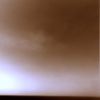
OPP-SOL956-PIA09170.jpgClouds over Meridiani (natural colors) - Sol 956183 visiteLike clouds on Earth, these Martian clouds are probably composed of ice crystals and possibly supercooled water droplets. They are similar in appearance to terrestrial cirrocumulus or high altocumulus clouds. On Earth, such clouds are relatively transient and consist of small, individual cloudlets arranged in rippled patterns. They usually form 6 to 12 Km (about 4 to 7 miles) above Earth's surface by a process known as convection, during which warm air rises and cools, with clouds condensing from the moist air once it has cooled sufficiently.
These Martian clouds appear to be associated with a broader layer of ice-crystal clouds fanning out toward the upper right of the frames at the end of the movie. This is similar to the occurrence of terrestrial cirrocumulus and altocumulus clouds within layers of cirrus or cirrostratus clouds on Earth.
Also apparent in this movie are prominent waves in the clouds, a result of the effect of gravity waves on cloud thickness, as on Earth.
Though both Rovers now have the ability to autonomously detect clouds, these images were taken prior to the first use of the new abilities. The images shown here were stored on Opportunity and were transmitted to Earth on Sol 1056 (such as Jan. 12, 2007) during a routine communications pass.
(11 voti)
|
|
OPP-SOL989.gifMartian Sunrise (GIF anim.)98 visitenessun commento
(11 voti)
|
|
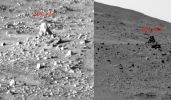
SOL813-825-A_P2408_R1b-A813R1-3.jpgThe "Totem" is alive! - Sol 813/825145 visitePer coloro i quali avessero avuto dei dubbi e/o per quanti pensano che gli Anomaly Hunters sono individui che soffrono di "traveggole", un nuovo mosaico del Dr Gianluigi Barca che ci mostra altri due "momenti" del rilievo superficiale che abbiamo battezzato "Totem".
Gli angoli visuali sono - e lo si vede bene - leggermente diversi, certo, ma le fattezze del Totem, invece, sono RADICALMENTE diverse (non nella loro forma esteriore bensì nella..."espressività" del rilievo)!
Nel Sol 813, il Totem è quasi del tutto piatto e "dormiente"; nel Sol 825, tutti i fori che caratterizzano la sua "faccia" sono aperti.
Attenzione: forse il Totem è "vivo" e forse non lo è, ma la NASA...Si rende conto, la "Grande NASA", di quello che "espone" sul suo Sito?!?
(11 voti)
|
|

SOL731-PIA06102.jpgMartian "Corals" (approx. true colors) - Sol 73180 visiteThe change in textures and the location of the basalts may be signs that Spirit is driving along the edge of a lava flow. This lava may be the same as the basalt blanketing the plains of Spirit's Landing Site, or it may be different. The large size and frothy nature of the boulders around Lorre Ridge might indicate that eruptions once took place at the edge of the lava flow, where the lava interacted with the rocks of the basin floor. Scientists hope to learn more as Spirit continues to investigate these rocks.
As Earth approaches the Chinese New Year (The Year of the Dog), the Athena Science Team decided to use nicknames representing Chinese culture and geography to identify rocks and features investigated by Spirit during the Chinese New Year celebration period. In ancient Chinese myth, FuYi was the first great emperor and lived in the East. He explained the theory of "Yin" and "Yang" to his people, invented the net to catch fish, was the first to use fire to cook food, and invented a musical instrument known as the "Se" to accompany his peoples' songs and dances. Other rocks and features are being informally named for Chinese gods, warriors, inventors, and scientists, as well as rivers, lakes, and mountains.
Spirit took this image on the rover's Martian day, or sol, 731 (Jan. 23, 2006). This is an approximate true color rendering combining images taken with the Pancam's 750-nanometer, 530-nanometer and 430-nanometer filters.
(11 voti)
|
|

SOL731-PIA06101.jpgMartian "Corals" (false colors) - Sol 73168 visiteIn recent weeks, as NASA's MER Spirit has driven through the basin south of Husband Hill, it has been traversing mainly sand and dune deposits. This week, though, Spirit has been maneuvering along the edge of an arc-shaped feature called Lorre Ridge and has encountered some spectacular examples of basaltic rocks with striking textures. This PanCam image shows a group of boulders informally named "FuYi". These basaltic rocks were formed by volcanic processes and may be a primary constituent of Lorre Ridge and other interesting landforms in the basin.
Spirit first encountered basalts at its landing site 2 years ago, on a vast plain covered with solidified lava that appeared to have flowed across Gusev Crater. Later, basaltic rocks became rare as Spirit climbed Husband Hill. The basaltic rocks that Spirit is now seeing are interesting because they exhibit many small holes or vesicles, similar to some kinds of volcanic rocks on Earth. Vesicular rocks form when gas bubbles are trapped in lava flows and the rock solidifies around the bubbles. When the gas escapes, it leaves holes in the rock. The quantity of gas bubbles in rocks on Husband Hill varies considerably; some rocks have none and some, such as several here at FuYi, are downright frothy.
(11 voti)
|
|
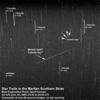
SOL643-PIA03613_fig1.jpgSpirit's search for meteors - Sol 64380 visiteSi vedano i commenti (nonchè la Original Caption) riportati nelle note al frame relativo al Sol 668.
(11 voti)
|
|

SOL643-2P183484842EFFAI38P2734L1M1.jpgA "streak" in the Martian Sky - Sol 643100 visiteUna "striscia" di luce decisamente lunga illumina il cielo notturno di Marte: sono appena passate le 22 MLT quando questo interessante fenomeno viene ripreso dalla Left PanCam di Spirit. Voi penserete che si tratta di uno dei 'soliti' raggi cosmici, magari un pò più intenso del solito, ma la realtà, a nostro parere, è che questa traccia appartiene ad un oggetto volante in movimento. Le strisce lasciate dai raggi cosmici - almeno sino ad ora - sono molto più brevi e meno intense (verificate Voi stessi: abbiamo svariati esempi di questo tipo di anomalìa nei nostri archivi).
In questo caso specifico, invece, la scia che appare nel cielo di Marte è identica a quella che caratterizza i Satelliti Iridium i quali, mentre ruotano su loro stessi, sembrano variare di luminosità ed emettere una sorta di flash (causato dai raggi del Sole che si riflettono sui loro pannelli). Se riuscite a "cogliere il momento" del flash ed a fotografarli, sulla foto che avrete ottenuto ci sarà una traccia IDENTICA a questa. Provate...
(11 voti)
|
|

SOL519-Husband5-PIA04180.jpgLooking at Husband's Summit - Sol 519 (Natural Colors; credits: NASA/JPL-Caltech)81 visiteEd ecco, così come accennavamo in sede di commento al sub-frame precedente, l'accecante biancore che, unito alla nebbiolina Marziana, copre, in parte, i rilievi più lontani di Gusev Crater e conferisce a questa visione un quid di vagamente 'familiare'.
Una bella immagine, ripetiamo, decisamente (ed almeno in accordo ai nostri mezzi ed alle nostre competenze ed esperienze) più realistica di quelle - svariate - ricostruzioni in pseudo-colori-quasi-veri che hanno caratterizzato le produzioni NASA degli ultimi mesi.
(11 voti)
|
|

OPP-SOL004-1F128540990EDN0205P1001R0M1.jpgEagle Crater on Sol 4108 visiteSperiamo di fare cosa gradita comunicandoVi l'indirizzo http dove potrete leggere le istruzioni per "decodificare" l'ID number dei frames di Spirit ed Opportunity:
"http://marsrovers.jpl.nasa.gov/gallery/edr_filename_key.html"
(11 voti)
|
|

SOL318-325-Husband_Hill-PIA07334_br2-04.jpgColumbia Hills: "Husband Hill's Region" - full 360° panorama (5 - Approximate True Colors; credits: NASA/JPL-Caltech)93 visiteLa pianura attraversata da Spirit per quasi un anno, infine (che vedete molto bene nei sub-frames 1 e 5 di questa carrellata), è stata anch'essa 'piallata ed offuscata'.
Il frame "BIG", se lo andrete a visionare, è altresì deludentissimo per quanto attiene la definizione dei dettagli posti in campo medio e lungo. O meglio: alcuni dettagli (specie quelli posizionati al centro ed alla Dx di chi guarda) sono splendidamente chiari, anche se lontani dal punto di ripresa. Altri, magari decisamente più vicini, sono annebbiati e confusi.
Altre tracce - secondo noi evidenti - di abrasioni e cancellazioni di particolari (riteniamo operate usando un aerografo o qualcosa di simile) nonchè una "nuvola" di puntini luminosi (uno 'spruzzo' fuori bersaglio?!?), sono ben visibili sullo skyline alla Dx di chi guarda.
Last but not least: le colline più lontane (che dovrebbero essere visibili sul filo dell'orizzonte) sembrano disegnate a mano e poi colorate con i "pastelli"...
Il nostro voto all'"Opera"? Un bel 4=!
(11 voti)
|
|
| 5453 immagini su 455 pagina(e) |
 |
|
4 | |
|
|
|
|
|
|
|





