| Piú votate - Walking on Mars with Spirit and Opportunity |
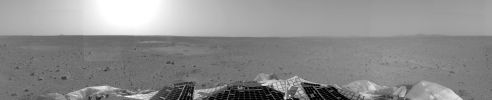
SOL001-PIA04991.jpgDeflated Air-Bags, bright Sun and distant Hills on Spirit's Sol 163 visitenessun commento
(8 voti)
|
|
SOL489-2P169794250EFFAAE0P2690L7M1.jpgSunset on Gusev Crater (3)84 visitenessun commento
(8 voti)
|
|

OPP-SOL060-LionKingPan.2.jpgThe reddish horizon of Meridiani Planum (2)105 visiteBen visibili le tracce dei rimbalzi degli airbags sulla superficie del Pianeta Rosso (le tracce scure) ed i riflessi color rosso-arancio delle sabbie (e delle polveri) che disegnano i profili superiori dei Side-Winders. Affascinante (e credibile, a nostro modo di vedere) il colore del Cielo di Marte il quale, ha causa delle polveri arancioni e rosse in sospensione, è plausibile che assuma, durante il giorno, questo colorito rosato che abbiamo visto anche in immagini similari, ma relative ad altre Missioni (vedi i frames Viking e Pathfinder).
(8 voti)
|
|

OPP-SOL005-1N128626057EFF0205P1511L0M1.jpgA "drop of light": an example of photo-artifact (1)130 visiteCome nel caso (eclatante) delle riprese fotografiche del Sole, così accade anche quando vengono fotografate delle superfici ad elevata riflettenza (tipo metallo o cristallo): l'artefatto fotografico che si produce sull'immagine è quella 'striscia', più o meno lunga, di luce che taglia il frame, passando dal centro della sorgente luminosa. Più la superficie riflettente è intensa, più lunga e spessa è la striscia che appare nell'immagine.
Noi abbiamo battezzato questo effetto come "goccia di luce" e Vi invitiamo a tenerlo ben presente: esso ci dirà, anche nel caso di riprese effettuate da distanze sensibili (dalle decine alle centinaia di metri), quando c'è qualcosa di 'metallico' all'orizzonte.
Gli esempi pratici li potete già trovare nelle Sezioni "Mars Spirit Anomalies and Maps" e "Mars Opportunity Anomalies and Maps".
(8 voti)
|
|

OPP-SOL001-1P128287837EFF0000P2303L2M1.jpgAir-Bags' tracks near Opportunity (2)145 visitenessun commento
(8 voti)
|
|
SOL006-2P126915826EFF0205P2212L2M1.jpgLate Afternoon at Gusev Crater - Sol 6 (Original NASA/JPL b/w Frame)63 visiteControluce, per un orizzonte Marziano scuro ed un cielo limpido e senza nuvole che lascia intuire la presenza del Sole (in alto, verso Dx).
Una "Cartolina da Marte": nulla di più.
(8 voti)
|
|
SOL001-2P126471364EDN0000P2303L6M1.jpgSol 1: the early pictures from Spirit (2)66 visitenessun commento
(8 voti)
|
|
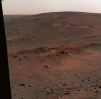
SOL454-PIA07855_3.jpgClark Hill, Larry's Lookout and Methuselah outcrops (false colors - 1) - Sol 45483 visiteCaption NASA originale:"NASA's Mars Exploration Rover Spirit is approaching an outcrop dubbed "Methuselah," which Scientists intend for the Rover to examine in detail for several days before resuming an uphill climb. This false-color view is assembled from frames taken by Spirit's PanCam on the Rover's 454th Sol (April 13, 2005). It shows a region in the "Columbia Hills" slightly downhill from the Rover. The view features two interesting outcrops in the middle distance and "Clark Hill" in the left background. The outcrop on the right, with Rover tracks leading from it, is "Larry's Lookout." On the left is the Methuselah outcrop, with apparent layering. This view combines images taken through the camera's 750-nnmt, 530-nnmt and 430-nnmt filters".
(8 voti)
|
|

OPP-SOL049-1P132542063EFF0600P2400L7M1.jpgIs this a "Little Lizard" or just a "Little Stone"? (1)228 visiteGuardate i commenti relativi al dettaglio di questo frame nella Sezione "Mars - Opportunity Anomalies and Maps": forse non c'è nulla di speciale in questa immagine e forse c'è tutto!...
(8 voti)
|
|
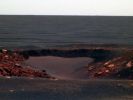
OPP-SOL389-NaturCrater.jpgNaturaliste Crater (false - but nice! - colors)130 visitenessun commento
(8 voti)
|
|
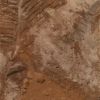
SOL400-A_P2551_True_RAD-A418R1.jpgMartian Regolith - Sol 400 (True Colors; credits: NASA/JPL-Caltech)93 visiteCaption NASA originale:"NASA's Mars Exploration Rover Spirit has been analyzing sulfur-rich rocks and surface materials in the "Columbia Hills" in Gusaev Crater on Mars. This image shows rocky debris and dust, which planetary scientists call "regolith" or "soil," that has been churned up by the rover wheels. This 40-centimeter-wide (16-inch-wide) patch of churned-up dirt, nicknamed "Paso Robles," contains brighter patches measured to be high in sulfur by Spirit's alpha particle X-ray Spectrometer. Spirit's PanCam took this image on Sol 400 (such as February 16, 2005). The image represents the PanCam team's best current attempt at generating a true color view of what this scene would look like if viewed by a human on Mars. The image was generated from a combination of six calibrated, left-eye images acquired through filters ranging from 430-nanometer to 750-nanometer wavelengths".
(8 voti)
|
|

OPP-SOL383-4-PIA07428.jpgFull Panorama on Sol 383 - Side-Winders and Solar Panels (4)106 visitenessun commento
(8 voti)
|
|
| 5453 immagini su 455 pagina(e) |
 |
|
|
|
|
17 | |
|
|
|
|





