| Piú votate - Mercury |

ZZ-Mercury-Volcanic_Regions-Plains-PIA13676.jpgSmooth Plains and Impact Craters96 visiteThis scene, a mosaic of images acquired as MESSENGER approached Mercury for its third fly-by of the Planet, shows a large expanse of Smooth Volcanic Plains near the center of the image.
Most Smooth Plains are believed to have formed by Lavas that flooded Mercury's Surface. In this view, Craters are visible that have been nearly filled with Lava, leaving only traces of their Circular Rims.
Curving Scarps (or "Cliffs") and "Wrinkle Ridges" can also be seen running mostly from top to bottom of the frame. The density of Impact Craters on the Smooth Plains is less than on the heavily Cratered Terrain visible in the upper right and lower right corners of this image.
The presence of fewer Impact Craters per unit area means that the Volcanic Smooth Plains are younger than the Cratered Terrain.
During orbital observations beginning in 2011, MESSENGER will gather high-resolution and color imaging data to map the global extent of Mercury's Volcanic Smooth Plains, gaining clues to the composition of the Plains and unraveling the History of Volcanism on the Solar System's Innermost Planet. The named craters Picasso, Firdousi and Steichen are visible in this scene.
Date Acquired: September, 29th, 2009
Instrument: Narrow Angle Camera (NAC) of the Mercury Dual Imaging System (MDIS)
Scale: The bottom edge of this image is approximately 1450 Km (900,45 miles) acrossMareKromium
(4 voti)
|
|

ZW-Mercury-PIA13508-PCF-LXTT.jpgHokusai Crater (Absolute Natural Colors; credits for the additional process. and color.: Dr Paolo C. Fienga - Lunexit Team)122 visiteThis mosaic of NAC images shows the Impact Crater Hokusai, located on Mercury at a latitude of approx. 58° North. The Crater has an impressive System of Rays, which extend as much as a thousand kilometers (more than 600 miles) across the Planet and are the longest that have yet been identified on Mercury.
Such Rays are formed when an impact excavates material from beneath the Surface and throws that material outward from the Crater. These bright Rays, consisting of both Ejecta and Secondary Craters (that form when the ejected material re-impacts the Surface), slowly begin to fade as they are exposed to the harsh Space Environment. Mercury and other airless Planetary Bodies are being constantly bombarded with Micrometeoroids and Energetic Ions, both concurring to produce an effect known as "Space Weathering".
Craters with Bright Rays are thought to be relatively young because the Rays are still visible, indicating that they have had less exposure to such weathering processes than craters that lack rays.
Although the extent of some of Hokusai's Rays have been determined, images acquired during MESSENGER's three Mercury fly-bys have not yet shown all of them.
During MESSENGER's orbital observations, which will begin in March 2011, MDIS will acquire high-resolution color images of Mercury's entire Surface.
This Global Color Map will allow the better understand the extent of the extensive Systems of Rays emanating from Hokusai and other young Craters, to be mapped for the first time.
Date Acquired: October, 6th, 2008
Instrument: Narrow Angle Camera (NAC) of the Mercury Dual Imaging System (MDIS)
Scale: The diameter of Mercury is of about 4880 Km (3030,48 miles) and Hokusai Crater has a diameter of approx. 95 Km (58,995 miles)MareKromium
(4 voti)
|
|

ZZ-Mercury-Limb-PIA12306.jpgBehind the Sun64 visiteAs MESSENGER approached Mercury during the Spacecraft's 3rd Mercury flyby, the Solar System's innermost Planet appeared to the imaging system as a sunlit crescent against the blackness of space. About 78 minutes prior to closest approach, the NAC captured this striking high-resolution image of the northernmost Region of Mercury's surface that was visible to the camera and illuminated by sunlight. The brightly lit North-Eastern walls of large impact craters can be seen near the horizon, catching the grazing rays of the Sun. The high Sun angle also accentuates wrinkle ridges winding across the smooth plains. In the foreground, features cast long shadows and the Terminator separates day from night.
Date Acquired: September 29, 2009
Image Mission Elapsed Time (MET): 162744006
Instrument: Narrow Angle Camera (NAC) of the Mercury Dual Imaging System (MDIS)
Scale: The crater near the middle of the left edge of the image is approximately 100 Km (about 60 miles) in diameter
Spacecraft Altitude: about 16.200 Km (approx. 10.100 miles)MareKromium
(4 voti)
|
|

ZZ-Mercury-Volcanic_Regions-PIA12284.jpgEvidence of Volcanism on Mercury73 visiteSome impact craters on Mercury have non-circular, irregularly shaped depressions or pits on their floors. Such craters have been termed "Pit-Floor Craters", and MESSENGER team members have suggested that such Pits formed by the collapse of subsurface magma chambers. If this suggestion is correct, the pits are evidence of volcanic processes at work on the Solar System's innermost Planet. With high-resolution images from MESSENGER's 3rd Mercury flyby, more pit-floor craters are being identified on Mercury's Surface.
This NAC image shows a good view of a Pit-Floor Crater imaged last week prior to closest approach. The large crater near the center of the image contains an elongated bean-shaped depression on its floor and is a Pit-Floor Crater. The slightly smaller crater to the South also contains a pair of depressions on its floor, though from this image alone it cannot be determined if the depressions are pits or overlapping impact craters. Other examples of pit-floor craters discovered in MESSENGER images include Beckett, Gibran, and another newly imaged crater from Mercury flyby 3.
Date Acquired: September 29, 2009
Image Mission Elapsed Time (MET): 162744290
Instrument: Narrow Angle Camera (NAC) of the Mercury Dual Imaging System (MDIS)
Resolution: 390 meters/pixel (0.24 miles/pixel)
Scale: this image is about 400 Km (approx. 250 miles) from top to bottom
Spacecraft Altitude: about 15.200 Km (approx. 9400 miles)MareKromium
(4 voti)
|
|

ZZ-Mercury-Craters-Raditladi_Impact_Basin-PIA12042_fig1.jpgRaditladi Basin62 visiteRaditladi Basin, imaged during MESSENGER's first Mercury flyby and named in April 2008 (PIA10611), is intriguing for several reasons. Shown extending across the top of this high-resolution NAC image, Raditladi Basin is relatively young, with only a few small impact craters on its floor and with well-preserved walls and peak-ring structure.
Visible on the floor of Raditladi are concentric troughs (blue arrows), formed by extension (pulling apart) of the surface. However, extensional troughs on Mercury are quite rare, having been seen to date only in two other locations on the Planet: as part of Pantheon Fossae and other troughs in Caloris Basin and on the floor of Rembrandt, the large basin discovered during MESSENGER's second Mercury flyby (see PIA11769).
Understanding how these troughs formed in the young Raditladi Basin could provide an important indicator of processes that acted relatively recently in Mercury’s geologic history.
Raditladi Basin was the topic of one of 25 presentations made by MESSENGER team members at the 40th Lunar and Planetary Science Conference held last week (April 2009).
Date Acquired: January 14, 2008
Image Mission Elapsed Time (MET): 108826792
Instrument: Narrow Angle Camera (NAC) of the Mercury Dual Imaging System (MDIS)
Resolution: 250 meters/pixel (0,16 miles/pixel)
Scale: Raditladi basin has a diameter of approx. 257 Km (about 160 miles)
Spacecraft Altitude: approx. 10.000 Km (about 6200 miles)MareKromium
(4 voti)
|
|

ZZ-Mercury-Limb-PIA12047.jpgMercurian Limb with Rembrandt Basin (Natural Colors; credits: Lunar Explorer Italia)62 visiteThis mosaic was assembled using NAC images acquired as the MESSENGER spacecraft approached the Planet during the mission's second Mercury flyby. The Rembrandt Impact Basin is seen at the center of the mosaic, as night was falling across the Basin's Eastern Edge. An image similar to this one appears on the cover of the 1st of May issue of the "Science" magazine, which contains four articles on the latest results from that flyby. Click here to view more materials presented during a NASA media teleconference about these latest findings.
Date Acquired: October 6, 2008
Instrument: Narrow Angle Camera (NAC) of the Mercury Dual Imaging System (MDIS)
Scale: Rembrandt Basin is approx. 715 Km (about 444 miles) in diameterMareKromium
(4 voti)
|
|

ZZ-Mercury-Limb-PIA12046.jpgMercurian Limb and Navoi Crater (Natural Colors; credits: Lunar Explorer Italia)60 visiteAt the center of this NAC image is the crater Navoi, named in November 2008 for the Uzbek poet Alisher Navoi (1441/1501 - see also PIA11762).
Located in the far north of Mercury’s Northern Hemisphere, Navoi can be seen clearly as a bright orange feature near the top of a previously released enhanced-color Wide Angle Camera (WAC) image of the Caloris Basin (part of which is shown in this release) (see PIA10359). As seen in that color WAC image, Navoi contains uncommon reddish material that indicates a different rock composition from its surroundings. In the high-resolution NAC image shown here, Navoi also appears to have an irregularly shaped depression in its center. Such depressions have been seen elsewhere on Mercury, including within Praxiteles Crater (see PIA12040), and may indicate past volcanic activity.
Date Acquired: January 14, 2008
Image Mission Elapsed Time (MET): 108828804
Instrument: Narrow Angle Camera (NAC) of the Mercury Dual Imaging System (MDIS)
Resolution: 550 meters/pixel (0,34 miles)
Scale: Navoi is about 66 Km (approx. 41 miles) in diameter
Spacecraft Altitude: approx. 21.700 Km (about 13.500 miles)MareKromium
(4 voti)
|
|
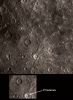
ZZ-Mercury-Craters-Enwonwu_Crater-PIA11784-1.jpgEnwonwu: a young Mercurian Crater (Natural Colors; credits: Lunar Explorer Italia)73 visiteThe feature indicated by the white arrow in this NAC image is the newly named crater Enwonwu (see also PIA11762). It is named in honor of Benedict (Ben) Chukwukadibia Enwonwu, the 20th Century modernist Nigerian sculptor and painter.
Enwonwu Crater displays a Central Peak and a set of bright rays emanating from the Crater Rim. The rays cross the surrounding surface and neighboring craters, indicating that Enwonwu Crater was formed comparatively recently in Mercury’s history. The brightness of the rays also suggests relative youth, as over time rays darken and disappear on Mercury's Surface.
These relationships provide useful indicators for determining the relative ages of features and the sequence of events that have shaped the Surface of Mercury.
Date Acquired: January 14, 2008
Image Mission Elapsed Time (MET): 108829024
Instrument: Narrow Angle Camera (NAC) of the Mercury Dual Imaging System (MDIS)
Resolution: 590 meters/pixel (0,37 miles/pixel)
Scale: Enwonwu Crater is about 38 Km (approx. 24 miles) in diameter
Spacecraft Altitude: about 23.000 Km (approx. 14.300 miles)MareKromium
(4 voti)
|
|
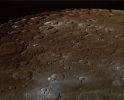
ZZ-Mercury-Limb-PIA11374-0.jpgA View to the South…from the Other Side of Mercury (Extremely Enhanced Natural Colors; credits for the additional process. and color.: Dr Paolo C. Fienga/Lunar Explorer Italia/Italian Planetary Foundation)59 visiteMESSENGER’s 2nd Mercury flyby passed over the opposite side of the Planet from that seen during the Mission’s 1st Mercury encounter. Thus, if one could follow this view obtained by the NAC during the 2nd flyby toward the South, beyond Mercury’s South Pole, it would lead to the Surface seen in an image from MESSENGER’s 1st Mercury flyby (see PIA10187).
Visible in the recently obtained image shown here are many features also seen by Mariner 10: Shevchenko crater named for the 19th century Ukrainian poet, Khansa for the Arabic poet of the 7th century, Rabelais for the Renaissance French writer, Holberg for the Norwegian-Danish writer of the 18th century, Spitteler for the Swiss epic poet who won the Nobel Prize for Literature in 1919, Rameau for the Baroque-era French composer, Puccini for the Italian composer of the late 1800s and early 1900s, and Horace for the ancient Roman poet. Discovery Rupes cuts through Rameau and is named for the ship of English explorer Captain James Cook.
Date Acquired: October 6, 2008
Image Mission Elapsed Time (MET): 131773823
Instrument: Narrow Angle Camera (NAC) of the Mercury Dual Imaging System (MDIS)
Resolution: 510 meters/pixel (0,32 miles/pixel) at the top of the image
Scale: Shevchenko crater is approx. 137 Km (about 85 miles) in diameter
Spacecraft Altitude: approx. 20.000 Km (about 12.400 miles)MareKromium
(4 voti)
|
|

ZZ-Mercury-Craters-Machaut_Crater-CN0131770808M_web.pngMachaut Crater (natural colors; credits: Lunexit)86 visiteDate Acquired: October 6, 2008
Image Mission Elapsed Time (MET): 131770808
Instrument: Narrow Angle Camera (NAC) of the Mercury Dual Imaging System (MDIS)
Resolution: 100 meters/pixel (0,06 miles/pixel)
Scale: This image is about 100 Km across (approx. 60 miles)
Spacecraft Altitude: about 3900 Km (approx. 2400 miles)
Of Interest: Machaut is the name of a crater, approx. 106 Km (about 66 miles) in diameter, first seen under high-Sun conditions by Mariner 10 in the 1970s. The crater is named for the medieval French composer and poet Guillaume de Machaut.
This NAC image shows an amazing new view of Machaut taken during MESSENGER’s second flyby of Mercury. The slanting rays of the Sun cast shadows that reveal numerous small craters and intricate features.
The largest crater within Machaut appears to have been inundated by lava flows similar to those that have filled most of the floor of the larger feature. The adjacent, slightly smaller crater was formed at a later time and excavated material below the lava-formed surface.
MESSENGER science team members will also be studying the shallow ridges that crisscross Machaut’s floor.MareKromium
(4 voti)
|
|

ZZ-Mercury-Craters-Crater_Field.jpgChangings...87 visiteDate Acquired: October 6, 2008
Image Mission Elapsed Time (MET): 131774145
Instrument: Narrow Angle Camera (NAC) of the Mercury Dual Imaging System (MDIS)
Resolution: 550 meters/pixel (0,34 miles/pixel)
Scale: Asvaghosa crater is approx. 90 Km in diameter (about 56 miles)
Spacecraft Altitude: about 21.000 Km (approx. 13.000 miles)
Of Interest: This pair of images illustrates the dramatic effect that illumination and viewing geometry (i.e., the angle at which Sunlight strikes the surface, and the angle from which the spacecraft views the surface) has on the appearance of terrain on Mercury. The image on the right is a frame captured by MESSENGER’s NAC as the spacecraft was departing the planet after its second Mercury flyby. On the left is a portion of a mosaic made from Mariner 10 clear-filter images, obtained by that mission in 1974. The yellow arrows point to the 90-Km- (56-mile-) diameter crater Asvaghosa (named for the first century AD Indian philosopher and poet), and the purple arrows indicate a smaller crater to the southwest. A bright ray, prominently visible in the high-Sun MESSENGER frame, crosses both craters. The stripe of high-reflectance material may have originated at Kuiper crater (to the southwest) or may come from a newly imaged crater to the northeast that has an extensive ray system. This ray and others seen in the NAC image were mostly invisible to Mariner 10, because low-Sun illumination emphasizes topography instead of differences in reflectance. As another example, the curving scarp (cliff) named Santa Maria Rupes (white arrows in the left image) is visible in the Mariner 10 image by the shadow it casts, but this rupes disappears in the MESSENGER image when the Sun is high overhead. Images collected under both high- and low-Sun conditions are needed for geologists to develop a complete understanding of the features on a planetary surface.MareKromium
(4 voti)
|
|

ZZ-Mercury-Limb-CN0131766454M.pngSigns of Aging... (natural colors; credits: Lunexit)88 visiteDate Acquired: October 6, 2008
Image Mission Elapsed Time (MET): 131766454
Instrument: Narrow Angle Camera (NAC) of the Mercury Dual Imaging System (MDIS)
Resolution: 420 meters/pixel (0,26 miles/pixel) on the right side of the image
Scale: The small crater superimposed on the long cliff is about 30 Km (approx. 19 miles) in diameter
Spacecraft Altitude: about 16.500 kilometers (approx. 10.300 miles)
Of Interest: This dramatic NAC image was acquired about 56 minutes prior to MESSENGER’s closest approach during the mission’s recent Mercury flyby, as the spacecraft approached the Planet's illuminated crescent. Prominent toward the horizon in this view of newly imaged terrain is a long cliff face. A small impact crater (about 30 Km, or approx. 19 miles, in diameter) overlies this lengthy scarp. The scarp extends for over 400 Km (about 250 miles) and likely represents a sign of aging unique to Mercury among the planets in the Solar System.
As time passes, the interior of a planet cools. However, the relative size of Mercury's central metallic core is larger than that of the other planets and hence has significantly affected the planet’s geologic evolution. The numerous long scarps on Mercury are believed to be the surface expression of faults formed in the rocks of Mercury's crust as the interior of the planet cooled and contracted. This contraction compressed the surface and thrust some sections of crust over others, creating long curving cliffs like the one shown here.MareKromium
(4 voti)
|
|
| 248 immagini su 21 pagina(e) |
 |
|
|
|
|
9 | |
|
|
|
|





