| |

| Piú votate - Mercury |

ZZ-Mercury-Craters-Rembrandt_Crater-PIA14497-PCF-LXTT.jpgRembrandt Crater (Absolute Natural Colors; credits for the additional process. and color.: Dr Paolo C. Fienga - Lunexit Team)142 visiteDate acquired: July, 11th, 2011
Image Mission Elapsed Time (MET): 218833662, 218833682, 218833666
Image ID: 489008 , 489013, 489009
Instrument: Wide Angle Camera (WAC) of the Mercury Dual Imaging System (MDIS)
WAC filter: 9 (1000 nanometers), 7 (750 nanometers), 6 (433 nanometers) as red-green-blue
Center Latitude: 34,67° South
Center Longitude: 100,4° East
Resolution: 1853 meters/pixel
Scale: Rembrandt Basin has a diameter of about 716 Km (approx. 445 miles)
Solar Incidence Angle: 50,5°
Emission Angle: 0,4°
Phase Angle: 50,5°MareKromium
(5 voti)
|
|

ZZ-Mercury-Craters-DeGas-PCF-LXTT.jpgBright-white Deposits inside Degas Crater (Absolute Natural Colors; credits for the additional process. and color: Dr Paolo C. Fienga - Lunexit Team)83 visitenessun commentoMareKromium
(5 voti)
|
|

ZZ-Mercury-Caloris_Montes-546192main_messenger_orbit_image20110517_1_full_full.jpgCaloris Montes (Natural Colors; credits for the additional process. and color.: Dr Paolo C. Fienga - Lunexit Team)140 visitenessun commentoMareKromium
(5 voti)
|
|

ZZ-Mercury-Craters-Crater_Field-PIA13823-2-PCF-LXTT_(2).jpgThe Surface of Mercury (Absolute Natural Colors; credits for the additional process. and color.: Dr Paolo C. Fienga - Lunexit Team)124 visitenessun commentoMareKromium
(5 voti)
|
|

ZZ-Mercury-Craters-Crater_Field-PIA13823-1.jpgSome Mercurian Surface Features explained (False Colors; credits: 74 visiteCaption NASA:"During MESSENGER's second Fly-By of Mercury, MDIS acquired a strip of HR images obtained with each of the WAC's 11 different color filters. The graphic shown here displays the resulting enhanced-color mosaic and gives considerable detail about the images, how the mosaic was created and the Geologic Features that can be seen.
Currently, these images are the Highest-Resolution color images ever obtained of the Solar System's innermost Planet, but not for long! On March 18, 2011, MESSENGER will enter into orbit about Mercury and the mission's extensive, year-long science observation campaign will begin.
That campaign includes capturing color images of Mercury's Surface at higher resolution than ever before".MareKromium
(5 voti)
|
|
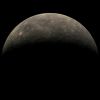
ZW-Mercury-PIA12365.jpgRising Mercury (Natural Colors; credits: NASA and Lunexit)74 visiteAs MESSENGER approached Mercury for the mission's 3rd and final flyby of the Solar System's innermost planet, the WAC acquired images through all 11 of its narrow-band color filters. The 1000, 700, and 430 nanometer filters were combined in red, green, and blue to create this color image, the last close-up color view that will be acquired until MESSENGER goes into orbit around Mercury in March of 2011. Only 6% of Mercury's Surface in this image had not been viewed previously by spacecraft, and most of the measurements made by MESSENGER's other instruments during this flyby were made prior to closest approach. The observations from MESSENGER's third flyby of Mercury nonetheless revealed fresh surprises. Check out the NASA Science Update Telecon held today for details about some of these new surprises.
Date Acquired: September 29, 2009
Instrument: Wide Angle Camera (WAC) of the Mercury Dual Imaging System (MDIS)
WAC Filter: 9, 1, 6 (1000, 700, and 430 nanometers)
Resolution: 5 Km/pixel (about 3 miles/pixel)
Scale: Mercury's diameter is approx. 4880 Km (about 3030 miles) MareKromium
(5 voti)
|
|

ZZ-Mercury-Terminator-PIA12279.jpgStrange Neighbors73 visiteThe MESSENGER Spacecraft was flying toward Mercury at 3,7 Km/second (8300 miles/hour) when it captured this image. The Sun was just above the horizon, and the deep shadows it cast emphasized the texture and topography of the terrain along the Terminator (day/night boundary). The large crater at upper left has a rough rim and walls, and the floor of this crater has a sunken inner circular area. At the center of the sunken floor section is an irregular depression (or pit) that is entirely in shadow in this view. Just to the South-South/West is the right half of another large crater whose rim intersects that of the crater with the sunken floor. The southern crater is about the same diameter as its northern neighbor, but instead of exhibiting a sunken floor with a pit, it has been filled nearly to its rim with smooth material likely of volcanic origin. These two close neighbors, one empty and one full, attest to the surprisingly complicated geological history of the little planet closest to the Sun.
Date Acquired: September 29, 2009
Image Mission Elapsed Time (MET): 162744138
Instrument: Narrow Angle Camera (NAC) of the Mercury Dual Imaging System (MDIS)
Resolution: 400 meters/pixel (0,25 miles/pixel)
Scale: This image is about 220 Km (approx. 140 miles) wide
Spacecraft Altitude: about 15.700 Km (approx. 9800 miles)MareKromium
(5 voti)
|
|

ZZ-Mercury-Craters-Lermontov_Crater-PIA12116.jpgLermontov Crater (possible Natural Colors; credits: Lunar Explorer Italia)62 visiteLermontov Crater was first observed by Mariner 10 and seen more recently by MESSENGER during its second flyby of Mercury. The Crater fFloor is somewhat brighter than the exterior surface and is smooth with several irregularly shaped depressions.
Such features, similar to those found on the floor of Praxiteles Crater (see PIA12040), may be evidence of past explosive volcanic activity on the Crater Floor. Lermontov appears reddish in enhanced-color views (see PIA11411), suggesting that it has a different composition from the surrounding surface.
Lermontov is named for Mikhail Yurevich Lermontov, a nineteenth-century Russian poet and painter who died from a gunshot suffered in a duel.
Date Acquired: October 6, 2008
Image Mission Elapsed Time (MET): 131771953
Instrument: Narrow Angle Camera (NAC) of the Mercury Dual Imaging System (MDIS)
Resolution: 250 meters/pixel (0,16 miles/pixel)
Scale: Lermontov’s diameter is about 152 Km (approx. 94 miles)
Spacecraft Altitude: about 10.000 Km (approx. 6200 miles)
Nota Lunexit: curiosamente, dopo il nostro Color Processing, non è Lermontov ad apparire "rossiccio", a fronte di terreni circostanti grigiastri, bensì l'esatto contrario! Curioso...MareKromium
(5 voti)
|
|

ZZ-Mercury-Craters-Cratered_Plains-PIA12050.jpgRudaki Plains and Crater75 visiteLast week (April 2009), MESSENGER team members presented the results from 4 papers published in the 1st of May issue of the "Science" magazine at a NASA media teleconference. The color views shown here of the Plains near Rudaki Crater was just one of the graphics presented at that teleconference (nota: NO. La versione che vedete su queste pagine è quella ottenuta da Lunar Explorer Italia, applicando la metodologia Multispettrale).
The left image was created by combining WAC images from three narrow-band color filters to approximate Mercury's color as it would be seen by the human eye. The right image used a statistical analysis of all 11 WAC filters to highlight subtle color differences on the surface, as has been used for many previous releases, such as ones focused on Thakur Crater and Caloris Basin.
Date Acquired: October 6, 2008
Image Mission Elapsed Time (MET): 131770571-131770621
Instrument: Wide Angle Camera (WAC) of the Mercury Dual Imaging System (MDIS).
WAC Filters: Left image: 3, 4, 5 (480, 560, 630 nanometers). Right Image: statistical analysis involving all 11 WAC filters
Scale: The crater in the center of the image is approx. 68 Km (about 42 miles) in diameter
Spacecraft Altitude: about 2800 Km (approx. 1700 miles)MareKromium
(5 voti)
|
|

ZZ-Mercury-Craters-Vyasa_and_Stravinsky_Crater-PIA12035_fig1.jpgLow-Sun over Mercury...62 visiteThis NAC image shows a close-up view of the craters Vyasa and Stravinsky (see PIA11360). Stravinsky is the smooth-floored crater partially seen on the right side of the image that overlies the rim of the larger, rougher crater Vyasa in the center and left. The low-Sun lighting angle casts distinctive shadows that show Mercury's rough surface, pockmarked by craters of all sizes. Small craters are visible on the smooth-floor of Stravinsky because of the high resolution of this image.
Date Acquired: October 6, 2008
Image Mission Elapsed Time (MET): 131771118
Instrument: Narrow Angle Camera (NAC) of the Mercury Dual Imaging System (MDIS)
Resolution: 140 meters/pixel (0,09 miles/pixel) near the bottom of the image
Scale: Stravinsky crater is about 190 Km in diameter (120 miles)MareKromium
(5 voti)
|
|

ZZ-Mercury-Craters-Praxiteles_Crater-PIA12052.jpgPraxiteles Crater (enhanced Natural Colors; credits: Lunar Explorer Italia)68 visiteMESSENGER's high-resolution images obtained during the mission's second Mercury flyby have revealed a number of irregularly shaped depressions on the floor of Praxiteles Crater. These depressions are intriguing indications of possible past volcanic activity within this Crater. View the previously released NAC image of Praxiteles for additional discussion.
The image shown here is similar to one recently published in the 1st of May issue of the "Science" magazine. This image was created by first mosaicking together the highest-resolution NAC images available of Praxiteles (one of which is shown in the previous web release), to produce complete coverage of the Crater. Independently, an enhanced-color image of Praxiteles was created by using images from all 11 WAC narrow-band color filters. (Visit last week's web release for more examples of enhanced-color images see PIA12051).
The WAC images provide important color information, but the WAC resolution is considerably less than that of the mosaicked NAC images. Thus, by overlaying a slightly transparent version of the WAC enhanced-color image on the high-resolution NAC mosaic, the high-resolution color view of Praxiteles crater shown here was produced. This overlay-color view helps associate the color features with the morphologic surface features. The fact that the irregularly shaped depressions on the floor of Praxiteles are associated with bright orange and yellow color features provides evidence that the depressions may be related to past volcanic activity in this area of Mercury.
Date Acquired: October 6, 2008
Instrument: Wide Angle Camera (WAC) and Narrow Angle Camera (NAC) of the Mercury Dual Imaging System (MDIS)
Resolution: 210 meters/pixel (0,13 miles/pixel)
Scale: Praxiteles Crater has a diameter of about 182 Km (approx. 113 miles) MareKromium
(5 voti)
|
|

ZT-Mercury-WAC_1x1_color.pngThe "True Colors" of Mercury?88 visite...Ed alla fine, anche la NASA (almeno per quanto riguarda la Missione MESSENGER) si è "arresa" alla Logica Generale dei Colori adottata - tempo fa - da Lunexit.
Citiamo (come da nostro Sondaggio) "I colori di un Mondo dipendono (o, se volete, stanno) dagli (negli) occhi di chi lo guarda".
Una considerazione che potrà anche sembrarVi stupida e scontata ma che, va detto per Onestà Intellettuale, è stata oggettivata e fatta propria da Lunar Explorer Italia da tempo ed attraverso l'articolo "True Colors", che potete trovare nell'archivio del nostro blog TrePlanets.
A nostro avviso, questa considerazione NASA (che riprende Lunexit) deve farci ancora una volta sentire fieri del Lavoro che svolgiamo e dei risultati che otteniamo.
Anche se, a parte Voi Lettori e noi STAFF, non sembra essersene accorto nessun altro (specie in Italia)...
Caption NASA:
Date Acquired: October 6, 2008
Image Mission Elapsed Time (MET): 131775256, 131775260, 131775264, 131775268
Instrument: Wide Angle Camera (WAC) of the Mercury Dual Imaging System (MDIS)
Resolution: 5 Km/pixel (about 3 miles/pixel)
Scale: Mercury’s diameter is roughly 4880 Km (approx. 3030 miles)
Spacecraft Altitude: about 27.000 Km (approx. 17.000 miles)
Of Interest: Given the WAC’s ability to take images through 11 narrow-band color filters, it is natural to wonder what does Mercury look like in “true” color such as would be seen by the human eye. However, creating such a natural color view is not as simple as it may seem. Shown here are four images of Mercury. The image in the top left is the previously released grayscale monochrome single WAC filter (430-nanometer) image; the remaining three images are three-color composites, produced by placing the same three WAC filter images with peak sensitivities at 480, 560, and 630 nanometers in the blue, green, and red channels, respectively. The differences between the color representations result from how the brightness and contrast of each individual WAC filter image was adjusted before it was combined into a color picture. In the top right view, all of the three filter images were stretched using the same brightness and contrast settings. In the bottom left picture, the brightness and contrast of each of the three filter images were determined independent of the others. In the bottom right, the brightness and contrast settings used in the upper right version were slightly adjusted to make each of the three filter images span a similar range of brightness and contrast values.
So which color representation is “correct” for Mercury? The answer to that would indeed DEPEND ON THE EYES OF THE BEHOLDER. Every individual sees color differently; the human eye has a range of sensitivities that vary from person to person, resulting in different perceptions of “true” color. In addition, the three MDIS filter bands are narrow, and light at wavelengths between their peaks is not detected, unlike the human eye. In general, in light visible to the human eye, Mercury’s surface shows only very subtle color variations, as seen in the three images here. However, when images from all 11 WAC filters are statistically compared and contrasted, these subtle color variations can be greatly enhanced, resulting in extremely colorful representations of Mercury’s surface.MareKromium
(5 voti)
|
|
| 248 immagini su 21 pagina(e) |
|
|
|
5 | |
|
|
|
|
|
|
|
|





