| |

| Piú votate - Mercury |

ZZ-Mercury-Craters-Tiziano_Crater-PIA12079.jpgTitian Crater (extremely enhanced Natural Colors; credits: NASA and Lunar Explorer Italia)62 visiteThis enhanced-color image shows Titian Crater (center) and is similar to an image that recently appeared in the 1st of May 2009 issue of Science magazine.
The enhanced-color view was created by using high-resolution images taken in all 11 WAC filers (one of which is shown in a previously released image, see PIA11765) and comparing and contrasting them to accentuate differences on Mercury’s Surface. Such color differences can be used to learn about the history of Mercury’s Surface in this area. In the enhanced color, the smooth floor of Titian is a brighter orange color than the surrounding area, likely due to being filled with volcanic material. Ejecta from Titian appear blueish and cover much of the Surface surrounding the Crater. This material was excavated from depth during the Crater’s formation.
Later impacts, such as the one that produced the small crater that appears yellowish in the upper center of the image, excavated material from below the Titian ejecta. This yellow-appearing material was present at or near the surface before the impact that created Titian and is a different composition (and thus, color) from its surroundings. Impacts make it possible to assess how Mercury’s Crust varies with depth and ultimately how the crust evolved through time.
Date Acquired: October 6, 2008
Instrument: Wide Angle Camera (WAC) of the Mercury Dual Imaging System (MDIS)
Resolution: 462 meters/pixel (0,29 miles/pixel)
Scale: Titian crater is about 121 Km (approx. 75 miles) in diameter
Nota Lunexit: curiosa la "chiazza violacea" visibile ad ore 01:00 del Cratere "Tiziano". La NASA, ovviamente, ha commentato tutto, tranne il dettaglio più intrigante. Noi, purtroppo, non possiamo aggiungere nulla, se non ribadire un concetto già espresso dalla NASA più volte, e cioè che "a colore diverso, nei frames colorizzati in natural enhanced colors, corrisponde un materiale diverso". Nulla di più.MareKromium
(6 voti)
|
|

ZZ-Mercury-Craters-Unnamed_Rayed_Crater-PIA12068.jpgRayed Crater Cluster (possible Natural Colors; credits: Lunar Explorer Italia)73 visiteThis NAC image from MESSENGER’s second Mercury flyby shows a crater with a set of light-colored rays radiating outward from it. Such rays are formed when an impact excavates material from below the surface and throws it outward from the crater.
These bright rays, consisting both of ejecta and the secondary craters that form when the ejected material re-impacts the surface, slowly begin to fade as they are exposed to the harsh space environment.
Mercury and other airless planetary bodies are constantly being bombarded with Micrometeorites and Energetic Ions, an effect known as "Space Weathering".
Craters with bright rays are thought to be relatively young because the rays are still visible, suggesting that they have had less exposure to Weathering processes. The crater in the center of this image has rays that have already begun to fade, implying that it is older than some other rayed craters on Mercury’s surface. Images of younger craters with much brighter and more striking rays have been previously released (see PIA11355).
Date Acquired: October 6, 2008
Image Mission Elapsed Time (MET): 131771863
Instrument: Narrow Angle Camera (NAC) of the Mercury Dual Imaging System (MDIS)
Resolution: 240 meters/pixel (0,15 miles/pixel)
Scale: Image is approximately 240 Km (about 150 miles) wide
Spacecraft Altitude: about 9500 Km (approx. 5900 miles)MareKromium
(6 voti)
|
|

ZZ-Mercury-Scarp-PIA12054.jpgLong and High Scarp (Natural Colors; credits: Lunar Explorer Italia)61 visiteThe Scarp cutting through this Unnamed Crater was imaged as MESSENGER approached the Planet during the mission's second Mercury flyby. The full NAC image acquired by MDIS is shown in a previous release (see PIA11772) while the image shown here is a reprojected view. Compare the two images to see the differences.
By using very precise knowledge about the time that the image was taken and the location of the Spacecraft at that time, the original image can be mapped onto a globe of Mercury. Once mapped onto a Mercury globe, that globe can be viewed in many different ways, including reprojections that create flat maps of Mercury's Surface, as seen in the Global Map of Mercury (see PIA11403). The reprojected image shown here is from a simple cylindrical map projection. Map projections are needed to measure accurately the extent of features on the surface. For example, from this reprojection it was determined that this Scarp is about 1 Km (0,6 miles) high and over 160 Km (about 100 miles) in length. MESSENGER Science Team members recently published an image similar to this reprojection in Science magazine.
Date Acquired: October 6, 2008
Image Mission Elapsed Time (MET): 131766501
Instrument: Narrow Angle Camera (NAC) of the Mercury Dual Imaging System (MDIS)
Resolution: 420 meters/pixel (0,26 miles)
Scale: This crater is about 200 Km (about 124 miles) in diameter
Spacecraft Altitude: 16.300 Km (about 10.100 miles)MareKromium
(6 voti)
|
|

ZZ-Mercury-Craters-Tiziano_Vecellio_Crater-PIA11765-2.jpgTiziano Vecellio Crater (Natural Colors; credits: Lunar Explorer Italia)86 visitenessun commentoMareKromium
(6 voti)
|
|

ZZ-Mercury-Limb-CW0131772818A_web.jpgMercury, during MESSENGER's 2nd Fly-By (natural, but enhanced colors; credits: Lunexit)77 visiteDate Acquired: October 6, 2008
Image Mission Elapsed Time (MET): 131772818
Instrument: Wide Angle Camera (WAC) of the Mercury Dual Imaging System (MDIS)
WAC Filter: 1 (700 nanometers)
Resolution: 2,6 Km/pixel (about 1,6 miles/pixel)
Scale: The left side of the image is about 2700 Km tall (approx. 1700 miles)
Spacecraft Altitude: about 15.000 Km (approx. 9300 miles)
Of Interest: One week ago, no spacecraft had ever seen the majority of the surface visible in this image. Today, one week after MESSENGER’s successful second Mercury flyby, about 95% of Mercury’s surface has been viewed by spacecraft, resulting in nearly global spacecraft imaging coverage of Mercury’s surface for the first time. This WAC image is just one of 99 in a set of 3 columns by 3 rows by 11 color filters that is being combined into a color mosaic of the departing planet. Kuiper crater, with its bright ejecta rays, is visible on the left edge of the image and was seen by Mariner 10, but most of the terrain east of Kuiper was not. A newly imaged crater with an unusual halo of dark material is visible at about the same latitude but toward Mercury’s limb. The long, bright rays that can be seen extending across the surface emanate from a crater just north of this image.MareKromium
(6 voti)
|
|
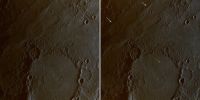
ZZ-Mercury-Global_View_of_the_Surface-PIA10601.jpgNew Lands on Mercury (Extremely Enhanced Natural Colors; credits for the additional process. and color.: Dr Paolo C. Fienga - Lunexit Team)68 visiteOn January 14, 2008, MESSENGER became the First Spacecraft in over three decades to visit Mercury, snapping images of a large portion of Mercury's Surface previously unseen by spacecraft. As the Spacecraft proceeds on its journey, the science team continues to study the 1213 images returned from the mission's historic first flyby. The probe's trajectory will bring it to a second Mercury flyby on October 6, 2008.
MESSENGER's Narrow Angle Camera (NAC) of the Mercury Dual Imaging System (MDIS) captured this image during the flyby of January 2008. The Sun is illuminating this Region at a low angle, accentuating the modest ridges and other low topography on these nearly flat plains. Low ridges trend from the top-center of the image to the left edge (white arrows). The ghostly remains of craters are visible, filled to their rims by what may have been volcanic lavas (red arrows). The faint remnant of an inner ring within the large crater in the bottom half of this picture can be seen (blue arrow); the area interior to this ring was also flooded, possibly by lava, nearly to the point of disappearance. Clusters of secondary craters on the floor of the large crater and elsewhere (yellow arrows) formed when clumps of material were ejected from large impacts beyond the view of this image, which is about 350 Km (approx. 220 miles) across.
Image Mission Elapsed Time (MET): 108826972MareKromium
(6 voti)
|
|

ZZ-Mercury-Craters-Eminescu_Crater-PIA10610.jpgEminescu Crater (MULTISPECTRUM-2; credits: Lunexit)74 visiteLast week, the MESSENGER team learned that the impact crater seen in the middle of this Narrow Angle Camera (NAC) image has been officially named Eminescu. The Crater was named in honor of Mihai Eminescu, an accomplished and influential poet who is still considered the national poet of Romania. The MESSENGER team proposed the name to the International Astronomical Union (IAU), the authority that officially names surface features on planetary bodies.
Eminescu Crater is 125 Km (about 78 miles) in diameter and can be seen just at the top of PIA10384.
The image shown here was acquired by the Mercury Dual Imaging System (MDIS) on January 14, 2008, and shows a portion of Mercury's surface unseen by spacecraft prior to MESSENGER's historic flyby.
Eminescu is a particularly interesting crater for several reasons. Eminescu formed more recently than most of the craters on Mercury, on the grounds that there are very few later craters superposed on it. Moreover, impressive chains of secondary craters, formed by material ejected by the impact explosion that formed the crater, radiate away from Eminescu.
The central peaks within the crater are arranged in a circular pattern; geologists call this a "Peak Ring".
The bright peaks inside Eminescu exhibit unusual color characteristics in the 11-color Wide Angle Camera (WAC) images, which the MESSENGER Science Team is currently studying.
They show up with a bluish tinge in the previously released false-color image of the entire planet (see PIA10398); Eminescu is just North of the Equator, near the day/night "Terminator" in that image.MareKromium
(6 voti)
|
|
ZO-Mercury14_Messenger-209132main_color_mercury.jpgMercury in Natural Colors (credits: Lunexit)65 visitenessun commentoMareKromium
(6 voti)
|
|

B-Mercury-PIA02424.jpgA VERY LARGE crater on Mercury73 visiteCaption NASA originale:"This image (FDS 166), acquired during the spacecraft's first encounter with Mercury, features a 140 Km diameter crater and it's surrounding zone of secondary craters. The narrow width of the rim facies, the prominent subradial secondary crater chains and grooves are representative of the larger mercurian craters".
(6 voti)
|
|

ZZ-Mercury-Rupes-Terror_Rupes-PIA17881-PCF-LXTT-IPF-00.jpgTerror Rupes (CTX Frame - Absolute Natural Colors; credits for the additional process. and color.: Dr Paolo C. Fienga/Lunar Explorer Italia/Italian Planetary Foundation)77 visiteThis is certainly not the first time that we can take a look at the Limb of Mercury and, just as usual, we have to underline that these kind of images never fail to showcase the Geological Diversities of the Innermost Planet of the Solar System. This time, something fills the scene with "terror" and that is, to be clear and precise, the "Terror Rupes", such as the long, Cliff-like Landform visible almost at (better yet to say "near"...) the center of the scene. Terror Rupes is one of Mercury's most prominent Lobate Scarps, and it was so named after the HMS (---> Her Majesty's Ship) Terror: an eighteenth-century warship that, later, participated in Scientific Polar Explorations.
Date acquired: February, 4th, 2012
Image Mission Elapsed Time (MET): 236853865
Image ID: 1353252
Instrument: Wide Angle Camera (WAC) of the Mercury Dual Imaging System (MDIS)
Center Latitude: 69,30° South
Center Longitude: 96,00° East
Solar Incidence Angle: 80,3° (meaning that the Sun, at the time that the picture was taken, was about 9,7° above the imaged Local Mercurian Horizon)
Emission Angle: 50,9°
Sun-Mercury-Messenger (or "Phase") Angle: 114,5°
This picture (which is an Original NASA - MESSENGER Spacecraft's b/w and NON-Map-Projected image published on the NASA - Planetary Photojournal with the ID n. PIA 17881) has been additionally processed, contrast enhanced, Gamma corrected, magnified to aid the visibility of the details and then colorized in Absolute Natural Colors (such as the colors that a human eye would actually perceive if someone were onboard the NASA - MESSENGER Spacecraft and then looked outside, towards the Southern Limb of Mercury), by using an original technique created - and, in time, dramatically improved - by the Lunar Explorer Italia Team. Different colors, as well as different shades of the same color, mean, among other things, the existence of different Elements (Minerals) present on the Surface of Mercury, each having a different Albedo (---> Reflectivity) and Chemical Composition.MareKromium
(5 voti)
|
|

ZZ-Mercury-Craters-Damer_Crater-PIA17812-PCF-LXTT-IPF.jpgThe Walls of Damer (Absolute Natural Colors; credits for the additional process. and color. Dr Paolo C. Fienga/Lunar Explorer Italia/Italian Planetary Foundation)71 visiteThe (relatively) steep Walls of the Impact Crater named Damer are well highlighted in today's APOD. Named after the English sculptor, Anne Seymour Damer (née Conway, she was born in Sevenoaks - UK - on November, 8, 1749 and died in London on May, 28, 1828) earlier this year by the International Astronomical Union (or "IAU", for short), this approx. 60-Km diameter (such as about 37,26 miles) Impact Crater is distinguished by a massive and complex Central Peak that is almost completely covered with Hollows.
Date acquired: November, 13th, 2013
Images Mission Elapsed Time (MET): 26687033
Images ID: 5191249
Instrument: Narrow Angle Camera (NAC) of the Mercury Dual Imaging System (MDIS)
Center Latitude: 36,25° North
Center Longitude: 243,40° East
Solar Incidence Angle: 68,3° (meaning that the Sun, at the time that the picture was taken, was about 21,7° above the imaged Local Mercurian Horizon)
Emission Angle: 3,0°
Sun-Mercury-Messenger (or "Phase") Angle: 65,3°
This frame (which is an Original NASA - MESSENGER Spacecraft's b/w and NON Map-Projected image-mosaic published on the NASA - Planetary Photojournal with the ID n. PIA 17812) has been additionally processed, contrast enhanced, magnified to aid the visibility of the details, Gamma corrected and then colorized in Absolute Natural Colors (such as the colors that a human eye would actually perceive if someone were onboard the NASA - MESSENGER Spacecraft and then looked down, towards the Western Edge of the Mercurian Impact Crater "Damer"), by using an original technique created - and, in time, dramatically improved - by the Lunar Explorer Italia Team. Different colors, as well as different shades of the same color, mean, among other things, the existence of different Elements (Minerals) present on the Surface of Mercury, each having a different Albedo (---> Reflectivity) and Chemical Composition.MareKromium
(5 voti)
|
|

ZZ-Mercury-Craters-Unnamed_Craters-CB-PIA17692-PCF-LXTT-IPF-1.jpgOn the Edge of Caloris Basin (EDM - Possible Absolute Natural Colors; credits for the additional process. and color. Dr Paolo C. Fienga/Lunar Explorer Italia/Italian Planetary Foundation)82 visiteThis picture, which is an Extra Detail Magnification (or "EDM" for short) of a crop taken from an image-mosaic made of 3 (three) frames obtained by the NASA - MESSENGER Spacecraft on October, 24, 2013, features, in particular, two Unnamed Impact Craters (being the larger one, visible at the top of the image, approximately 54 Km - such as about 33,53 miles - in diameter) that are located in the proximities of the Eastern Edge of the Giant Caloris Basin. These two large Unnamed Impact Craters have excavated (at the time of their formation, and according to NASA's Scientists) "Low Reflectance Material", and they both show extrenmly bright Hollows (which, in fact, caused an oversaturation of the picture in the areas where thay are present) within their relatively flat Floors.
The Orange/Reddish Deposits visible in the North/Eastern Quadrant (---> upper right corner) of the scene, exhibit a so-called "Spectral Signature" that is similar to the one usually left by Pyroclastic Deposits, and this circumstance suggests that this Region (just like way many others on Mercury) might have, once, been the Site of Explosive Volcanism.
Date acquired: October, 24th, 2013
Images Mission Elapsed Time (MET): 24470528, 24960452, 24470516
Images ID: 5033545, 5068359, 5033542
Instrument: Wide Angle Camera (WAC) of the Mercury Dual Imaging System (MDIS)
Center Latitude: 23,72° North
Center Longitude: 179,10° East
Solar Incidence Angle: 24,8° (meaning that the Sun, at the time that the picture was taken, was about 65,2° above the imaged Local Mercurian Horizon)
Emission Angle: 8,4°
Sun-Mercury-Messenger (or "Phase") Angle: 33,2°
This frame (which is an an Extra Detail Magnification (or "EDM" for short) of a crop taken from an Original NASA - MESSENGER Spacecraft's False Colors and Map-Projected image-mosaic published on the NASA - Planetary Photojournal with the ID n. PIA 17692) has been additionally processed, contrast enhanced, magnified to aid the visibility of the smaller details, Gamma corrected and then re-colorized in Absolute Natural Colors (such as the colors that a human eye would actually perceive if someone were onboard the NASA - MESSENGER Spacecraft and then looked down, towards the Surface of Mercury), by using an original technique created - and, in time, dramatically improved - by the Lunar Explorer Italia Team. Different colors, as well as different shades of the same color, mean, among other things, the existence of different Elements (Minerals) present on the Surface of Mercury, each having a different Albedo (---> Reflectivity) and Chemical Composition.MareKromium
(5 voti)
|
|
| 248 immagini su 21 pagina(e) |
|
3 | |
|
|
|
|
|
|
|
|
|
|





