| Piú votate - Mercury |

ZU-PIA12135.jpgGood-bye Mercury!74 visiteThese images were taken by MESSENGER as the spacecraft departed Mercury after completing its 2nd flyby on October 6, 2008. During this sequence, images were taken every 5 minutes.
A portion of the same sequence, totaling 198 images in all, has also been made into a movie (see PIA11412). MESSENGER will make its third and final flyby of Mercury on September 29, 2009, and will become the first Spacecraft ever to orbit Mercury in March 2011.
Date Acquired: October 6, 2008
Image Mission Elapsed Time (MET): 131788060-131840260
Instrument: Narrow Angle Camera (NAC) of the Mercury Dual Imaging System (MDIS)
Scale: Mercury’s diameter is 4880 Km (approx. 3030 miles)
Spacecraft Distange from Target: from 95.000 up to 370.000 Km (such as from about 59.000 up to 230.000 miles)MareKromium
(2 voti)
|
|

ZZ-Mercury-Craters-Munch_Crater_et_al_-PIA12034.jpgMunch, Sander and Poe Crater (Natural Colors; credits: Lunar Explorer Italia)69 visitenessun commentoMareKromium
(2 voti)
|
|

B-B-Mercury-PIA02947.jpgIntercrater Plain near Caloris Basin71 visiteCaption NASA originale:"Intercrater Plains and heavily cratered terrain typical of much of Mercury outside the area affected by the formation of the Caloris Basin are shown in this image (FDS 166738) taken during the spacecraft's second encounter with Mercury. Abundant shallow elongate craters and crater chains are present on the intercrater plains.
North is to the top of this image, centered at 56° South, 128° West and measuring about 400 Km across".
Note: The Mariner 10 mission, managed by the Jet Propulsion Laboratory for NASA's Office of Space Science, explored Venus in February 1974 on the way to 3 encounters with Mercury (March and September 1974 and March 1975). The spacecraft took more than 7000 photos of Mercury, Venus, the Earth and the Moon.
(2 voti)
|
|
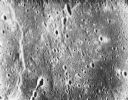
B-A-Mercury-PIA02961.jpgMercury, in HR61 visiteCaption NASA originale:"Taken only minutes after Mariner 10 made its closest approach to the planet Mercury on March 29, 1974, this is one of the highest resolution pictures obtained during the Mission. Craters as small as 150 mt (roughly 500 feet) across can be seen. The picture, taken from a distance of about 5900 Km (such as approx. 3700 miles), measures 50 by 40 Km (such as approx. 931 by 25 miles). The relativity level surface contrasts with the abundant relief seen in some close-up views on the opposite side of the planet. The long, narrow area of hills and scarps to the left resembles ridges in the mare of Earth's Moon. Abundant craters in various stages of degradation dot the surface".
(2 voti)
|
|

B-Mercury-PIA02939.jpgDark-rimmed crater and extensive "Ejecta Blanket"62 visiteCaption NASA originale:"Mariner 10 took this picture (FDS 166840) from a distance of 63.400 Km (39.300 miles) about one hour after it passed under the South Pole of Mercury. The dark-rimmed crater at upper left is 67 Km (42 miles) in diameter. It is surrounded by an extensive ejecta blanket and exhibits a bright ray pattern, which extends into and beyond the larger crater (120 Km - or 75 miles) to its right and near the picture's center. The dark-rimmed crater is similar to crater Tycho on Earth's moon. The center of this picture is located 33° South Lat. and 158° West Long. North is to the top".
(2 voti)
|
|
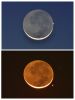
ZG-Mercury_occulted_by_the_Moon-2026Feb18-Melandri.jpgOccultation (Credit & Copyright: Fabrizio Melandri)166 visitenessun commentoMareKromium
(1 voti)
|
|

ZZZ-Mercury-PIA19448.jpgFarewell Messenger!....134 visiteCaption NASA:"Originally planned to orbit Mercury for one year, the mission exceeded all expectations, lasting for over four years and acquiring extensive datasets with its seven scientific instruments and radio science investigation. This afternoon, the Spacecraft succumbed to the pull of Solar Gravity and impacted Mercury's Surface.
The image shown here is the last one acquired and transmitted back to Earth by the mission. The image is located within the Floor of the roughly 93-Km-diameter Impact Crater named "Jokai". The Spacecraft struck the Planet just north of Shakespeare Basin".
Date acquired: April 30, 2015
Image Mission Elapsed Time (MET): 72716050
Image ID: 8422953
Instrument: Narrow Angle Camera (NAC) of the Mercury Dual Imaging System (MDIS)
Center Latitude: 72,0° North
Center Longitude: 223,8° East
Resolution: 2,1 meters/pixel
Scale: This image is about 1 Km across
Solar Incidence Angle: 57,9° (meaning that the Sun was 32,1° high on the Local Horizon)
Emission Angle: 56,5°
Phase Angle: 40,7°MareKromium
(1 voti)
|
|

ZZZ-Mercury-PIA19445.jpgReady to say "Farewell"....98 visiteCaption NASA:"This image, acquired on April, 29th, 2015, is one of MESSENGER's last. On April 30th, the Spacecraft will complete its highly successful orbital mission and impact the Surface of Mercury.
Impact was expected at 19:26:02 UTC (3:26:02 pm EDT) but will occur out of sight and communication with the Earth. The MESSENGER Team will try to establish communications with the Spacecraft when its orbit would allow it to be visible from Earth. The inability to establish communications between MESSENGER and the scheduled Earth-based tracking antenna will provide the first confirmation that the Spacecraft has impacted the Surface. After about 30 minutes following the predicted Mercury Impact Time, the Team plans to announce whether MESSENGER's orbital mission has come to an end".
Date acquired: April 29, 2015
Image Mission Elapsed Time (MET): 72595737
Image ID: 8414772
Instrument: Narrow Angle Camera (NAC) of the Mercury Dual Imaging System (MDIS)
Center Latitude: 69.46° North
Center Longitude: 229,49° East
Resolution: 1,7 meters/pixel
Scale: The largest crater in this image has a diameter of about 330 meters.MareKromium
(1 voti)
|
|

ZZZ-Mercury-PIA19424.jpg104 visiteCaption NASA:"The MESSENGER Spacecraft sent this frame back to Earth after the it emerged from Superior Solar Conjunction, when the communication is largely blocked by the Sun. This is one of our last views of Mercury from MESSENGER. Featured here is the Ejecta Blanket of a (relatively) fresh Unnamed Impact Crater located just outside the scene. Ejecta scoured the Surface leaving behind beautiful patterns of Secondary Impact Craters".
Date acquired: April 16, 2015
Image Mission Elapsed Time (MET): 71544702
Image ID: 8343072
Instrument: Narrow Angle Camera (NAC) of the Mercury Dual Imaging System (MDIS)
Center Latitude: 55,67° North
Center Longitude: 97,37° East
Resolution: 19,9 meters/pixel
Scale: This scene is approximately 20 Km acrossMareKromium
(1 voti)
|
|

ZZ-Mercury-Terminator-PIA10937-1.jpgNorthern Latitudes and a possible Orbital Anomaly (EDM - Enhanced Natural Colors; credits for the add. process. and color.: Dr Paolo C. Fienga)) 131 visiteRaggio Cosmico, senza dubbi.MareKromium
(1 voti)
|
|

ZZ-Mercury-Volcanic_Features-Vent-GC-PIA16990-PCF-LXTT-IPF-1.jpgVolcanic Vent? (Absokute Natural Colors; credits for the additional process. and color.: Dr Paolo C. Fienga/Lunar Explorer Italia/Italian Planetary Foundation)100 visiteThis picture is a NASA - MESSENGER Spacecraft frame that shows us a potential Volcanic Vent located within the Mercurian Impact Crater Glinka. The resolution of this image (which is approx. 46 Km - such as about 28,566 miles - across) is more than two times better than the one of quite a few previous images of the same area, but there are still many doubts among Planetary Scientists that the Depression of the Surface that we see here is actually a Volcanic Vent (---> as a matter of fact, it could also easily be an unusually-looking Collapse Pit, for instance...). The Impact Crater Glinka was named after the Russian composer Mikhail Glinka (1804 - 1857), who is regarded as one of the Fathers of the Russian Classical Music.
Date acquired: November 26th, 2012
Image Mission Elapsed Time (MET): 262402263
Image ID: 3026496
Instrument: Narrow Angle Camera (NAC) of the Mercury Dual Imaging System (MDIS)
Center Latitude: 14,96° North
Center Longitude: 247,40° East
Resolution: 44 meters/pixel
Solar Incidence Angle: 67,5° (meaning that the Sun, at the time that the picture was taken, was about 22,5° above the imaged Local Mercurian Horizon)
Emission Angle: 3,1°
Sun-Mercury-Messenger (or "Phase") Angle: 64,5°
This image (which has been cropped from an Original NASA - MESSENGER Spacecraft Map Projected b/w frame published on the NASA - Planetary Photojournal with the ID n. PIA 16990) has been additionally processed and then colorized in Absolute Natural Colors (such as the colors that a human eye would actually perceive if someone were onboard the NASA - MESSENGER Spacecraft and then looked down, towards the Surface of Mercury), by using an original technique created - and, in time, dramatically improved - by the Lunar Explorer Italia Team. Different colors, as well as different shades of the same color, mean, among other things, the existence of different Elements (Minerals) present on the Surface of Mercury, each having a different Albedo (---> Reflectivity) and Chemical Composition.MareKromium
(1 voti)
|
|

ZZ-Mercury-Craters-Stieglitz_Crater-Central_Peak-PIA16420-PCF-LXTT-IPF.jpgLong Shadows from the Complex Central Peak of Stieglitz Crater (Absolute Natural Colors; credits for the additional process. and color.: Dr Paolo C. Fienga/Lunar Explorer Italia/Italian Planetary Foundation)106 visiteThis really beautiful and dramatic image taken by the NASA - MESSENGER Spacecraft shows us the Central Peak of the Stieglitz Impact Crater, which is located high on Mercury's Northern Hemisphere. The fresh appearance of its Ejecta Deposit suggests that Stieglitz is a relatively young Crater. Intriguingly, Stieglitz also hosts some significant amounts of Radar-Bright Materials whose origin and composition is, so far, unknown.
Date acquired: August, 27th, 2012
Image Mission Elapsed Time (MET): 254597521
Image ID: 2471477
Instrument: Narrow Angle Camera (NAC) of the Mercury Dual Imaging System (MDIS)
Center Latitude: 72,71° North
Center Longitude: 67,90° East
Resolution: 17 meters/pixel
Solar Incidence Angle: 83,4° (meaning that the Sun, at the time that the picture was taken, was about 6,6° above the imaged Local Mercurian Horizon)
Emission Angle: 47,6°
Sun-Mercury-Messenger (or "Phase") Angle: 130,9°
This picture (which is an Original NASA - MESSENGER Spacecraft b/w frame published on the NASA - Planetary Photojournal with the ID n. PIA 16420) has been additionally processed and then colorized in Absolute Natural Colors (such as the colors that a human eye would actually perceive if someone were onboard the NASA - MESSENGER Spacecraft and then looked down, towards the Surface of Mercury), by using an original technique created - and, in time, dramatically improved - by the Lunar Explorer Italia Team. Different colors, as well as different shades of the same color, mean, among other things, the existence of different Elements (Minerals) present on the Surface of Mercury, each having a different Albedo (---> Reflectivity) and Chemical Composition.MareKromium
(1 voti)
|
|
| 248 immagini su 21 pagina(e) |
 |
|
|
|
|
|
|
|
19 | |
|





