| |

| Piú votate - Mercury |

ZZ-Mercury-Craters-Prokofiev_Crater-PIA16857-PCF-LXTT-IPF.jpgIn the Everlasting Night of Prokofiev Crater (Absolute Natural Colors; credits for the additional process. and color.: Dr Paolo C. Fienga - Lunar Explorer Italia/Italian Planetary Foundation)89 visiteProkofiev Crater, so officially named in August 2012 after the Russian composer, is the largest Impact Crater (with a diameter of approx. 112 Km - such as about 69,5 miles) located in Mercury's North Polar Region which hosts Radar-Bright Surface Material. Furthermore, the NASA - MESSENGER Spacecraft has also found evidence that within the cold, dark, and permanently shadowed Inner Regions of Prokofiev, Water Ice is exposed on the Mercurian Surface, just like it seems to happen on the Floors of extremely deep and steep Impact Craters and Canyons located near and at the Poles of our own Moon.
Date acquired: January, 17th, 2013
Image Mission Elapsed Time (MET): 266090610
Image ID: 3288616
Instrument: Wide Angle Camera (WAC) of the Mercury Dual Imaging System (MDIS)
Center Latitude: 84,90° North
Center Longitude: 68,75° East
Resolution: 70 meters/pixel
Solar Incidence Angle: 84,9° (meaning that the Sun, at the time that the pictures were taken, was about 5,1° above the imaged Local Mercurian Horizon)
Emission Angle: 6,1°
Sun-Mercury-Messenger (or "Phase") Angle: 78,8°
This picture (which is an Original NASA - MESSENGER Spacecraft b/w frame published on the NASA - Planetary Photojournal with the ID n. PIA 16857) has been additionally processed and then colorized in Absolute Natural Colors (such as the colors that a human eye would actually perceive if someone were onboard the NASA - MESSENGER Spacecraft and then looked down, towards the Surface of Mercury), by using an original technique created - and, in time, dramatically improved - by the Lunar Explorer Italia Team. Different colors, as well as different shades of the same color, mean, among other things, the existence of different Elements (Minerals) present on the Surface of Mercury, each having a different Albedo (---> Reflectivity) and Chemical Composition.
MareKromium
(2 voti)
|
|

ZZ-Mercury-Craters-Kertesz_Crater-PIA16770-PCF-LXTT-IPF.jpgLow Sun over Kertész Crater (Absolute Natural Colors; credits for the additional process. and color.: Dr Paolo C. Fienga/Lunar Explorer Italia/Italian Planetary Foundation)91 visiteThis spectacular NASA - MESSENGER Spacecraft's image is a mosaic of 3 (three) separate Narrow Angle Camera (NAC) frames. It gives us a close-up look at the enigmatic Kertesz Crater (whose diameter is approx. 31 Km - such as about 19,2 miles) and its very extensive System of Hollows.
Date acquired: Jaunuary, 11th, 2013
Images Mission Elapsed Time (MET) since January 8, 2013: 187422, 187426, 187430
Images ID: 3307043, 3307044, 3307045
Instrument: Narrow Angle Camera (NAC) of the Mercury Dual Imaging System (MDIS)
Center Latitude: 27,38° North
Center Longitude: 146,3° East
Resolution: 30 meters/pixel
Solar Incidence Angle: 80,5° (meaning that the Sun, at the time that the pictures were taken, was about 9,5° above the imaged Local Mercurian Horizon)
Emission Angle: 16,2°
Sun-Mercury-Messenger (or "Phase") Angle: 64,3°
This picture (which is an Original NASA - MESSENGER Spacecraft b/w image mosaic published on the NASA - Planetary Photojournal with the ID n. PIA 16770) has been additionally processed and then colorized in Absolute Natural Colors (such as the colors that a human eye would actually perceive if someone were onboard the NASA - MESSENGER Spacecraft and then looked down, towards the Surface of Mercury), by using an original technique created - and, in time, dramatically improved - by the Lunar Explorer Italia Team. Different colors, as well as different shades of the same color, mean, among other things, the existence of different Elements (Minerals) present on the Surface of Mercury, each having a different Albedo (---> Reflectivity) and Chemical Composition.MareKromium
(2 voti)
|
|

ZZ-Mercury-Craters-Poe_Crater-PIA16755-PCF-LXTT-IPF.jpgPoe Crater (Absolute Natural Colors; credits for the additional process. and color.: Dr Paolo C. Fienga/Lunar Explorer Italia/Italian Planetary Foundation)82 visiteThis picture is an image-mosaic made of 3 (three) frames taken by the NASA - MESSENGER Spacecraft in July 2011; it shows the huge and magnificent Mercurian Crater Poe (so named after the American writer, and whose diameter is approx. 77 Km - or about 48 miles), with its almost black colored Rim standing out from the reddish Volcanic Plains that surround it. Even in this case, a number of relatively small Hollows speckles the dark Rim of Poe Crater like stars, in the blackness of night.
Date acquired: July, 3rd, 2011
Images Mission Elapsed Time (MET): 218204194, 218204190, 218204186
Images ID: 458399, 458398, 458397
Instrument: Narrow Angle Camera (NAC) of the Mercury Dual Imaging System (MDIS)
Center Latitude: 42,83° North
Center Longitude: 158,9° East
Resolution: 213 meters/pixel
Solar Incidence Angle: 42,8° (meaning that the Sun, at the time that the pictures were taken, was about 47,2° above the imaged Local Mercurian Horizon)
Emission Angle: 35,9°
Sun-Mercury-Messenger (or "Phase") Angle: 78,7°
This picture (which is an Original NASA - MESSENGER Spacecraft b/w image mosaic published on the NASA - Planetary Photojournal with the ID n. PIA 16770) has been additionally processed and then colorized in Absolute Natural Colors (such as the colors that a human eye would actually perceive if someone were onboard the NASA - MESSENGER Spacecraft and then looked down, towards the Surface of Mercury), by using an original technique created - and, in time, dramatically improved - by the Lunar Explorer Italia Team. Different colors, as well as different shades of the same color, mean, among other things, the existence of different Elements (Minerals) present on the Surface of Mercury, each having a different Albedo (---> Reflectivity) and Chemical Composition.MareKromium
(2 voti)
|
|
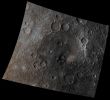
ZZ-Mercury-Craters-Raffaello_Crater-PIA16307-PCF-LXTT-IPF-1.jpgRaffaello Crater (Absolute Natural Colors; credits for the additional process. and color.: Dr Paolo C. Fienga/Lunar Explorer Italia/Italian Planetary Foundation)95 visiteThis beautiful Absolute Natural Color image-mosaic of the huge Impact Basin Raffaello (named after the Italian Renaissance painter and having a diameter of approx. 343 Km), taken in the past month of October 2012 by the NASA - MESSENGER Spacecraft, shows us a wide diversity of colors (which, as you know, represent a wide variety of Mineral Compositions) that exist and can be easily identified within the Volcanic Plains that, eons ago, flooded the Raffaello Basin's Floor. Furthermore, many white-colored Hollows appear to be in process of being formed along most of the Rim and the Northern portion of the Floor - and, in both cases, they are forming in the so-called Low Reflectance Material (or LRM for short) - of a smaller - roughly 40-Kilometer (such as approx. 25-miles) diameter -, Unnamed and Highly Complex Impact Crater that is located just South of the center of the giant Raffaello Basin.
Date acquired: October, 19th, 2012
Images Mission Elapsed Time (MET): 259122560, 259122580, 259122564
Images ID: 2793045, 2793050, 2793046
Instrument: Wide Angle Camera (WAC) of the Mercury Dual Imaging System (MDIS)
Center Latitude: 20,39° South
Center Longitude: 283,6° East
Resolution: 599 meters/pixel
Solar Incidence Angle: 53,4° (meaning that the Sun, at the time that the pictures were taken, was about 36,6° above the imaged Local Mercurian Horizon)
Emission Angle: 27,0°
Sun-Mercury-Messenger (or "Phase") Angle: 80,3°
This picture (which is an Original NASA - MESSENGER Spacecraft color frame published on the NASA - Planetary Photojournal with the ID n. PIA 16307) has been additionally processed and then re-colorized in Absolute Natural Colors (such as the colors that a human eye would actually perceive if someone were onboard the NASA - MESSENGER Spacecraft and then looked down, towards the Surface of Mercury), by using an original technique created - and, in time, dramatically improved - by the Lunar Explorer Italia Team. Different colors, as well as different shades of the same color, mean, among other things, the existence of different Elements (Minerals) present on the Surface of Mercury, each having a different Albedo (---> Reflectivity) and Chemical Composition.MareKromium
(2 voti)
|
|

ZZ-Mercury-Craters-Rachmaninoff_Crater-PIA16399-PCF-LXTT-IPF.jpgFeatures of Rachmaninoff Cratrer (Absolute Natural Colors; credits for the additional process. and color.: Dr Paolo C. Fienga/Lunar Explorer Italia/Italian Planetary Foundation)74 visiteRachmaninoff is a spectacular Double-Ring Impact Basin on Mercury, and this Absolute Natural Color view of it, is one of the highest resolution color image sets acquired of the Basin's Floor. Visible around the edges of the frame is a circle of Mountains that make up Rachmaninoff's Peak-Ring Structure, which surrounds concentric Troughs located on the on the Basin Floor. The color of the Basin's Floor inside the Peak-Ring differs from the darker material outside of it, as can also be seen in other images of this Feature.
Date acquired: July 31, 2012
Image Mission Elapsed Time (MET): 252265403, 252265399, 252265395
Image ID: 2305612, 2305611, 2305610
Instrument: Wide Angle Camera (WAC) of the Mercury Dual Imaging System (MDIS)
WAC filters: 9, 7, 6 (996, 748, 433 nanometers) in red, green, and blue
Center Latitude: 27,64° North
Center Longitude: 57,58° East
Resolution: 149 meters/pixel
Scale: Rachmaninoff's Inner Ring is approximately 140 Km (about 87 miles) in diameter
Solar Incidence Angle: 39,7° (meaning that the Sun was about 50,3° above the imaged Local Horizon at the time that the picture was taken)
Emission Angle: 19,2°
Sun-Mercury-MESSENGER (or "Phase") Angle: 59,0°MareKromium
(2 voti)
|
|

ZZ-Mercury-Craters-Soseki-PIA16356-PCF-LXTT-IPF.jpgFeatures of Soseki Crater (Absolute Natural Colors; credits for the additional process. and color.: Dr Paolo C. Fienga/Lunar Explorer Italia/Italian Planetary Foundation)89 visiteThis Image-Mosaic shows part of the Mercurian Crater Soseki, in the North/West. A deep Scarp cuts through several Impact Craters visible on the right side of the image, though it does not stand out in this high-Sun view. The bright band crossing from upper right to lower left, is a Ray coming from the Crater Hokusai, which is located far away, to the North/East. Hokusai's Rays overprint older Impact Craters and cover a large portion of the whole Planet.
This image was acquired as a High-Resolution Targeted Color Observation. Targeted Color Observations are images of a small area on Mercury's Surface at resolutions higher than the 1-kilometer per pixel "Color Base Map". During MESSENGER's one-year Primary Mission, hundreds of Targeted Color Observations were obtained. During MESSENGER's extended mission, HR Targeted Color Observations are more rare, as the Color Base Map is covering Mercury's Northern Hemisphere with the highest-resolution color images that are possible.
Date acquired: April 09, 2011
Image Mission Elapsed Time (MET): 210807763, 210807759, 210807755
Image ID: 108194, 108193, 108192
Instrument: Wide Angle Camera (WAC) of the Mercury Dual Imaging System (MDIS)
WAC filters: 9, 7, 6 (996, 748, 433 nanometers) in red, green, and blue
Center Latitude: 36,39° North
Center Longitude: 323,5° East
Resolution: 302 meters/pixel
Scale: the Unnamed Impact Crater with the bright Floor (visible in the upper left corner of the frame) is about 32 Km in diameter (such as approx. 20 miles)
Solar Incidence Angle: 37,5° (meaning that the Sun was about 52,5° above the imaged Local Horizon at the time that the pictures were taken)
Emission Angle: 11,2°
Sun-Mercury-MESSENGER (or "Phase") Angle: 48,7°MareKromium
(2 voti)
|
|

ZZ-Mercury-Terninator_Line-PIA16360-PCF-LXTT-IPF.jpgMercurian Terminator (Absolute Natural Colors; credits for the additional process. and color.: Dr Paolo C. Fienga/Lunar Explorer Italia/Italian Planetary Foundation)104 visiteThis striking image shows the progression of Daylight across the Surface of Mercury and the line separating the night from the day is called "Terminator". Scientists have studied interesting phenomena occurring near the Terminator of the Moon for years. Such occurrences involve the interaction between Lunar Dust and Charged Solar Particles (---> the Ions making the Solar Wind). Because Mercury's Regolith is exposed to almost ten times as many Charged Particles as the Moon, it is an excellent place to study the effects of Solar Radiation on Surface Materials. In this unprojected image, North is to the right.
This image was acquired as part of MDIS's campaign to monitor the South Polar Region of Mercury. By imaging the Polar Regions approximately every 4 (four) MESSENGER orbits as illumination conditions change, the Surface Features that were in the shadows on earlier orbits, can be discerned and any permanently shadowed areas can also be identified after repeated imaging over One Solar Day. During MESSENGER's one-year primary mission, MDIS's WAC was used to monitor the South Polar Regions for the first Mercury Solar Day (which corresponds to 176 Earth Days), and MDIS's NAC made repeated images of the South Polar Regions during the second Mercury Solar Day.
Date acquired: August 01, 2011
Image Mission Elapsed Time (MET): 220726567
Image ID: 579208
Instrument: Wide Angle Camera (WAC) of the Mercury Dual Imaging System (MDIS)
WAC filter: 7 (748 nanometers)
Center Latitude: 84.97° South Lat.
Center Longitude: 75,81° East Long.
Resolution: 1500 meters/pixel
Scale: the large crater at the bottom center is approx. 155 km (such as about 96 miles) in diameter.
Solar Incidence Angle: 84,9° (meaning that the Sun, at the picture was taken, was about 5,1° above the Imaged Local Horizon)
Emission Angle: 23,8°
Sun-Mercury-MESSENGER (or "Phase") Angle: 97,0°MareKromium
(2 voti)
|
|

ZZ-Mercury-Craters-Qi_Baishi_et_al_-PIA14398-PCF-LXTT.jpgTolstoj Basin (Enhanced Absolute Natural Colors; credits for the additional process. and color.: Dr Paolo C. Fienga - Lunexit Team)268 visiteThe various named features present in this color image, Qi Baishi, Hovnatanian, Kalidasa and Tolstoj, create a stunning depiction of Mercury's scarred and variable Surface. Tolstoj, the large basin in the bottom right of the image, represents the war and peace of its namesake's famous novel through its smooth, light-colored center and rough, dark blue exterior.
This image was acquired as part of MDIS's color base map. The color base map is composed of WAC images taken through eight different narrow-band color filters and will cover more than 90% of Mercury's Surface with an average resolution of 1 Km/pixel (0,6 miles/pixel). The highest-quality color images are obtained for Mercury's Surface when both the spacecraft and the Sun are overhead, so these images typically are taken with viewing conditions of low incidence and emission angles.
Date acquired: June, 27th, 2011
Image Mission Elapsed Time (MET): 217689462, 217689478, 217689458
Image ID: 433721, 433725, 433720
Instrument: Wide Angle Camera (WAC) of the Mercury Dual Imaging System (MDIS)
WAC filter: 9 (1000 nanometers), 7 (750 nanometers), 6 (430 nanometers) as red-green-blue
Center Latitude: 11,69° South
Center Longitude: 178,1° East
Resolution: 1387 meters/pixel
Scale: the Inner Ring of Tolstoj is roughly 365 Km
Incidence Angle: 13,4°
Emission Angle: 14,6°
Phase Angle: 28,0°MareKromium
(2 voti)
|
|

ZZ-Mercury-Terminator-PIA14357.jpgMercurian Terminator (credits for the additional process. and color.: NASA/Johns Hopkins University Applied Physics Laboratory/Carnegie Institution of Washington)87 visiteCaption NASA:"The Terminator of Mercury, shown here in color, is the line between light and dark, or day and night. On Mercury, three days are equivalent to two years or, in other words, the Planet spins around its axis three times for every two orbits around the Sun. The first Mercury year of the MESSENGER mission ended on Monday, June 13, 2011".
Date acquired: June 07, 2011
Image Mission Elapsed Time (MET): 215945273, 215943853, 215945277
Image ID: 349804, 349803, 349805
Instrument: Wide Angle Camera (WAC) of the Mercury Dual Imaging System (MDIS)
WAC filter: 9 (1000 nanometers), 7 (750 nanometers), 6 (430 nanometers)
Center Latitude: 79,32° South
Center Longitude: 173,9° East
Resolution: 1715 meters/pixel
Scale: the approximate width of the image is 1840 KmMareKromium
(2 voti)
|
|

ZZ-Mercury-Craters-Unnamed_Craters-PIA14362-PCF-LXTT.jpgAlbedo Differences (Absolute Natural Colors; credits for the additional process. and color.: Dr Paolo C. Fienga - Lunexit Team)142 visiteCaption NASA:"This image depicts a stark contrast between Albedo differences on Mercury. The Crater Kalidasa, located in the upper left of the image, contains a smaller but exceptionally bright Crater on its Floor. Nearby to the South/West, Low Reflectance Material (LRM) is found on Kalidasa's Floor. LRM is also visible at the upper left corner of the image. The law of superposition tells us that Kalidasa must have formed before the small bright Crater".
Date acquired: June, 07th, 2011
Image Mission Elapsed Time (MET): 215940577
Image ID: 349800
Instrument: Narrow Angle Camera (NAC) of the Mercury Dual Imaging System (MDIS)
Center Latitude: 17,25° South
Center Longitude: 182,2° East
Resolution: 141 meters/pixel
Scale: Kālidāsa Crater is approximately 100 Km in diameter.
Incidence Angle: 17,4°
Emission Angle: 65,8°
Sun-Target-Spacecraft (such as "Phase") Angle: 78,3°MareKromium
(2 voti)
|
|

ZZ-Mercury-Global_View_of_the_Surface-PIA14378.jpgThe Cratered Surface of Mercury (Natural Colors; credits: NASA/Johns Hopkins University Applied Physics Laboratory/Carnegie Institution of Washington)94 visiteThis color image reveals two of Mercury's named Craters, Basho and Bartok. Basho is the Dark-Rimmed Crater to the far left of the image, and Bartok is the bright yellow crater approximately in the center. Both Craters have visible Central Peaks, but Bartok's Peaks appear blue in this image, indicating they may be made of a different material that was unearthed by the large force of the impact.
This image was acquired as part of MDIS's color base map. The color base map is composed of WAC images taken through eight different narrow-band color filters and will cover more than 90% of Mercury's Surface with an average resolution of 1 Km/pixel (0,6 miles/pixel). The highest-quality color images are obtained for Mercury's Surface when both the Spacecraft and the Sun are overhead, so these images typically are taken with viewing conditions of low Incidence and Emission Angles.
Date acquired: June, 21st, 2011
Image Mission Elapsed Time (MET): 217134583, 217134599, 217134579
Image ID: 407077, 407081, 407076
Instrument: Wide Angle Camera (WAC) of the Mercury Dual Imaging System (MDIS)
WAC filters: 9 (1000 nanometers), 7 (750 nanometers), 6 (430 nanometers) as red-green-blue.
Center Latitude: 3,.68° South
Center Longitude: 221,4° East
Resolution: 1806 meters/pixel
Scale: Basho, the Dark-Rimmed Crater at far left, is approx. 74 Km in diameter.
Solar Incidence Angle: 51.4° (with the Sun about 38,6° above the Local Horizon)
Emission Angle: 0,6°
Sun-Target-Spacecraft (or "Phase") Angle: 51,6°MareKromium
(2 voti)
|
|

ZZ-Mercury-Global_View_of_the_Surface-PIA14081-PCF-LXTT.jpgNorth Polar Highly Cratered Terrain (Absolute Natural Colors; credits for the additional process. and color.: Dr Paolo C. Fienga - Lunexit Team)205 visiteDate Acquired: March 29, 2011
Image Mission Elapsed Time (MET): 209895911
Image ID: 65416
Instrument: Wide Angle Camera (WAC) of the Mercury Dual Imaging System (MDIS)
WAC filer: 7 (748 nanometers wavelength)
Center Latitude: 81,2° North
Center Longitude: 72,3° East
Resolution: 166 mt/pixel (0,10 miles/pixel)
Scale: the bottom of this image is about 84 Km (approx. 52 miles) acrossMareKromium
(2 voti)
|
|
| 248 immagini su 21 pagina(e) |
|
|
|
|
|
|
|
18 | |
|
|
|
|





