| |

| Piú votate - Mercury |
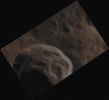
ZZ-Mercury-Craters-Unnamed_Crater-PIA16948-PCF-LXTT-IPF.jpgUnnamed Crater with "Slump" Deposits (Absolute Natural Colors; credits for the additional process. and color.: Dr Paolo C. Fienga/Lunar Explorer Italia/Italian Planetary Foundation)134 visiteThe Unnamed Impact Crater visible in this image taken by the NASA - MESSENGER Spacecraft shows prominent "Slump Deposits" that were created when the Crater Walls collapsed and, perhaps, some portion of the Ejecta, fell back down, inside the Crater itself. These events, according to NASA Scientists, probably occurred immediately (or just a VERY little time) after the Crater formation. If you look closely, you can also see that the Inner Rim appears to host small patches of Hollows. One clue to understand the Hollow formation is that they appear to form, preferentially (but NOT always!), on Sunward-facing Slopes (and since this Impact Crater is located at a high Northern Latitude, its Northern (Inner) Wall gets the most exposure to the Sun). This extra heating may enhance the sudden loss (---> escape) of the Volatiles that are present in and near the subsurface, thus creating those strange, bright Features that are now commonly known as "Hollows" (---> litterally: a "hollow" is a place that once was full of "something" - i.e.: Ice, Gases and/or other Volatiles like Nitrogen, Carbon Dioxide, Ammonia, Hydrogen, Methane and Sulfur Dioxide - and that now has become empty).
Date acquired: October 12th, 2012
Image Mission Elapsed Time (MET): 258544256
Image ID: 2752092
Instrument: Narrow Angle Camera (NAC) of the Mercury Dual Imaging System (MDIS)
Center Latitude: 59,38° North
Center Longitude: 307,20° East
Resolution: 16 meters/pixel
Solar Incidence Angle: 71,8° (meaning that the Sun, at the time that the picture was taken, was about 18,2° above the imaged Local Mercurian Horizon)
Emission Angle: 50,2°
Sun-Mercury-Messenger (or "Phase") Angle: 122,1°
This picture (which is an Original NASA - MESSENGER Spacecraft Map Projected b/w frame published on the NASA - Planetary Photojournal with the ID n. PIA 16948) has been additionally processed and then colorized in Absolute Natural Colors (such as the colors that a human eye would actually perceive if someone were onboard the NASA - MESSENGER Spacecraft and then looked down, towards the Surface of Mercury), by using an original technique created - and, in time, dramatically improved - by the Lunar Explorer Italia Team. Different colors, as well as different shades of the same color, mean, among other things, the existence of different Elements (Minerals) present on the Surface of Mercury, each having a different Albedo (---> Reflectivity) and Chemical Composition.MareKromium
(3 voti)
|
|

ZZ-Mercury-Craters-Faulkner_Crater-PIA16908-PCF-LXTT-IPF-0.jpgFaulkner Crater (CTX Frame - Absolute Natural Colors; credits for the additional process. and color.: Dr Paolo C. Fienga/Lunar Explorer Italia/Italian Planetary Foundation)122 visiteIn this picture, taken by the NASA - MESSENGER Spacecraft, we can see relatively young and smooth Lava Plains which have filled and partially (actually, almost completely) buried the Mercurian Faulkner Crater (approx. 168 Km - such as about 104,32 miles - in diameter), leaving only the Northern three-quarters of its highly degraded Rim visible. These smooth Lava Plains, which have relatively few superposed Impact Craters (and that is why they can be considered - always relatively speaking - "young") and appear of a light brown-pink color in this Absolute Natural Colors image, were - likely - emplaced when powerful Volcanic Flows breached Faulkner's Southern Rim, invaded the whole Floor of the Crater and then set, leaving only the highest-standing portions of Terrain (such as, as we wrote herebefore, some part of its Northern Rim) almost intact.
Date acquired: January, 19th, 2013
Images Mission Elapsed Time (MET): 878881, 878901, 878885
Images ID: 3356193, 3356198, 3356194
Instrument: Wide Angle Camera (WAC) of the Mercury Dual Imaging System (MDIS)
Center Latitude: 8,61° North
Center Longitude: 77,37° East
Resolution: 299 meters/pixel
Solar Incidence Angle: 36,5° (meaning that the Sun, at the time that the picture was taken, was about 53,5° above the imaged Local Mercurian Horizon)
Emission Angle: 43,6°
Sun-Mercury-Messenger (or "Phase") Angle: 78,1°
This picture (which has been cropped from an Original NASA - MESSENGER Spacecraft false color image-mosaic published on the NASA - Planetary Photojournal with the ID n. PIA 16908) has been additionally processed and then re-colorized in Absolute Natural Colors (such as the colors that a human eye would actually perceive if someone were onboard the NASA - MESSENGER Spacecraft and then looked down, towards the Surface of Mercury), by using an original technique created - and, in time, dramatically improved - by the Lunar Explorer Italia Team. Different colors, as well as different shades of the same color, mean, among other things, the existence of different Elements (Minerals) present on the Surface of Mercury, each having a different Albedo (---> Reflectivity) and Chemical Composition. MareKromium
(3 voti)
|
|

ZZ-Mercury-Craters-Unnamed_Crater_with_Hollows-PIA16940-PCF-LXTT-IPF-0.jpgHollowland (Absolute Natural Colors; credits for the additional process. and color.: Dr Paolo C. Fienga/Lunar Explorer Italia/Italian Planetary Foundation)81 visiteThis image (taken by the NASA - Messenger Spacecraft in middle February 2013), shows us an area of ~ 23 Km - such as about 14,28 miles - across that is located within an Unnamed Mercurian Impact Basin that has been litterally "etched" by Hollows. Out of curiosity, this is the only area within the Basin in which Hollows are found. To the bottom left portion of the frame, some part of the Peak Ring of the Basin can also be seen and, most likely, this Peak Ring has been heavily modified by a number of subsequent impacts.
Date acquired: February, 13th, 2013
Image Mission Elapsed Time (MET): 3038823
Image ID: 3509823
Instrument: Narrow Angle Camera (NAC) of the Mercury Dual Imaging System (MDIS)
Center Latitude: 43,52° North
Center Longitude: 291,50° East
Resolution: 21 meters/pixel
Solar Incidence Angle: 74,2° (meaning that the Sun, at the time that the picture was taken, was about 15,8° above the imaged Local Mercurian Horizon)
Emission Angle: 10,4°
Sun-Mercury-Messenger (or "Phase") Angle: 63,8°
This picture (which is an Original NASA - MESSENGER Spacecraft b/w frame published on the NASA - Planetary Photojournal with the ID n. PIA 16940) has been additionally processed and then colorized in Absolute Natural Colors (such as the colors that a human eye would actually perceive if someone were onboard the NASA - MESSENGER Spacecraft and then looked down, towards the Surface of Mercury), by using an original technique created - and, in time, dramatically improved - by the Lunar Explorer Italia Team. Different colors, as well as different shades of the same color, mean, among other things, the existence of different Elements (Minerals) present on the Surface of Mercury, each having a different Albedo (---> Reflectivity) and Chemical Composition.MareKromium
(3 voti)
|
|

ZZ-Mercury-Craters-Theophanes_Crater-PIA16868-PCF-LXTT-IPF.jpgTheophanes Crater (Absolute Natural Colors; credits for the additional process. and color.: Dr Paolo C. Fienga/Lunar Explorer Italia/Italian Planetary Foundation)74 visiteThis image, taken by the NASA - MESSENGER Spacecraft in the early October 2012, shows the ancient Mercurian Impact Crater Theophanes (whose diameter is approx. 46 Km - such as a little more than 28,5 miles), which was originally imaged by the NASA - Mariner 10 Spacecraft.
This Impact Crater was named after the Byzantine iconographer known as "Theophanes the Greek". Though he was born in Constantinople, the Capitol of the Byzantine Empire, around the AD 1340, Theophanes spent most of his life in Russia, where he moved in the AD 1370, and it was right there that he gained notoriety as an icon painter. Some of his more prominent works include Our Lady of the Don and the Transfiguration of Christ. He is also known as the teacher and mentor of the great medieval Russian painter Andrei Rublev, the eponym of another Impact Crater located in the Southern Hemisphere of Mercury.
As you can se, the Hollows which characterize Thophanes Crater are all concentrated in a relatively flat area going from the North-East of Theophanes' Complex Central Uplift, until its upper margin (---> Inner Rim), but only in that portion of its Floor that is located in between (approx.) 1 to 2 o'clock. The reason of such a peculiar configuration of Theophanes' Hollows is (obviuosly) so far unknown, even though we, as IPF, have a theory about it, which we shall try to explain in the future.
Date acquired: October, 3rd, 2012
Image Mission Elapsed Time (MET): 257735204
Image ID: 2694715
Instrument: Narrow Angle Camera (NAC) of the Mercury Dual Imaging System (MDIS)
Center Latitude: 5,04° South
Center Longitude: 217,2° East
Resolution: 74 meters/pixel
Solar Incidence Angle: 69,3° (meaning that the Sun, at the time that the pictures were taken, was about 20,7° above the imaged Local Mercurian Horizon)
Emission Angle: 2,2°
Sun-Mercury-Messenger (or "Phase") Angle: 71,6°
This picture (which is an Original NASA - MESSENGER Spacecraft b/w frame published on the NASA - Planetary Photojournal with the ID n. PIA 16868) has been additionally processed and then colorized in Absolute Natural Colors (such as the colors that a human eye would actually perceive if someone were onboard the NASA - MESSENGER Spacecraft and then looked down, towards the Surface of Mercury), by using an original technique created - and, in time, dramatically improved - by the Lunar Explorer Italia Team. Different colors, as well as different shades of the same color, mean, among other things, the existence of different Elements (Minerals) present on the Surface of Mercury, each having a different Albedo (---> Reflectivity) and Chemical Composition.MareKromium
(3 voti)
|
|

ZZ-Mercury-Limb-PIA16820-PCF-LXTT-IPF.jpgSouthern Craters (Absolute Natural Colors; credits for the additional process. and color.: Dr Paolo C. Fienga - Lunar Explorer Italia/Italian Planetary Foundation)83 visiteThe set of 3 (three) frames shown here in Absolute Natural Colors and forming this image mosaic, was acquired by the NASA - MESSENGER Spacecraft as part of a sequence intended to monitor any changes in the calibration of the Multispectral Wide Angle Camera onboard the Spacecraft over time. However, the final result of this "calibration" also gives us a simply beautiful view of a wide portion (the whole scene is approx. 1900 Km - such as a little less of 1180 miles - across) of Mercury's heavily cratered Southern Hemisphere. Furthermore, the Impact Craters Magritte, Neruda, and Sher-Gil can be easily spotted within this scene. North is towards the top-left of the image.
Date acquired: December, 17th, 2012
Images Mission Elapsed Time (MET): 264237810, 264237814, 264237830
Images ID: 3157538, 3157539, 3157543
Instrument: Wide Angle Camera (WAC) of the Mercury Dual Imaging System (MDIS)
Center Latitude: 59,16° South
Center Longitude: 149,3° East
Resolution: 1663 meters/pixel
Solar Incidence Angle: 59,2° (meaning that the Sun, at the time that the pictures were taken, was about 30,8° above the imaged Local Mercurian Horizon)
Emission Angle: 28,8°
Sun-Mercury-Messenger (or "Phase") Angle: 78,1°
This picture (which is an Original NASA - MESSENGER Spacecraft color image mosaic published on the NASA - Planetary Photojournal with the ID n. PIA 16820) has been additionally processed and then re-colorized in Absolute Natural Colors (such as the colors that a human eye would actually perceive if someone were onboard the NASA - MESSENGER Spacecraft and then looked outside, towards the Surface of Mercury), by using an original technique created - and, in time, dramatically improved - by the Lunar Explorer Italia Team. Different colors, as well as different shades of the same color, mean, among other things, the existence of different Elements (Minerals) present on the Surface of Mercury, each having a different Albedo (---> Reflectivity) and Chemical Composition.MareKromium
(3 voti)
|
|

ZZ-Mercury-Volcanic_Features-Vents-PIA16627-PCF-LXTT-IPF.jpgVolcanic Vents near Caloris' Outer Edge - Credits for the additional process. and color.: Dr Paolo C. Fienga/Lunar Explorer Italia/Italian Planetary Foundation)85 visiteThis image highlights the velvety texture that surrounds several Volcanic Vents located near the Outer Rim of the huge Impact Basin known as "Caloris Basin", on Mercury. This (apparently) soft texture, like freshly fallen snow, is formed by the emplacement of tiny beads of Lava that were explosively erupted and then quenched and solidified just before they reached the Surface. This diffuse Deposit heavily blankets several Impact Craters and older Vents, while it becomes thinner as long as it goes farther away from the Source of the Eruption. A large amount of the typical Mercurian Surface Features known as "Hollows" is also very well visible on the Rims of a number of Unnamed (and relatively modest in size) Impact Craters. This whole scene is approx. 106 Km across.
Date acquired: November, 17th, 2012
Image Mission Elapsed Time (MET): 261627279
Image ID: 2971208
Instrument: Narrow Angle Camera (NAC) of the Mercury Dual Imaging System (MDIS)
Center Latitude: 22,03° North
Center Longitude: 146,4° East
Resolution: 54 meters/pixel
Solar Incidence Angle: 39,1° (meaning that the Sun, at the time that the pictures were taken, was about 50,9° above the imaged Local Mercurian Horizon)
Emission Angle: 61,4°
Sun-Mercury-Messenger (or "Phase") Angle: 90,9°
This picture (which is an Original NASA - MESSENGER Spacecraft b/w frame published on the NASA - Planetary Photojournal with the ID n. PIA 16627) has been additionally processed and then colorized in Absolute Natural Colors (such as the colors that a human eye would actually perceive if someone were onboard the NASA - MESSENGER Spacecraft and then looked down, towards the Surface of Mercury), by using an original technique created - and, in time, dramatically improved - by the Lunar Explorer Italia Team. Different colors, as well as different shades of the same color, mean, among other things, the existence of different Elements (Minerals) present on the Surface of Mercury, each having a different Albedo (---> Reflectivity) and Chemical Composition.MareKromium
(3 voti)
|
|

ZZ-Mercury-Volcanic_Regions-Plains-PIA16428-PCF-LXTT-IPF.jpgVolcanic Region (Absolute Natural Colors; credits for the additional process. and color.: Dr Paolo C. Fienga/Lunar Explorer Italia/Italian Planetary Foundation)88 visiteMany Regions of Mercury's Surface show a relatively smooth and dark brown/reddish-colored Terrain (with almost black patches near and around the Rims of the major Impact Craters) that, in a way, appears to have "flooded" (---> quickly covered, either in whole or in part) low-lying Areas and, at the same time, which has also partially filled (and/or, here and there, almost completely buried) what seem to be the oldest Impact Craters existing on the Surface. Said that, we can reasonably speculate that these smooth Plains could have formed, in a very distant past of the Innermost Planet of the Solar System, as a consequence of the occurrence of some powerful Volcanic Activity which, in fact, ended up by - litterally - "drowning" these Regions with - and in - extremely voluminous amounts of, most likely, low-viscosity Basaltic Lavas.
Notice that the beautiful colors of the Mercurian Surface, as well as all the details of the Terrain seen here, all appear to be extremely clear, sharp and well visible, (also) thanks to to fact that the Sun, at the time that the picture was taken, was relatively high in the Sky (59,2° on the Local Horizon, to be exact).
Date acquired: July, 21st, 2012
Images Mission Elapsed Time (MET): 251402330, 251402350, and 251402334
Images ID: 2244264, 2244269, and 2244265
Instrument: Wide Angle Camera (WAC) of the Mercury Dual Imaging System (MDIS)
Center Latitude: 8,27° South
Center Longitude: 113,1° East
Scale: this scene is approx. 475 Km across
This picture (which is an Original NASA - MESSENGER Spacecraft color frame published on the NASA - Planetary Photojournal with the ID n. PIA 16428) has been additionally processed and then re-colorized in Absolute Natural Colors (such as the colors that a human eye would actually perceive if someone were onboard the NASA - MESSENGER Spacecraft and then looked down, towards the Surface of Mercury), by using an original technique created - and, in time, dramatically improved - by the Lunar Explorer Italia Team. Different colors, as well as different shades of the same color, mean, among other things, the existence of different Elements (Minerals) present on the Surface of Mercury, each having a different Albedo (---> Reflectivity) and Chemical Composition.MareKromium
(3 voti)
|
|

ZZ-Mercury-Limb-PIA16299-PCF-LXTT-IPF-1.jpgOn the Limb... (Absolute Natural Colors; credits for the additional process. and color. Dr Paolo C. Fienga/Lunar Explorer Italia/Italian Planetary Foundation)80 visiteEven though quite a few Impact Craters are visible in this Absolute Natural Color view of Mercury's Limb, the Crater Degas (whose diameter is approx. 55 Km) gets easily noticed. Located near the center of the image, the distinctive gray color of the Low-Reflectance (---> Albedo) Material associated with Degas Crater (Material that covers most of the Floor, the Inner and Outer Rim, as well as a little bit of the Surface located in close proximity with the Crater itself) makes a clear contrast with the surrounding Terrain and neighboring Craters.
This image was acquired as a Targeted Observation that occurred simultaneously with a measurement carried out by the Mercury Atmospheric and Surface Composition Spectrometer (MASCS). Targeted Observations that involve both MDIS and MASCS, once the data from both instruments are combined, facilitate a better understanding of the color and reflectance of small-scale Geologic Features which are present on the Surface of Mercury.
Date acquired: October, 6th, 2012
Images Mission Elapsed Time (MET): 258052701, 258052721, 258052705
Images ID: 2717216, 2717221, 2717217
Instrument: Wide Angle Camera (WAC) of the Mercury Dual Imaging System (MDIS)
Center Latitude: 35,98° North
Center Longitude: 231,2° East
Center Resolution: 533 meters/pixel
This picture (which is an Original NASA - MESSENGER Spacecraft color frame published on the NASA - Planetary Photojournal with the ID n. PIA 16299) has been additionally processed and then re-colorized in Absolute Natural Colors (such as the colors that a human eye would actually perceive if someone were onboard the NASA - MESSENGER Spacecraft and then looked down, towards the Surface of Mercury), by using an original technique created - and, in time, dramatically improved - by the Lunar Explorer Italia Team. Different colors, as well as different shades of the same color, mean, among other things, the existence of different Elements (Minerals) present on the Surface of Mercury, each having a different Albedo (---> Reflectivity) and Chemical Composition.MareKromium
(3 voti)
|
|

ZZ-Mercury-Craters-Geddes_Crater-PIA16302-PCF-LXTT-IPF-2.jpgCollapse Pit inside Geddes Crater (Absolute Natural Colors; credits for the additional process. and color.: Dr Paolo C. Fienga/Lunar Explorer Italia/Italian Planetary Foundation)88 visiteGeddes Crater (so named, in March 2010, in honor of Wilhelmina Geddes (1887 - 1955), an Irish stained glass and graphic artist) is well known to be a Mercurian extremely geologically interesting Impact Feature. As you know, the Ridge of Antoniadi Dorsum bisects the Crater, and in the center of the Crater's Floor there is a large Depression with a distinctive orangish hue: a color similar to the one seen in other areas (still on Mercury and elsewhere in the Solar System, such as, for instance, on our Moon) which are (better yet: were) associated with Explosive Volcanism or other phenomena of (perhaps Sulphurous-rich) Outgassing. This recently acquired image reveals new, High-Resolution detail of such a potentially Volcanic Depression (---> a Volcanic - in origin - Collapse Pit, to be more specific, which might have formed as a consequenc of the progressive withdrawal of Subsurface Magma), including the presence of many Hollows (a Surface Feature that, as we know now, is extremely common and that can be found all over the Surface of Mercury and which do not seem to be only related, in our opinion, as IPF, to the verification of Impact Events).
Date acquired: October, 11th, 2012
Image Mission Elapsed Time (MET): 258458455
Image ID: 2745982
Instrument: Narrow Angle Camera (NAC) of the Mercury Dual Imaging System (MDIS)
Center Latitude: 27,15° North
Center Longitude: 330,4° East
Resolution: 28 meters/pixel
Solar Incidence Angle: 74,1° (meaning that the Sun, at the time that the picture was taken, was about 15,9° above the imaged Local Mercurian Horizon)
Emission Angle: 33,2°
Sun-Mercury-Messenger (or "Phase") Angle: 107,3°
This picture (which is an Original NASA - MESSENGER Spacecraft b/w frame published on the NASA - Planetary Photojournal with the ID n. PIA 16302) has been additionally processed and then colorized in Absolute Natural Colors (such as the colors that a human eye would actually perceive if someone were onboard the NASA - MESSENGER Spacecraft and then looked down, towards the Surface of Mercury), by using an original technique created - and, in time, dramatically improved - by the Lunar Explorer Italia Team. Different colors, as well as different shades of the same color, mean, among other things, the existence of different Elements (Minerals) present on the Surface of Mercury, each having a different Albedo (---> Reflectivity) and Chemical Composition.MareKromium
(3 voti)
|
|

ZZ-Mercury-Limb-PIA16429-PCF-LXTT-IPF.jpgMercurian Horizon (Absolute Natural Colors; credits for the additional process. and color.: Dr Paolo C. Fienga/Lunar Explorer Italia/Italian Planetary Foundation)83 visiteImages of Mercury's Limb provide information about the shape and topography of Mercury, but they also provide a sense of what it would be like to fly over the Innermost Planet, and to look out of the Spacecraft's window and toward the distant Horizon. See anywhere good to land?
Date acquired: July 24, 2012
Image Mission Elapsed Time (MET): 251598850
Image ID: 2258481
Instrument: Narrow Angle Camera (NAC) of the Mercury Dual Imaging System (MDIS)
Center Latitude: 18,25° South
Center Longitude: 353,70° East
Scale: the bottom of this scene is approximately 150 Km (about 93 miles) across, from left to right
Solar Incidence Angle: 58,6° (meaning that the Sun was about 31,4° above the imaged Local Horizon at the time the picture was taken)
Emission Angle: 80,0°
Sun-Mercury-MESSENGER (or "Phase") Angle: 138,6°MareKromium
(3 voti)
|
|

ZZ-Mercury-Craters-Eitoku_Crater-PIA16361-PCF-LXTT.jpgEitoku Crater (Absolute Natural Colors; credits for the additional process. and color.: Dr Paolo C. Fienga/Lunar Explorer Italia/Italian Planetary Foundation)81 visiteThe main and really impressive Impact Crater visible in this NASA - MESSENGER Spacecraft image, Eitoku (which has a diameter of approx. 100 Km - such as about 62 miles) , displays several (almost) Central Peaks that appear especially prominent due to the high Solar Incidence Angle (meaning that the Sun was setting onto the imaged Local Horizon at the time that this picture was taken - and therefore the shadows of each and every Mercurian relief resulted way more visible - i.e.: longer - and suggestive) as well as to the fact that this frame has not been Map Projected. Note that Central (and/or almost Central, like in this case) Peaks are a relatively common Feature in Mercury's larger Impact Craters. Note, also, that the smaller Impact Craters visible on the Floor and Rim (which, on its side, appears quite degraded) of Eitoku Crater indicate/suggest that we are actually looking at an old Impact Feature.
Date acquired: July, 3rd, 2012
Image Mission Elapsed Time (MET): 249790754
Image ID: 2129670
Instrument: Narrow Angle Camera (NAC) of the Mercury Dual Imaging System (MDIS)
Center Latitude: 21,77° South
Center Longitude: 202,6° East
Resolution: 120 meters/pixel
Solar Incidence Angle: 83,4° (meaning that the Sun, at the time that the picture was taken, was about 6,6° above the imaged Local Mercurian Horizon)
Emission Angle: 59,9°
Sun-Mercury-Messenger (or "Phase") Angle: 134,5°
This picture (which is an Original NASA - MESSENGER Spacecraft color frame published on the NASA - Planetary Photojournal with the ID n. PIA 16361) has been additionally processed and then colorized in Absolute Natural Colors (such as the colors that a human eye would actually perceive if someone were onboard the NASA - MESSENGER Spacecraft and then looked down, towards the Surface of Mercury), by using an original technique created - and, in time, dramatically improved - by the Lunar Explorer Italia Team. Different colors, as well as different shades of the same color, mean, among other things, the existence of different Elements (Minerals) present on the Surface of Mercury, each having a different Albedo (---> Reflectivity) and Chemical Composition.MareKromium
(3 voti)
|
|

ZZ-Mercury-Craters-Rustaveli_Crater-PIA16359-PCF-LXTT-IPF.jpgRustaveli Crater (Absolute Natural Colors; credits for the additional process. and color.: Dr Paolo C. Fienga/Lunar Explorer Italia/Italian Planetary Foundation)100 visiteThis Absolute Natural Color Image-Mosaic shows the Rustaveli Crater, a newly named Impact Basin located in the Northern Hemisphere of Mercury. The Basin has a smooth, filled Floor with little weathering and a Peak-ring Structure. Shota Rustaveli was a Georgian poet who lived from 1172-1216. He is well known for writing the Georgian National Epic Poem, "The Knight in the Panther's Skin". He is also the namesake of the coveted Shota Rustaveli State Prize, the highest honor a Georgian artist or writer can achieve.
Date acquired: July 18, 2011
Image Mission Elapsed Time (MET): 219478808, 219478804, 219478800
Image ID: 519956, 519955, 519954
Instrument: Wide Angle Camera (WAC) of the Mercury Dual Imaging System (MDIS)
WAC filters: 9, 7, 6 (996, 748, 433 nanometers) in red, green, and blue
Center Latitude: 52,40° North
Center Longitude: 81,79° East
Resolution: 187 meters/pixel
Scale: the diameter of Rustaveli basin is roughly 180 Km (such as approx. 112 miles).
Solar Incidence Angle: 59,8° (meaning that the Sun was about 30,2° above the imaged Local Horizon at the time that the picturs were taken)
Emission Angle: 30,6°
Sun-Mercury-MESSENGER (or "Phase") Angle: 90,4°MareKromium
(3 voti)
|
|
| 248 immagini su 21 pagina(e) |
|
|
|
|
|
13 | |
|
|
|
|
|
|





